When clients want everything, FDEs should give ground on scope first
The client owns the deadline and quality needs a floor; the hard skill is telling genuine discovery from scope creep.
In brief
- The client sets the deadline and the environment, and quality depends on scope, so scope is the lever an FDE should pull first.
- Keep scope narrow from the start: widening a tight scope is cheaper than unwinding a loose one. Building more than the question needs is waste.
- A new request is not automatically scope creep. Ask whether it clarifies or adds an outcome. If it adds one, time or resources must change in return.
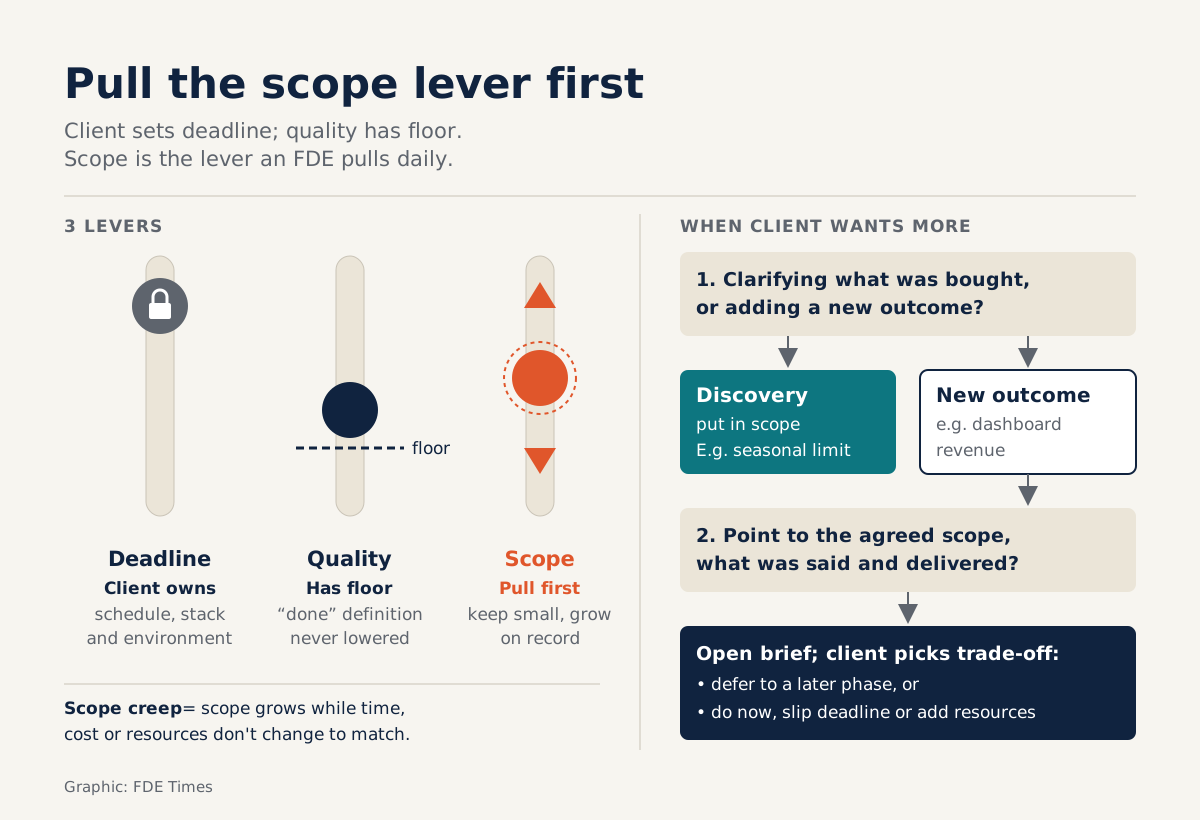
PostHog’s FDE handbook contains one short sentence that sums up a whole way of working: keep scope small, because widening a tight scope is always cheaper than unwinding a loose one.
Read quickly, it sounds like standard project-management advice. In fact it answers the hardest question on a client site: when the client wants everything, where do you give way?
Clients rarely say “we can live with slower” or “rough is fine”. They want every feature, delivered early and running smoothly. Every FDE trades these three things off against each other. The real difference is whether you make those trade-offs on purpose or let them happen to you.
For developers moving into FDE work, this tension shows up in the first week on site. Three levers sit in front of you, and scope is the one to pull first. The skill to practise is pulling it without souring the relationship.
Three levers: which one first?
The project triangle is familiar to anyone in project management. Wikipedia describes one of its central points: the quality of work is constrained by the project’s budget, deadlines and scope of features. Quality is not a separate dial you can turn. It follows from the other three.
On a client site, most of those constraints come from the client. Ben Griswold argues that FDE work is bounded by the customer’s own timeline, technology stack and environment, and that it ends with ownership being handed back to them.
The deadline, then, is effectively an input. You seldom get to set the client’s internal launch date, and you cannot change the infrastructure they run.
Quality has a floor. Griswold writes that the goal is to transfer capability, not to create long-term dependence. A rushed system the client cannot operate on their own is a failure, even if it ships on time.
That is why scope is the lever an FDE should pull first. Deadlines and resources can still change, but those are matters to negotiate with the client. Scope is something you actively propose narrowing or widening every day.
| Lever | Who actually holds it | What goes wrong if you pull it badly | What the FDE should do |
|---|---|---|---|
| Deadline | The client: their timeline, stack and environment | Pushing for speed with unchanged scope makes quality pay | Put it in the brief from the start; move it only when the client agrees to trade it for scope |
| Quality | Nobody directly; it is constrained by budget, deadline and scope | Lower the floor and the client cannot take back ownership | Fix the minimum in the definition of “done” |
| Scope | The FDE and the client, negotiating continuously | Growth without a change in time or resources is scope creep | Pull it first: keep it small, test every request, expand with a record |
Small scope does not mean doing less
PostHog requires every engagement to have three things before work starts: a measurable outcome, an estimated timeline and a shared definition of “done”, written in a short brief. Those three lines are the project triangle on paper. The outcome is scope, the timeline is speed and the definition of “done” is the quality floor.
The handbook goes further: building more than the question needs is not thoroughness, it is waste. If you are in the habit of adding a few extras to please the client, that line is worth copying down. Every feature added outside the brief either eats into the agreed time or drags quality below the floor.
PostHog also offers a subtler filter: a solution may be specific to one customer, but useful findings should not stay trapped there.
When weighing whether to take on extra work, ask: does this serve only this client, or will it teach the company something reusable? Work of the second kind is more worth expanding for.
Discovery or creep: two questions worth remembering
The difficulty is that an FDE cannot freeze requirements the way an old-style scope contract does. Tandem notes that the job forces practitioners to gather requirements and calibrate with the customer continuously. Changing requirements are normal. The question is what kind of change it is.
Tandem defines scope creep as scope growing without a corresponding change in time, cost or resources. That definition fits the lever logic: scope is allowed to grow, as long as another side of the triangle adjusts with it. The damage comes from added scope that nobody pays for.
Of the four tests Tandem proposes, two can be used straight away. The first: does this request clarify the outcome the client already bought, or add a new outcome?
The second: can you point to what scope was agreed, what was said and what was delivered? The first question classifies the request. The second determines whether you have enough evidence to negotiate.
Applying it to a concrete case
Take a hypothetical case. You have four weeks to build a low-stock alert pipeline for a retailer, covering 10 pilot stores. The three-line brief, confirmed by the client in week one, might read:
Outcome: reduce stock-outs at the 10 pilot stores.
Timeline: four weeks.
Done when: alerts run daily on real data from the 10 stores, and the client’s operations team can handle them on their own.
In week two, the client’s operations manager asks for two more things: seasonal alert thresholds, and a revenue dashboard for the leadership team.
Apply the first test. Seasonal thresholds clarify exactly the outcome already bought, because they make alerts more accurate, so this is discovery and reasonable to include. The revenue dashboard is a new outcome. Taking it on without moving the deadline or adding people is precisely Tandem’s definition of scope creep.
The second test gives you a way to say “not yet” without damaging the relationship. You open the brief and reply in one sentence: “Seasonal thresholds sit within the agreed outcome, so we’ll do them now. The revenue dashboard is a new outcome, so could you choose: move it to a later phase, or do it now and push the deadline back a week?”
Note that the second option is pulling the deadline lever, and that is entirely legitimate because the client is the one deciding. The conversation shifts from “you don’t want to help” to “which trade-off do we choose”.
When the levers jam
The model has limits, and Wikipedia acknowledges them: in practice, trading off between constraints is not always possible. Some scope cannot be cut. If the client needs an integration with a payment system, that integration is the core; remove it and there is nothing left to deliver.
In that case, the advice to keep scope small becomes advice to cut in the right place. What shrinks is the number of edge cases handled in the first round, the number of screens, the number of reports, not the core that produces the outcome.
If even the core does not fit the deadline, that is a signal to tell the client early and renegotiate time or resources, not a signal to lower the quality floor.
Griswold makes another easily forgotten point: FDEs ship in weeks what product teams ship in quarters, but the difference is not speed. It is fitting the constraints of exactly one customer. If you cut scope to move faster and the product no longer fits the client’s environment, you have pulled the wrong lever.
What to practise
If you have worked in outsourcing, you may be used to change requests. But if someone else on your current project still handles negotiating those requests, that is a gap worth closing deliberately. Because calibrating requirements with the client never stops, an FDE can hardly avoid standing at the point of trade-off personally.
When reading job descriptions, look for phrases such as “scoping”, “trade-offs”, “definition of done” or “customer discovery”. They suggest the company expects you to set scope yourself, not just execute it. For interviews, prepare a real story about a time you said “not yet” to a request, and what you got in return.
On your CV, replace a line like “developed the reporting module” with one that shows how you made trade-offs: which scope you deferred, which deadline you held, which quality bar you did not lower. Do not try to prove you can do everything. Show that you know what to set aside, and can explain why to the client.
Was this article useful?
Thanks for the feedback!