Palantir splits the FDE job in two. Some AI startups hand it to one
Botminds wants a hands-on CTO for each deployment and Arist adds building a whole function, so read job ads for the strategist role hidden inside.
In brief
- Descriptions of Palantir say a Delta who writes code is paired with an Echo who handles relationships and processes, while a Dev team builds one capability for many customers.
- In job ads from Botminds and Arist, one FDE covers the whole cycle. At Arist, that person also has to build the FDE function from scratch.
- Cloud Authority warns that running many FDEs is expensive and can turn a startup into a consultancy in disguise. In interviews, ask how lessons from the field get back into the product.
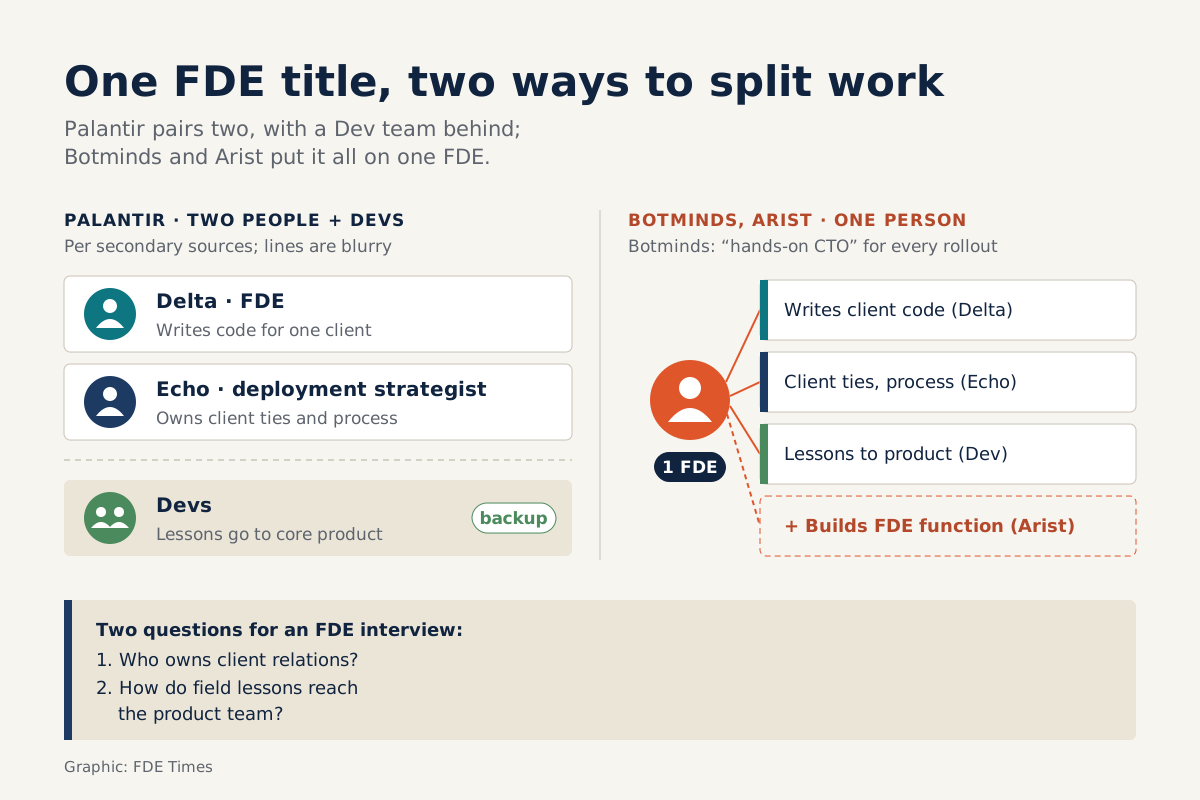
Palantir used to put two people on a single customer. The Delta was the FDE, the person who wrote the code. The Echo was the deployment strategist, the person who handled relationships and processes. Botminds, an AI startup, says something different in its FDE job ad: the person it hires will work as a hands-on CTO for each deployment.
One company splits the work between two people. The other gives all of it to one. Both call the role FDE, and developers thinking of moving into the job can easily misread it.
If you are reading FDE job ads and assume that strong coding plus a willingness to sit next to the customer will be enough, read them again. In ads from two AI startups, Botminds and Arist, the FDE also takes on the work that descriptions of Palantir assign to the Echo. At Arist, the FDE also has to build an entire function.
Once you know which role you are about to carry, you can prepare for the right things.
How does Palantir divide the work?
Many descriptions of Palantir’s model rest on a contrast. According to a summary by ResumeAdapter, the Dev team builds one capability and deploys it across many customers. The Delta works the other way: one customer, but many capabilities.
The Echo sits alongside the Delta. An analysis on Cloud Authority, citing a Medium post from April 2026, says the pairing exists so that a solution is both technically correct and actually adopted by the customer. Those two goals need different skills, so Palantir gives them to two people.
Treat the details with care. Secondary sources disagree about who sits where. FourWeekMBA describes the Echo as working inside the customer’s operations to find bottlenecks and needs the customer has not stated, while other accounts say the Delta also works alongside the customer.
According to ResumeAdapter, Palantir itself says the line between Echo and Delta is very blurry.
So do not read Delta/Echo as a fixed org chart. It is more useful as a way of separating three kinds of work: writing code for one customer, getting that customer to use it, and turning what was learned into a product for many customers. Once those three are separate, it becomes clear how much a startup is loading onto one person.
At two startups, the work lands on one person
According to Cloud Authority, the FDE role is really three full-time jobs combined: developer, architect and consultant. Job ads from the two AI startups below show that this is not an exaggeration.
Botminds describes an FDE who covers the whole cycle. This person understands the problem, structures it, and then stands beside users when the system goes live. The company stresses small teams, high trust and direct ownership of results. Set against the descriptions of Palantir, that is the Delta’s work and the Echo’s work combined.
Arist goes further. It is hiring a founding FDE who is tasked with building both the team and the operating model for the FDE function. The ad places the role at the intersection of engineering, AI and customer outcomes. In other words, Arist is using the FDE role to build a new function, not to provide post-sales support.
Palantir is rewriting the role too
Even Palantir no longer describes the FDE as one half of a neat split. Its job ad for a Forward Deployed AI Engineer says candidates will work in small teams and own the delivery of important projects for customers.
The ad contains another notable detail: FDEs are expected to bring lessons from the field back to the AIP product suite. When the two teams were separate, the Dev team owned that feedback loop. The ad suggests the line between an FDE at Palantir and an FDE at a startup is blurring from both sides.
The cost of combining roles
Cloud Authority warns that keeping many FDEs on staff is expensive and can turn a startup into a consultancy in disguise. The warning is about the cost of scaling FDEs, but set beside the three-role model, it points to a risk that comes specifically from combining roles.
The likely mechanism is this. In the descriptions, Palantir’s model includes a Dev team whose job is to turn what was learned at each customer into shared capabilities. When a startup gives everything to the FDE without such a team, the FDE has to be the bridge to the product.
If nobody does that, each deployment tends to become a one-off project, and the company slowly starts to look like a consultancy.
For you, this is not just a question of company strategy. It decides what your next two years look like. Where feedback from the field really reaches the product, you learn how to design things that work for many customers.
Where that path does not exist, you may end up writing the same kind of integration over and over.
What does a job ad tell you about the role you will carry?
Because one title can hide very different workloads, read job ads for signals about the role rather than just scanning the list of technologies. The table below is one suggested reading, based on phrases from the ads mentioned above.
The second column uses the Dev/Delta/Echo split as a reference frame, not an official chart, because the sources describing it do not agree.
| Phrase in the job ad | Mapped to the Delta/Echo/Dev frame | What to prove on your CV and in interviews |
|---|---|---|
| “Hands-on CTO for each deployment” (Botminds) | Close to Delta and Echo at once | A project you took from clarifying the problem to go-live, including standing beside users |
| “Founding”, building the team and operating model (Arist) | Delta and Echo, plus building the organisation | A process or document you created that others have reused |
| “Small teams, own project delivery” (Palantir) | Delta, with a blurry boundary to Echo | A high-risk project where you were primarily accountable for the outcome |
| Bringing field lessons back to the product (Palantir) | Work usually assigned to the Dev team | A time you turned one customer’s request into a shared feature |
The third column matters most. Most developer CVs prove only the “technically correct” half. Yet the very reason Palantir needed an Echo shows that the other half, whether the customer actually uses the thing, matters just as much.
How developers in Vietnam should prepare
If you work in outsourcing, or on a project team serving overseas clients, you may already be doing Echo work without calling it that. It is the meetings spent working out what the client really needs, guiding users through their first go-live, or changing a process so the system actually gets used.
Put that work on your CV as concrete results. Do not reduce it to a line about “client communication”.
The part most often overlooked is the Dev role. From your most recent project, find one thing you could generalise, such as a connector, a data validation suite or a prompt template, and rewrite it so a second customer could use it too. That is evidence that you will not turn the company into a consultancy.
In the interview, ask two questions directly: who owns the customer relationship, and how do lessons from the field get back to the product team? The answers tell you how many roles you will carry, and whether the company knows how to keep you from carrying them alone indefinitely.
According to descriptions of Palantir, this work takes two people and a whole team behind them, while Botminds and Arist give it to a single FDE. People who do the role well have a large advantage, but only if they choose a company with a real path for turning field work into product.
Was this article useful?
Thanks for the feedback!
7 sources
- The Rise of the Forward Deployed Engineer: History, Myths, and Why It's Back
- The Rise of the Forward Deployed Engineer: History, Myths, and Why It's Back
- Forward Deployed Engineer (Botminds) · 2026-07-17
- Palantir Technologies - Forward Deployed AI Engineer
- Founding Forward Deployed Engineer @ Arist
- Palantir Forward Deployed Engineer Guide and Resume | ResumeAdapter · 2026-07-04
- From Palantir's Playbook to AI's Present · 2025-11-12