Hippocratic AI ranks long onsite stints above healthcare experience
The specialist-or-generalist debate misses the point: industry and account knowledge never travel intact, but the habit of entering an unfamiliar operation does.
In brief
- Hippocratic AI builds AI for healthcare yet lists HL7/FHIR and Epic/Cerner as a bonus. The hard requirement is willingness to work onsite for long periods.
- Paraform, Aced and Valletta do not really contradict each other. One side warns against specialising in general; the other is talking about account depth built up across one to three customers.
- Engineers should bet on the vertical bar of embedding and integration skills. People from ops, product and consulting already bring industry judgement, and in the Palantir model deployment strategists own the upstream work.
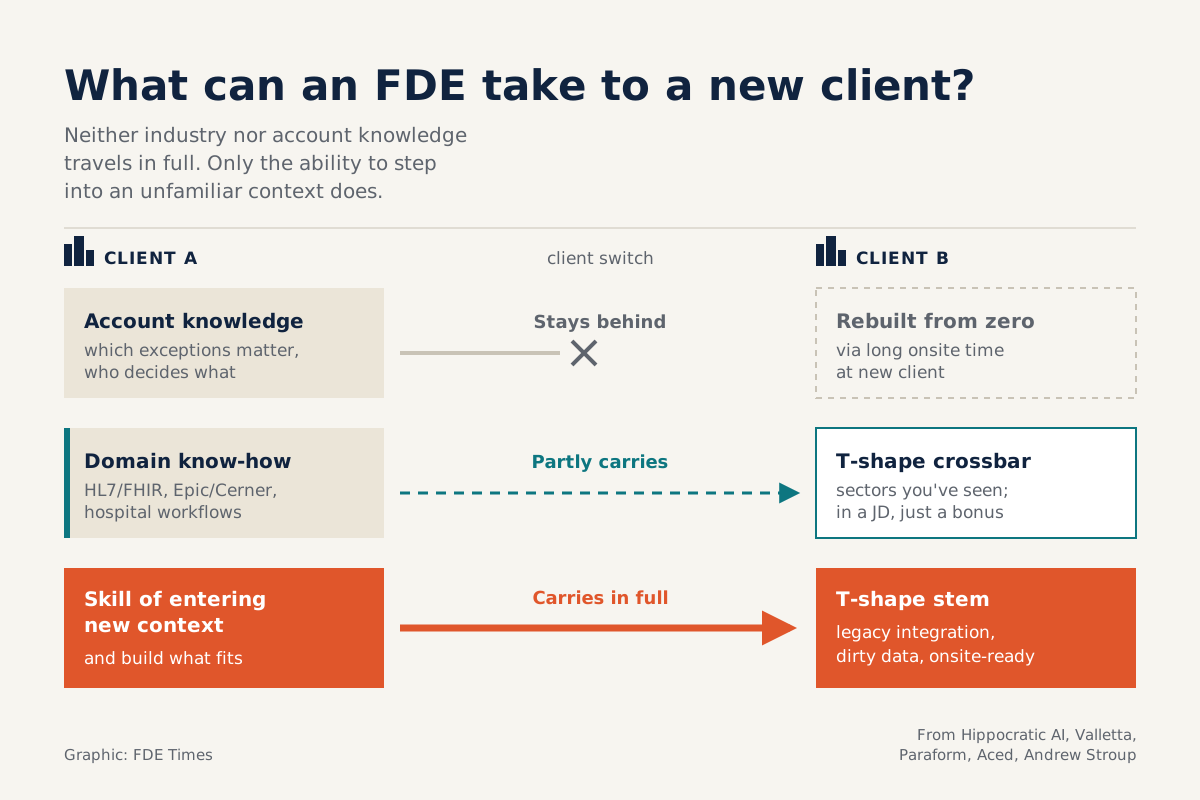
Hippocratic AI builds AI for healthcare. Its job posting for a Forward Deployment Engineer in York, Pennsylvania lists healthcare integration experience (HL7/FHIR, Epic/Cerner) as a bonus. The hard requirement is willingness to be deployed onsite at customers for long periods.
That detail runs against the instinct of most developers thinking about a move into FDE work. The usual question is whether to pick an industry (banking, logistics, healthcare) and go deep, or to stay a generalist who can go anywhere. A posting from a company as plainly vertical as Hippocratic AI suggests the question is aimed at the wrong thing.
If you have two to eight years of experience and are aiming for an FDE role, your answer shapes what you learn next year, how you write your CV and how you filter job descriptions. So it is worth looking closely at the two camps in this debate, and then showing that they are actually talking about different things.
Two camps that sound contradictory
The generalist camp is louder. Paraform says plainly that most engineering roles let you specialise, while FDEs do not have that luxury. Aced (formerly Exponent) goes further: for FDEs, breadth beats depth, the reverse of the SWE role.
Andrew Stroup, a practitioner, adds the reason. Embedding skills, he argues, work across industries because the underlying pattern belongs to no single industry: go into the customer’s operational reality, then build a solution that fits it.
The other camp is quieter but makes a solid case. Valletta Software argues that an FDE’s value lies in domain knowledge, and that this kind of knowledge can only be built up over time within one context. Forward deployment, in their view, means going deep into one to three customers.
On a quick read, the two sides disagree. On a careful read, Valletta’s “depth” is not the “depth” that Paraform and Aced reject.
There are two kinds of “depth”, and neither travels intact
The first is industry depth, chosen in advance: you decide that this year you are “a healthcare person”, learn HL7 and hospital workflows, and only then go looking for work. Paraform’s warning is about the FDE role in general, but read this way it applies most clearly to that kind of specialisation.
This is also the kind of knowledge Hippocratic AI’s posting lists as a bonus.
The second is account depth, built up over time: you sit inside a customer’s operations long enough to know which exceptions matter, which systems are really running and who decides what. This is the kind Valletta means, and it comes from being there, not from choosing an industry in advance.
Hippocratic AI’s long-term onsite requirement can be read in that light: what the company needs first is someone willing to stay with the customer long enough.
Aced describes the FDE as T-shaped: deep in one area, broad across many, plus customer-facing skills. But the vertical bar of the T need not be an industry.
The vertical bar is the ability to step into an unfamiliar context and build what that context actually needs, the pattern Stroup describes as belonging to no single industry. The horizontal bar is the industries you have passed through; the details of each account stay with that customer.
Race on domain knowledge and engineers are playing an away game
There is a more practical reason not to bet on industry depth. MindStudio points out that people from operations, product or consulting arrive with judgement about the customer’s domain: they already know which exceptions matter and why a tidy process diagram breaks in the real world. Their gap is technical depth.
The implication follows. On industry understanding, engineers compete with people who already have that judgement, while your advantage lies exactly where they fall short. If you, a developer, spend two years competing on industry knowledge, you are racing on their home ground.
Palantir has institutionalised a similar division of labour. According to Paraform, deployment strategists there own all the upstream work, from requirements to stakeholders, while engineers build. Framing the problem and engineering become two separate roles.
That is why the right question for an engineer is not “which industry” but “where is my technical depth”. Here The Pragmatic Engineer’s May 2026 analysis offers an uncomfortable suggestion: the modern FDE role is essentially a consultant or solutions architect, leaning more towards advice and integration than building new software.
If that is right, the FDE’s technical vertical bar is most likely integration: connecting legacy systems, dirty data, access permissions, half-finished APIs, not elegant algorithms.
Company stage decides how broad you must be
There is one more variable both camps rarely mention: the stage of the company you join. Valletta describes a fifty-person startup where one person is sales engineer, solutions architect and FDE at once. There, breadth is not a choice; it is the job description.
Paraform’s advice points the same way: start with FDEs covering both functions, then split them once deployment complexity exceeds what one person can handle. So under the same “FDE” title, the content of the job shifts as the organisation matures.
| Context | Who handles “understanding the industry” | Should the engineer be broad or deep |
|---|---|---|
| Startup of about 50 people (Valletta) | You, doubling as sales engineer and solutions architect | Broad across almost everything; account depth builds up over time |
| Organisation with Palantir-style split roles (Paraform) | Deployment strategist owns upstream | Engineer focuses on building; problem framing sits with the strategist |
| Vertical AI company (Hippocratic AI) | The company has chosen the industry for you | Industry knowledge is a bonus; long-term onsite work is required |
The table shows there is no universal answer to “specialist or generalist”. What changes with stage is how much of the industry framing lands on your shoulders.
Where developers should place their bet
For an engineer with two to eight years of experience, in Vietnam or elsewhere, the practical advice is: do not rush to pick an industry now. Pick the vertical bar.
Practise the unglamorous integration skills: reading an undocumented legacy system, mapping data from an unfamiliar schema, building a pipeline that runs in the customer’s environment rather than on your laptop, and talking to operators long enough to learn which exceptions they fear.
If you have worked in outsourcing across several industries, as many Vietnamese developers have, that is not the “lack of specialisation” many people feel insecure about. But it only has value if you can explain, for each project, how quickly you learned that industry and what in real operations differed from the original spec.
On your CV, replace lines like “experience in industry X” with sentences structured as “entered context Y, found Z differed from assumptions, adjusted what was being built”.
When reading a job description, split it into two columns, as Hippocratic AI has inadvertently done for you: the must-have column tells you what the job really is; the nice-to-have column tells you what the company hopes for. If industry knowledge sits in the second column, do not let it stop you applying.
Industry knowledge, as Valletta observes, builds up as you stay long enough in one context. Your job is to become the person who gets sent into that context: solid on integration and willing to work onsite, which even a healthcare AI company ranks above healthcare experience.
Was this article useful?
Thanks for the feedback!
7 sources
- Forward-Deployed Engineer vs. Deployment Strategist: What's the Difference? · 2026-05-14
- Forward Deployed Engineer vs Software Engineer · 2026-09-08
- Forward Deployed Engineer vs Software Engineer (Aced/Exponent)
- Forward deployed didn't start in tech · 2026-05-16
- How to become a forward deployed engineer · 2026-08-24
- The Pulse: Forward deployed engineering heats up again (daily.dev summary of The Pragmatic Engineer) · 2026-05-24
- Forward Deployment Engineer (York, PA) – Hippocratic AI · 2026-05-01