Gartner's 70% forecast puts the FDE handover on trial
A working agent is not enough: what matters is whether the client's team can ship the next release on its own once the engineers have left.
In brief
- Gartner predicts that by 2028, 70% of enterprises will abandon agentic AI built by vendor FDEs, because costs rise and they cannot develop it further themselves.
- Microsoft, Cohere and PostHog have all said the goal is to transfer capability; the gap lies in how the handover is executed.
- The strongest evidence for an FDE is a client team that ships a new release without you.
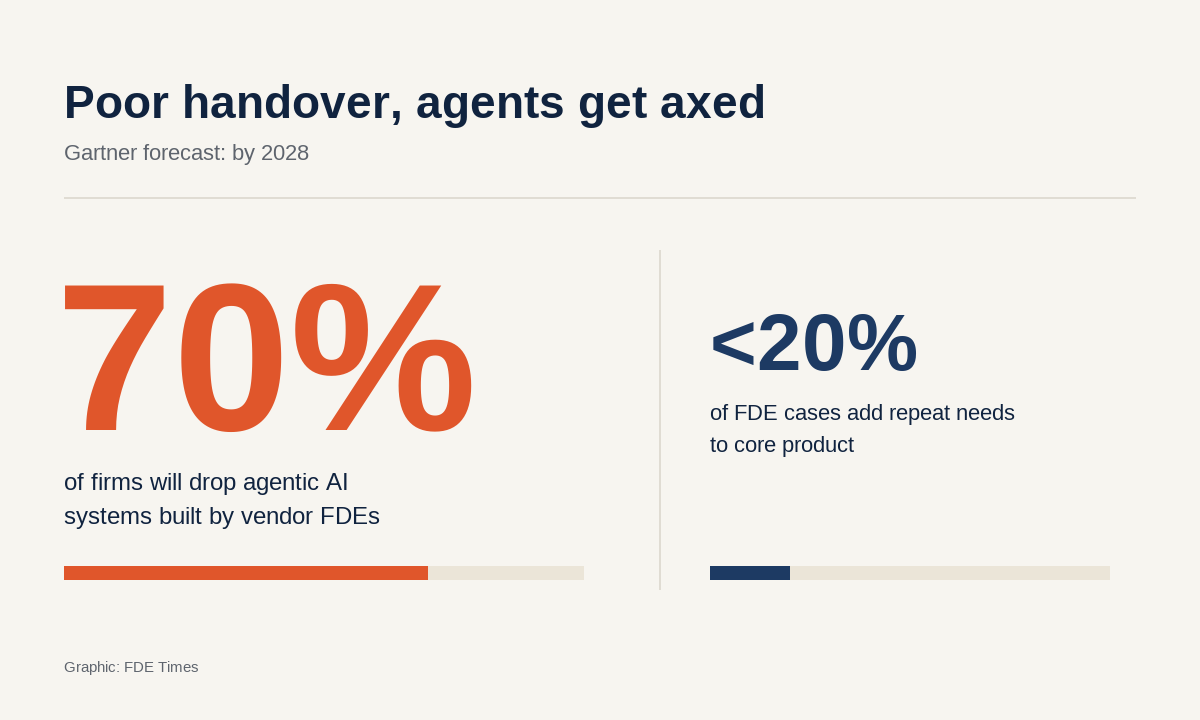
On September 30th 2026, Gartner issued a forecast aimed squarely at forward-deployed engineering: by 2028, 70% of enterprises will abandon agentic AI systems built by vendors’ FDEs. The reasons it gave were rising costs and an inability to develop the systems further on their own.
This is a forecast, not a measurement. But it came with a second number that should worry practitioners more: Gartner expects that through 2028, fewer than 20% of FDE projects will turn clients’ recurring needs into capabilities in the vendor’s core product.
Both of the reasons Gartner cites, escalating cost and the inability to keep developing the system, surface only after go-live, when the client has to carry the system alone.
So if you are an FDE, or want to become one, read this forecast as a test of how you hand over. Over the next two years, a good handover is likely to be what separates strong FDEs from the rest.
The finish line has moved
Gartner’s press release says plainly that success is measured not by completing the deployment but by the enterprise’s ability to manage, optimize and scale the solution. That sentence moves the finish line from go-live to months later, when nobody from the vendor is left in the room.
The Register quoted Gartner describing the problem more tersely: the FDE model can create fast early progress but leaves clients dependent on expensive outside expertise. That early speed is precisely what clients buy, and precisely what hides the capability debt building up underneath.
The debt has a concrete price. According to Channel Dive, Gartner estimates that FDE consulting fees alone can exceed $200,000 per quarter for each use case.
An enterprise with several use cases that has to call the outside team back every quarter to fix a prompt or add a tool will sooner or later ask whether the system is worth keeping.
Gartner predicts most will decide it is not.
An agent broken by a folder
Take a typical, hypothetical case. An FDE team builds an insurer an agent that triages claims files. It reaches the accuracy the client accepts, runs in production and is signed off. Three months later the client changes its rules, and a new group of claims starts being misclassified.
The internal team opens the repo and finds the source code complete. But the set of claims used to test the agent sits in the notebook of an FDE who has moved to another project, the labeled examples live in a spreadsheet nobody knows about, and the prompt versions were tweaked by hand with no record of why.
They fix the prompt, but have no way of knowing whether the new version breaks the older types of claims.
Not a line of code is missing, yet the system cannot evolve. This is the “unable to develop further” scenario Gartner describes, and its seeds lie in small decisions made in the first week of the project.
Vendors already knew
What stands out is that FDEs themselves had written down the right goal before Gartner spoke. Nastya Kats, an FDE at Cohere, wrote in August that the aim is to give clients lasting capability to operate, evaluate, troubleshoot and extend their AI systems.
Kevin Shatzkamer, CVP of Forward Deployed Engineering at Microsoft, wrote after the release that the goal at the end of an engagement is to transfer operating capability to the client rather than create ongoing dependence. He listed what must be left behind: an observable system, a knowledge graph, fine-tuned models, an eval framework and trained experts.
So the problem is not philosophy. Everyone agrees on the destination. The gap lies in turning that intent into checkable items with dates and owners, as in the table below.
| Handover item | Raised by | Check before the exit date |
|---|---|---|
| Exit plan drawn up on day one | Gartner | A fixed exit date; no extension just because the internal team is not ready |
| Eval datasets, labeled examples, prompt library | CDOTrends | The contract states they are the client’s assets, and they sit in the client’s systems |
| Observable system, eval framework | Microsoft | The client team reads logs and runs evals without asking the FDE |
| Trained experts on the client side | Microsoft, Cohere | The client team handles a real incident on its own |
| One complete release cycle | CDOTrends | The internal team fixes, tests and ships a new version itself |
| A named approver | PostHog | The deliverable ships and a specific person on the client side signs off |
The most important test is a release
Of the items above, the weightiest is CDOTrends’ proposal: before the exit date, the client’s internal team must complete a full release cycle on its own. It matters most because it folds every other item into a single test.
Go back to the insurer. If the client team had already changed a prompt, rerun the eval set, read the results and pushed a new version to production while the FDE merely watched, the missing notebook would have been discovered that week. One rehearsal is far cheaper than a quarter of consulting fees.
CDOTrends also stresses that the intellectual property of an agentic system includes the evaluation datasets, labeled examples and prompt library, so the contract must spell this out. For an FDE the task is concrete: from the first sprint, store evals and prompts in the client’s repo or data store, not in your own account.
Gartner adds an uncomfortable constraint: at the close of the engagement, carry out the exit plan drawn up at the start instead of extending the contract because the internal team is not ready. An extension sounds considerate, but it is the very mechanism that turns fast progress into expensive dependence.
Recurring lessons must flow back into the product
Gartner’s second forecast, that fewer than 20% of projects will turn recurring needs into product capabilities, looks at the vendor side. If every client needs FDEs to rewrite the same connector or the same eval suite, costs will never fall, and clients will keep paying for them.
OpenAI’s FDE job posting in San Francisco shows that at least one company has written this into the role’s responsibilities: codifying what works into tools, playbooks or building blocks others can reuse. Handover should therefore run in two directions: operating capability to the client, and recurring lessons back to the product team.
The two feed each other. An eval framework that has become a standard product tool is far easier to hand over than a set of scripts written for each client. Conversely, every difficult handover tells the product team where something is still missing.
What this changes in your career
Mukul Saha, Senior Director Analyst at Gartner, told Channel Dive that where there is truly the right FDE model, Gartner sees it deliver good results. The key word is “right”, and as Gartner, Microsoft and CDOTrends describe it, it hinges on the client being able to carry on alone. That is what you should be able to prove with concrete evidence.
On your CV, do not just write “deployed an agent for client X”. Write what happened next: how many releases the client team shipped after you left, what you left behind (eval suite, runbooks, observability dashboards), and who on the client side signed off. If you do not have those numbers yet, your next project is the time to start recording them.
When reading job postings, look for words such as “codify”, “playbook”, “enablement” or “handoff”. In interviews, turn the question around: when does the company plan the exit, and how does it measure the success of an FDE project? An answer that only mentions go-live is information worth weighing.
Gartner’s 70% figure will be tested in 2028. Until then, every time a client team ships a new release without calling you is evidence that the forecast need not come true.
Was this article useful?
Thanks for the feedback!
8 sources
- Gartner Predicts 70% of Enterprises Will Abandon Agentic AI Built by Vendor Forward-Deployed Engineering by 2028 (TechEdgeAI) · 2026-09-30
- 7 in 10 enterprises expected to abandon vendor-built agentic AI by 2028 (The Register) · 2026-09-30
- Are forward deployed engineers flirting with failure? (Channel Dive) · 2026-09-30
- The Engineers Left Yesterday. Can You Run Your Agents Today? (CDOTrends) · 2026-10-05
- Why forward-deployed engineers should build capability, not dependency (Cohere) · 2026-08-27
- Thinking about the evolution of forward-deployed engineers over the last 24 months (Microsoft Command Line) · 2026-10-28
- Forward Deployed Engineer (FDE) - SF (OpenAI Careers)
- Working with customers (PostHog Handbook, Forward Deployed Engineering)