xAI's closed FDE jobs show how engineers read a CV
Only one of the two postings promised an engineer would screen applications, but it shows how to describe work for a reader who can debug, not a keyword filter.
In brief
- The line 'every application is reviewed by a member of our technical team' appears only in xAI's 2025 Enterprise FDE posting, not in the X API one.
- Two postings with the same FDE title ask for two different skill sets: model evals and benchmarking, versus API design, streaming and SDKs, MCP and CLIs.
- According to Aced, xAI has no FDE roles left after the SpaceX merger, but writing an application for an engineer reader still works elsewhere.
“Every application is reviewed by a member of our technical team.” That sentence appeared in xAI’s posting for a Forward Deployed AI Engineer – Enterprise on Built In. The listing was taken down at 4:21 pm UTC on August 13, 2025.
Almost a year later, xAI’s last FDE posting, for X API, came down too. According to Aced, after the merger with SpaceX the only FDE role xAI was hiring for disappeared, and no position with an FDE title remains on SpaceXAI’s careers pages.
So why read two closed postings closely? Because they show, in specific terms, how an FDE application gets scrutinized when the person holding it is an engineer rather than a keyword filter. At any company that hires this way, you have to tell the story of your experience differently.
Only one posting says who reads applications
First, the evidence needs to be read correctly. The line about a “member of our technical team” appears only in the Enterprise posting on Built In. A copy of the same listing on RiseMe is vaguer: after you apply, “the team” will review your CV and your statement of exceptional work, with no mention that the team is made up of engineers.
The X API listing on Built In NYC says nothing about who reviews applications. Aced’s xAI interview guide, which carries no publication date and does not mention FDEs, says the company appears to have no formal hiring committee and that the process opens with a call with an engineer.
What can be claimed is therefore narrow: for one FDE role in 2025, xAI committed to having technical staff read applications, and the company’s general process seems to bring engineers in very early. Stretching that to “every FDE application at xAI is read by an engineer” goes beyond the evidence.
What does an engineer look for in an application?
A keyword filter asks whether you named the right technologies. An engineer asks a harder question: has this person actually done the kind of work the posting describes? At xAI, that “kind of work” differed sharply between two roles that both carried the Forward Deployed label.
The Enterprise posting leans toward the model: benchmarking models or helping customers write evals to find weaknesses, along with tasks such as reading prompt data. The X API posting, part of the X Developer Platform team, asks the hire to build, improve and ship developer tools such as SDKs, MCP and CLIs, while working directly with Enterprise customers to stand up production-grade solutions quickly.
| Aspect | Enterprise FDE (removed Aug 13, 2025) | X API FDE (removed Aug 6, 2026) |
|---|---|---|
| Main work | Benchmark models, write evals for customers, read prompt data | Production solutions for Enterprise customers, ship SDKs, MCP, CLIs |
| Technical focus | Measuring where the model goes wrong | API design, REST/GraphQL, real-time streaming, authentication |
| Languages named | Not specified | Rust, ideally Scala, or JVM languages |
| Who reads applications | A member of the technical team (per Built In) | The listing does not say |
The two skill sets barely overlap. Someone strong at evals may not know how to design an SDK developers enjoy using, and someone strong at APIs may never have measured where a model fails.
An engineer reading applications will spot that gap immediately. So match your CV to the verbs in the posting: “write evals” and “ship SDKs” are two different stories, and your CV should tell the one the posting is asking about.
How the technical requirements fit together
The X API posting asks for a solid grasp of API design, REST/GraphQL, real-time streaming systems and authentication, plus at least five years in a technical, customer-facing role. Welcome to the Jungle adds familiarity with Rust, Scala or JVM languages. This is a role for people with a fair amount of experience.
Take a hypothetical case to see how the pieces connect. A media company wants to track posts mentioning its brand in real time, and at the first meeting all it says is “we want to know the moment something happens.”
The FDE has to turn that into technical questions. Use a streaming feed or poll a REST endpoint on a schedule? When the connection drops, how does the client reconnect without losing data, and how are tokens issued and rotated inside the customer’s systems?
Only here does the platform-specific part begin. If the reconnection code written for this customer is good enough, the sensible move is to fold it into an SDK or CLI so other developers can reuse it. That is the posting’s “ship developer tools,” showing up in a concrete case.
Writing for a reader who knows how to debug
When the reader is an engineer, every line of your CV has to survive the question “and then what?” A list reading “REST, GraphQL, Kafka” gets through a keyword filter, but it tells an engineer nothing about what you decided.
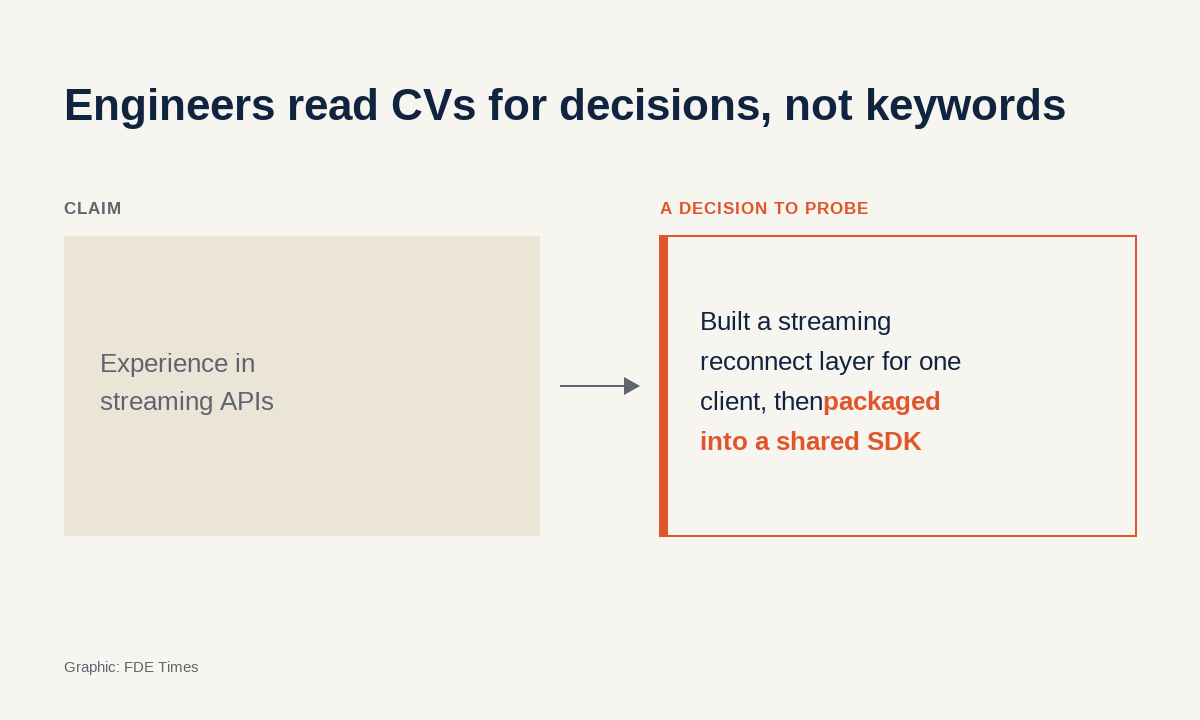
Compare two ways of writing it. “Experience with streaming APIs” is a claim. “Built a streaming reconnection layer for one customer, then packaged it into a shared SDK” is a decision someone can ask follow-up questions about, and engineers like lines they can probe.
As the RiseMe copy notes, for the Enterprise role the hiring team reviews both your CV and a statement about your exceptional work. That statement should follow the arc of FDE work: the customer’s problem in their own words, how you translated it into technical requirements, what you shipped, and what changed afterward.
If you are aiming at the platform track, also explain how a solution for one customer became a tool for many.
The roles are closed; the way to read them is not
Built In NYC removed the X API posting at 12:33 pm EST on Thursday, August 6, 2026. Welcome to the Jungle lists it as no longer available, and the careers page of Duke Capital Partners says the position is no longer accepting applications. If you were planning to apply to xAI, that door is now shut.
What remains is a useful exercise anywhere. If you are three or four years in, build a small developer tool on a public API yourself, a CLI or an MCP server with decent documentation, and use it as the story for your exceptional-work statement.
A keyword filter would skim right past that repo.
Was this article useful?
Thanks for the feedback!
7 sources
- Forward Deployed AI Engineer - Enterprise (Built In)
- X Developer Platform - Forward Deployed Engineer, X API (Built In NYC)
- X Developer Platform - Forward Deployed Engineer, X API (Welcome to the Jungle)
- X Developer Platform - Forward Deployed Engineer, X API (Duke Capital Partners job board)
- FDE jobs ranking (Aced) · 2026-09-02
- Forward Deployed AI Engineer - Enterprise (RiseMe)
- xAI interview process (Aced)