At AWS, strong code can still lose to a weak customer story
For forward deployed engineers, many Leadership Principles questions come down to one thing: whether you can be trusted in front of a customer.
In brief
- Amazon states that its interview process is designed to assess fit with the Leadership Principles, and the Bar Raiser is the one who upholds that standard.
- The AWS Sr FDE job posting describes an engineer embedded inside an enterprise customer, so customer stories carry as much weight as code.
- Interviewers can spend 10-15 minutes digging into a single story, so memorized answers will not hold up.
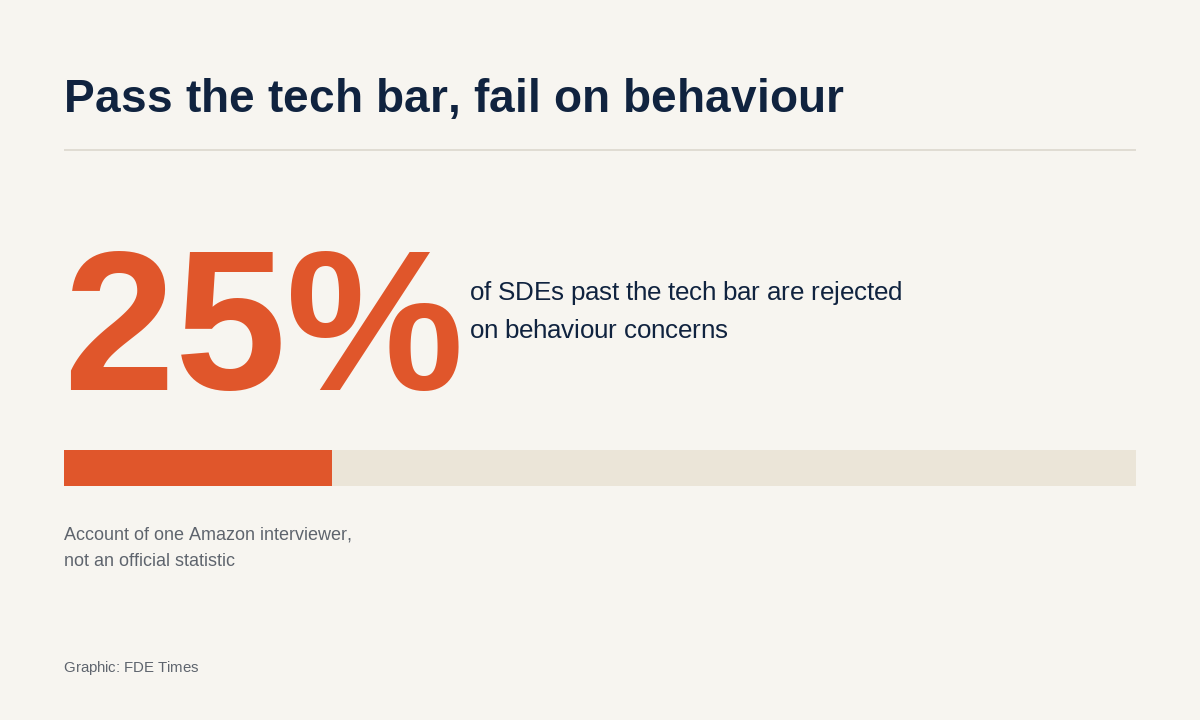
An Amazon interviewer quoted by interviewing.io offers a figure that should make many engineers rethink how they prepare: 25% of SDEs who clear the technical bar are still rejected over behavioral concerns.
The figure is anecdotal, one interviewer’s account. Still, it fits how Amazon describes its own hiring.
Amazon writes plainly that its interview process is designed to assess how well candidates fit the Leadership Principles and how well they can apply them. A former Amazon Director/GM, speaking to Levels.fyi, put it more bluntly: the company hires against the principles, and both positive and negative feedback refer back to them.
If you are aiming for a Forward Deployed Engineer role at AWS, that figure matters even more than it does for an SDE. The reason sits in the job posting itself: for an FDE, what the behavioral round asks about overlaps almost entirely with what you will do every day.
For an FDE, the behavioral round is also the technical one
AWS’s official Sr Forward Deployed Engineer posting describes an engineer working inside a strategic enterprise customer to design, build, deploy and operate production AI systems.
This person owns the technical strategy and execution for the customer’s complex AI programs, including several workstreams running in parallel.
Among the basic qualifications, AWS adds experience explaining technical concepts to both technical and non-technical audiences, including senior leadership. It is a requirement for applying, not a “preferred” item.
Now set that description against the Customer Obsession principle. Amazon states it in a sentence: leaders start with the customer and work backwards.
When the job is to work inside the customer, the gap between the principle and the daily work almost disappears. Every Customer Obsession story you tell will be heard as a sample of the very job you are applying for.
Who holds the ruler in the interview room
Amazon places a Bar Raiser in its hiring loops, an interviewer who acts as an objective third party. According to Amazon’s own 2019 article, the Bar Raiser’s role is to uphold the company’s 16 Leadership Principles.
That detail should change how you prepare. The Bar Raiser sits outside the hiring team and is charged with upholding the principles, so the principles-based assessment has someone in the room who answers for it alone.
The logical consequence is that an outstanding live coding session will struggle to make up for a thin customer story. The two are measured with different rulers, and the second ruler has its own keeper.
Fifteen minutes on one story
Amazon advises candidates to practice structuring answers with STAR: situation, task, action, result. For Customer Obsession, the company suggests preparing specific examples of times you put the customer first, even when it was not the easiest path.
The hard part lies elsewhere. According to interviewing.io’s guide, drawing on an Amazon interviewer, the person asking can spend 10-15 minutes on a single point, firing off follow-up after follow-up and digging deep. A memorized two-minute story runs dry by the third question.
Take a hypothetical example to feel that pressure. You say you once delayed a feature promised to a customer in order to fix a data bug that was distorting their revenue reports. The first question sounds easy: who decided to delay it?
Then come the sharper ones: whom on the customer side did you give the bad news to, in what words, how did they react, what alternatives did you weigh, and how did you measure afterwards whether the decision was right?
By minute ten, the interviewer knows whether you were really at the center of the story or merely standing next to it. In this example, the two weaknesses most likely to surface are saying “we” for ten minutes without pointing to a single decision that was yours, and leaving the result without a number. Have answers to both ready before you walk in.
Read the job posting like an exam paper
The most effective preparation is to take each requirement in the AWS FDE posting and ask where an interviewer would dig. The table below pairs the posting with what Amazon says about the Leadership Principles round; treat it as a practice guide only, since it is no official question set.
| Line in the job posting | Where the interviewer is likely to dig | Story to have ready |
|---|---|---|
| Working inside a strategic enterprise customer | Did you start from the customer’s problem or from the solution you liked | A time you changed technical direction after rethinking what the customer actually needed |
| Designing, building, deploying and operating production AI systems | When the system breaks on real data, what do you do first | A production incident on the customer side and how you handled it, with a measurable result |
| Owning strategy and execution for a multi-workstream program | How do you prioritize when workstreams compete for resources | A time you said “no” or “not yet” to a request to keep the program on course |
| Explaining technical concepts to non-technical audiences and senior leadership | How did you persuade someone who doesn’t read code | A presentation to customer leadership that led to a specific decision |
The third column is your job. Each cell should be a real story, naming the role of the person on the customer side, a decision that was yours alone, and at least one number in the result.
OpenAI asks the same question in different words
If you think this is peculiar to Amazon, look at how one guide to OpenAI’s FDE interviews, compiled from candidate accounts, sums up the behavioral round. The real question the interviewer wants answered is whether this person can be trusted in front of a customer, and whether they can be trusted to build the solution that is needed.
The two companies use different vocabulary. Amazon has its Leadership Principles, the Bar Raiser and STAR; OpenAI, as candidates describe it, wraps everything into the word “trust.” What gets measured is the same: the ability to work with customers without anyone holding your hand.
So the effort you put into the AWS Leadership Principles round carries over if you apply elsewhere.
What to practice if you want to pass this round
Start by gathering material before you rehearse anything. Go back over your last two or three years of work and write down every time you dealt with a customer: a difficult call, a request you turned down, a demo that failed, a time you had to explain something to a non-technical person.
If you are an SDE who has never met a customer, internal users or other teams in the company are valid sources of stories too.
Next, write each story in STAR form, then grill yourself the way a Bar Raiser would: who decided, why, which options were dropped, how the result was measured. Any question you cannot yet answer marks the place to dig back into your memory, or to check with former colleagues, before you walk into the room.
Finally, put those same stories into your CV. A bullet such as “worked with customers to deploy systems” tells the reader nothing. Rewrite it to say what kind of customer, what you decided and which number changed, and you have given the recruiter a preview of the story they want to hear in the interview.
When you read an FDE posting at any company, look for lines such as “senior leadership,” “non-technical audiences” or “working inside the customer.” They reveal the other half of the exam in advance, the half LeetCode cannot train you for.
Was this article useful?
Thanks for the feedback!
7 sources
- How to use Amazon's Leadership Principles in your interview · 2025-05-14
- Exploring Amazon's unique interview process · 2019-01-09
- Sr Forward Deployed Engineer, AWS Forward Deployed Engineering
- Leadership Principles - Discover - A to Z
- Amazon Leadership Principles: Questions and Interview Tips · 2022-09-24
- A Senior Engineer's Guide to the Amazon Leadership Principles Interview
- OpenAI Forward Deployed Engineer (FDE) Interview Guide | Sample Questions (2026)