FDE roles are built to shrink, and that is good news for your career
The role contracts as a company grows, but the skill of turning lessons from the field into product goes with you.
In brief
- Insight Partners states plainly that the FDE is not a permanent position: once a solution works, ownership moves to the teams that turn it into product.
- The part that tends to disappear is repeated custom work for each customer. The learning loop from the field back to the product stays.
- For a durable career, measure yourself by the number of patterns you have turned into product, not by the number of customers you have served.
In June 2025, a16z called the Forward Deployed Engineer the hottest job in startups. Thirteen months later, Insight Partners wrote a sentence that landed like cold water: the FDE is not a permanent position.
Anyone weighing a move from a stable software engineering job into FDE work should read that sentence carefully. Skimmed, it sounds like a warning that the role is just a hiring wave. Read closely, it describes how to do the job so that your value grows over time.
The key is to separate two things that are often lumped together. An FDE’s presence at any single customer is temporary. The function the FDE carries, the learning loop from the field back to the product, is not, and your career depends on which of the two you attach yourself to.
Temporary for whom?
Insight Partners is fairly specific about what it means: once a solution works, ownership passes to the teams that productize it and run it at scale, while the capability the FDE created compounds into the core product rather than disappearing.
A week later, the same firm advised companies not to treat their FDE team as a temporary bridge until customers can run AI themselves. The two statements do not contradict each other. Individual FDEs leave individual deployments; the FDE team is built to last.
Practitioners describe the loop even more bluntly. Marcello Pedersen of Databricks, quoted by Insight Partners, sees the goal of every deployment as working yourself out of a job, and PostHog says lessons from its FDEs are generalized by the core product teams for other customers.
Rocketlane draws a clear line between the two sides: FDEs surface insights and prove patterns, and the platform team is the one that builds them into the product. A stopgap connector is the easiest example.
Say you write a connector that reads data from a customer’s legacy ERP system for customer A, and then customers B and C ask for exactly the same thing. At that point the most valuable move is to document the pattern and hand it to the platform team. Copying the connector a third time only adds to the technical debt.
Umbrex’s playbook states outright that stopgap connectors should be removed once an approved integration exists. If your connector is retired because the product now has a feature that replaces it, that is a sign you did the job right.
The role shrinks as the company grows
The question of temporary versus permanent has a second layer, at the level of the company. First Round Review argues that the FDE model makes sense at certain points in a company’s life, which means there are also points when it does not.
The early stage is where it fits best. a16z argues that for a young AI company, high-touch services help win larger contracts, and early services deals also test whether customers are willing to pay. The company accepts thin margins in exchange for an advantage that is hard to copy.
Then the product catches up. Rocketlane’s signal is simple: if many customers ask for the same feature, that work probably belongs in the product. Each time that happens, a slice of FDE work moves to the platform team.
In a mature organization, that decision is made deliberately for each piece of field work. Umbrex lists the options: productize now, defer, turn into an approved pattern, document, decline, keep watching or stop doing. The shrinking is a process, not a sign that the profession is dying.
As the product gradually absorbs the repetitive work, what remains for FDEs at a mature company are the problems the product has not yet reached.
That is also where Insight Partners places the FDE when it distinguishes the role from consultants and sales engineers: taking on ambiguous, unscoped problems, building the last-mile solution and owning the outcome.
The real risk lies elsewhere
What can damage the profession is FDEs being used the wrong way. Rocketlane warns that building the same custom solution over and over only produces expensive one-offs, while the product does not improve in a way that scales.
That is first a risk for the company, but it spreads to you. A role whose only output is code written for individual customers adds nothing to the product, and whoever holds it will struggle to prove their worth when the company has to cut.
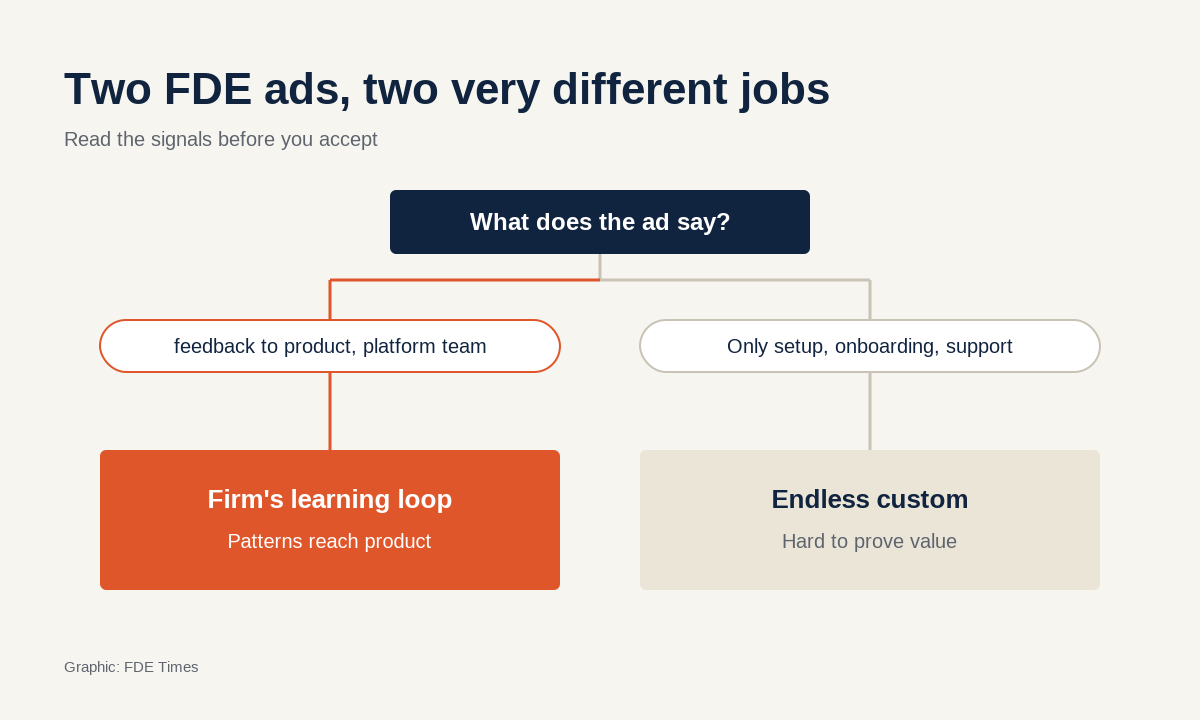
So two job postings that both say “Forward Deployed Engineer” can lead to very different jobs. One treats the FDE as the company’s learning loop; the other uses FDEs as a standing custom-work team. The accompanying chart collects the signals that tell you which is which before you accept an offer.
When agents get easier to build, who still needs an FDE?
One view on Latent Space pushes the role further: if you are an FDE, you should be building the product itself. The same source argues that agents will keep getting easier to build, but there will always be room for people who can work with customers.
The two ideas meet in the word “owning” in Insight Partners’ definition. Your results only matter in the long run when they make it into the product. And as agent-building tools get cheaper, the most valuable work is sitting with customers to turn an ambiguous problem into something that can be built.
What this changes for your career
If your presence at each deployment is temporary, the way you measure your career should change too. The number of customers you have served says very little. The number of patterns you have proved and got into the product, with specific features or modules as evidence, is the figure that counts.
On a CV, a line such as “deployed for multiple enterprise customers” is close to meaningless. Write it in three parts: the ambiguous problem you started with, the last-mile solution you built, and the part that became a shared feature. A hiring manager who sees the FDE as a learning loop will recognize at once how you understand the role.
When reading job postings, look for phrases such as “feedback to product”, “work with platform team” or “ambiguous problems”. If the description is all configuration, onboarding and post-sales support, it is probably repetitive custom work under a new name. That work is not necessarily bad, but you should know what you are signing up for.
The role also opens another path. PostHog observes that a great many former Palantir employees have gone on to found their own companies. That makes sense: years of FDE work train exactly what a product builder does, which is to hear a raw problem, spot the pattern and know what is worth turning into product.
The line “the FDE is not a permanent position” should not put you off. It is a reminder of how to do the job: with every deployment, make yourself less needed there and more needed on the next hard problem.
Was this article useful?
Thanks for the feedback!
8 sources
- Demystifying the forward deployed engineer · 2026-07-14
- The FDE Hiring Decision: When You Need One and When You Don't · 2026-06-15
- How companies are building and scaling the FDE bench · 2026-07-21
- WTF is a forward deployed engineer? (and why everyone is hiring them) · 2026-02-11
- Turning Field Work Into Product Leverage
- Forward Deployed Engineers and the future of software engineering
- So You Want to Hire a Forward Deployed Engineer: How to Know If You Need One and How to Get the Role Right · 2026-02-24
- Trading Margin for Moat: Why the Forward Deployed Engineer Is the Hottest Job in Startups · 2025-06-04