AWS uses 'forward deployed' for two very different engineering jobs
The last verb in the job ad, "evaluate" or "operate", tells you which role to apply for and what the interviews will probe.
In brief
- The Generative AI Innovation Center and the AWS Forward Deployed Engineering organization share roots but are separate units that hire different kinds of people.
- The Deep Learning Architect role leans toward research, design and evaluation alongside scientists. The FDE role builds, deploys and operates production systems inside the customer.
- AWS FDE is sold in 45-day sprints at a known price, tied to business outcomes, so an FDE has to pin down the target in the first week.
The web address of the Generative AI Innovation Center page on the AWS website now opens a different page altogether: the sales page for AWS Forward Deployed Engineering. On it, AWS says FDE is sold in 45-day sprints under the FDE Terms, with no statement of work to negotiate.
That small detail shows AWS using one phrase for two different jobs. “Forward deployed” now attaches to at least two roles: Senior Forward Deployed Deep Learning Architect in the Generative AI Innovation Center (GenAIIC), and Sr Forward Deployed Engineer in the newly formed AWS Forward Deployed Engineering organization.
Apply for the wrong one and you will prepare for the wrong interviews. The two roles differ in who you work with and what you hand over. For the FDE role, the way the customer pays shapes daily work more than the job title does.
Two units, one root
On June 30, 2026, Amazon announced a separate Forward Deployed Engineering organization. Amazon presented it as building on the experience of GenAIIC, where engineers had been building solutions for customers for about three years. The two teams are connected, but they remain separate units.
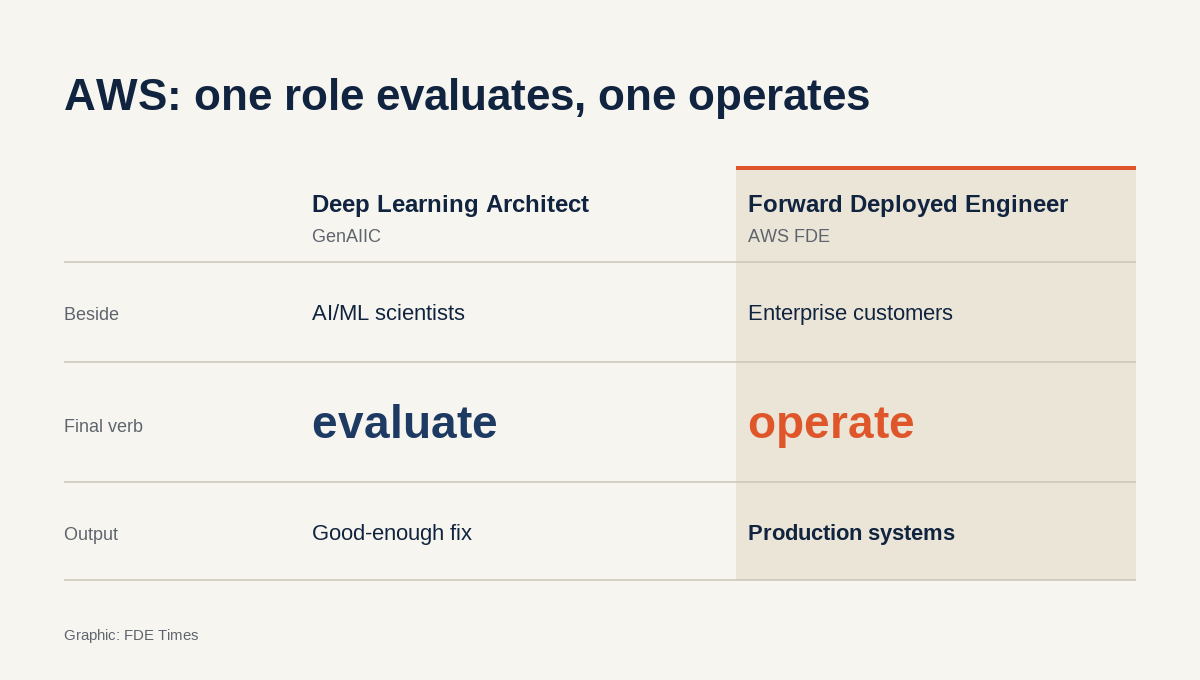
GenAIIC describes its mission as helping AWS customers deploy generative AI solutions. The Deep Learning Architect role there is described as collaborating with scientists and AI/ML architects to research, design, develop and evaluate generative AI solutions.
The Sr Forward Deployed Engineer posting reads differently. The hire works directly inside a strategic enterprise customer to design, build, deploy and operate production systems that use AI. The last verb in each list is where the roles diverge most: one ends at “evaluate”, the other at “operate”.
Operating means you are still on the hook after go-live: the system fails at midnight, the customer’s data changes format, inference costs overshoot the estimate. Evaluating means you answer which solution is good enough, and why. Both are real skills; they are simply honed in different ways.
How the service is sold decides how FDEs work
Traditional consulting bills by the hour. AWS says plainly that FDE engagements are built around shared goals and business outcomes, not hours worked. Each sprint has a fixed price depending on the team’s location, so customers know the cost before they commit.
FDE teams also have a clear structure: an AWS product lead and an AWS tech lead, working with an owner on the customer side.
AWS’s official pitch is to put the same engineers who built AWS’s AI to work inside the customer’s team. The page headline spells out the end goal: AI running in production, operated by the customer’s team.
For the engineer, those terms translate into a very specific rhythm. No statement of work means no weeks of scope negotiation to serve as a buffer.
A fixed price and an outcome commitment mean the success metric has to be settled at the start of the sprint, because on day 45 nobody pays extra for “nearly done”.
Take a hypothetical insurer that wants an agent to read claims files and propose payout amounts. In the first week, the FDE and the customer-side owner agree on a number, such as the share of claims processed with no human review, and also fix the set of claims used to measure it.
Roughly the next four weeks go to building and measuring on real data. The remaining days of the sprint go to putting the system into production and handing it over to the customer’s operations team.
The handover is the part most easily underestimated. If the customer’s team cannot run the system on its own after day 45, the sprint has missed its goal, however good the demo looked. Runbooks, dashboards and incident documentation should therefore be built alongside the code from the first week.
The posting also asks for 30–50% travel. Applied loosely to a 45-day sprint, that gives a rough estimate of 13.5 to 22.5 days on the customer’s site, although actual travel schedules may not line up with individual sprints.
Weigh that number before applying, especially if your personal schedule is hard to change.
Read the job ad like a recruiter
Do not stop at the title. Look for the final verb and the people you will sit next to. From those two details you can guess whether the interviews are more likely to lean toward experiment design and evals, or toward the times you shipped a system to production and kept it running.
The difference in verbs suggests how to prepare for each role. The table below offers preparation tips; it does not reproduce the job postings.
| Preparation tip | Deep Learning Architect (GenAIIC) | Forward Deployed Engineer (AWS FDE) |
|---|---|---|
| Interview story to tell | How you compared options and which evals you used to conclude one was “good enough” | How you set the success metric and kept the system running after go-live |
| CV line that carries weight | An eval suite you designed that changed a model-selection decision | A system you handed over that another team runs on its own |
| Exercise for the week | Write a small eval suite for a generative AI problem, with pass criteria | Write a 45-day plan for a past project, with a handover runbook |
What more does a senior AWS FDE need?
The Sr Forward Deployed Engineer posting has one more requirement that is easy to miss. Senior hires must create reusable architectures, patterns and technical mechanisms that can scale across the whole FDE practice. Delivering individual projects is not enough.
That fits the sprint model. When every sprint has a fixed price, the way to get more done in 45 days is to avoid starting from scratch at each customer. The eval pipeline written for the insurer in the example above, if turned into a template, would shorten the first week of the next sprint at a bank.
On a CV, a line like “built system X for customer Y” only proves you can deliver. A stronger line reads: “extracted a shared component from the project that was later reused on other projects and cut start-up time”.
If you do not have a line like that yet, find the code you wrote over and over in your last two projects. Turn it into a documented module, use it on the next project and record how many days it saved.
Which role to choose
If you are a software engineer with a few years of shipping systems to production, have done on-call and are used to working with other people’s teams, the FDE posting fits you better. The stated requirement is five or more years of software development experience, not a research degree.
What you need to prove is that you can settle goals quickly and hand over a system the customer’s team can run on its own.
If you enjoy comparing models, designing evals and working daily with scientists, the Deep Learning Architect role at GenAIIC is the better fit. For interviews, be ready to explain how you decide a solution is “good enough” and back it with numbers.
Whichever you choose, practice planning a 45-day sprint. For a service sold by the sprint and tied to outcomes, an engineer who can say what they will measure on day one and which team will run the system after the last day is likely to walk into the interview in a strong position.
Was this article useful?
Thanks for the feedback!
4 sources
- AWS $1 billion forward deployed AI engineers (About Amazon) · 2026-06-30
- AI in production, run by your team – AWS Forward Deployed Engineering – AWS
- Sr Forward Deployed Engineer, AWS Forward Deployed Engineering (Job ID 10517491)
- Senior Forward Deployed Deep Learning Architect, Generative AI Innovation Center (AnitaB.org job board mirror of Amazon posting)