At Celonis, the job called FDE is really a Value Engineer role
The hands-on work most engineers picture when they hear FDE sits under another title, Deployment Engineer, where agents build the dashboards and English is the only required language.
In brief
- The Senior FDE listing in Paris describes the position as a Value Engineer. Both it and the FDE listing in Munich assign the whole customer lifecycle: land, expand, adopt, renew.
- The Deployment Engineer listing assigns the hands-on work: directing the Apollo agent to build data models, KPIs and dashboards. It requires only English.
- Before applying, read the role description in the body of the listing and its responsibility verbs, because the title does not tell you what you will actually do.
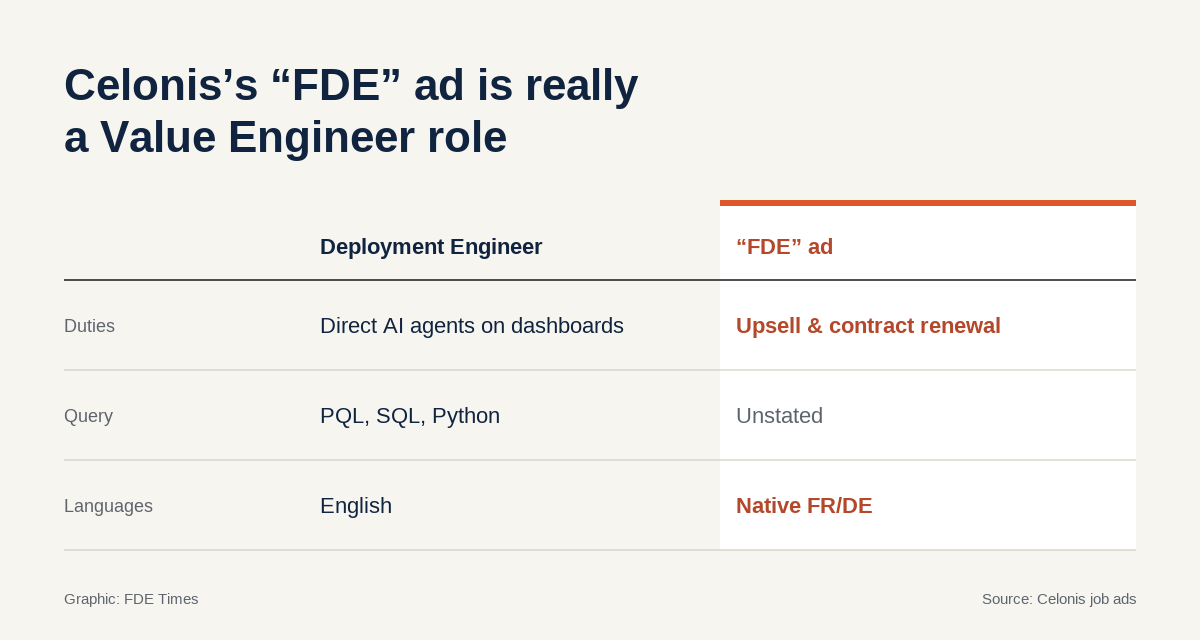
Celonis is advertising for a “Senior Forward Deployed Engineer” in Paris. A few lines into the listing, the job is described under a different name: Value Engineer, the person who owns the customer’s value journey from end to end.
The listings titled Deployment Engineer, meanwhile, describe the work most engineers have in mind when they hear the letters FDE. The Lead Deployment Engineer listing calls the hire the person directly responsible for deploying Celonis at the customer. The Deployment Engineer listing assigns the job of directing AI agents to build data models and dashboards.
This matters because, within one company, the two labels demand two different skill sets. Anyone who picks a job by its title risks applying for the wrong role, preparing for the wrong interview and discovering a year later that the work looks nothing like what they expected.
At Celonis, the FDE label sits on a role that owns the whole customer lifecycle
The Paris FDE listing sets out its responsibilities in four verbs: land, expand, adopt, renew. The “Forward Deployed Engineer – CPG/Retail” listing in Munich uses the same four words. This is the vocabulary of a customer account, not of a deployment project.
The Munich listing never uses the term Value Engineer. But the identical set of verbs suggests both listings describe the same kind of role, even though only Paris spells out the name.
Expand means widening how much the customer uses the product. Renew means extending the contract. When those two words appear in a job description, the hire’s responsibility runs all the way to whether the customer stays and buys more, well beyond getting the system running.
Celonis’s own careers site confirms this reading. A post introducing the Value Engineering team says value engineers own the entire value journey of every Celonis customer, from end to end.
Another post on the same site describes the daily work: building demos, business cases and proof-of-value projects, and turning a CEO’s strategic goals into high-impact use cases.
The Paris listing is more specific about method. The Value Engineer leads business value workshops and uses Celonis to find, then validate, opportunities to improve processes.
The language requirements make the nature of the role plain. The Paris listing requires native-level French; the Munich listing requires native-level German. Munich also explains why: the hire must lead workshops, present to executives and work with stakeholders in German.
The Deployment Engineer does the technical work
The Lead Deployment Engineer listing puts the hire directly in charge of deployment for the customer, including leading discovery workshops. On the technical side, it requires SQL and Python. The ERP requirements are spelled out in detail: SAP MM/SD/PP, S/4HANA, APO/IBP, or equivalent systems such as Oracle, Kinaxis, o9 and Blue Yonder.
The Deployment Engineer listing posted on Accel’s job board asks for PQL, Celonis’s process query language, alongside SQL and Python. It also asks for knowledge of ERP.
The most telling detail is the language requirement. The Deployment Engineer listing requires only English, with other languages a plus. For an engineer who speaks neither German nor French, that is the biggest difference between the two labels.
When the agent builds the dashboard, your job is to check it
The Deployment Engineer listing says engineers direct Celonis’s deployment agents, called Apollo, to build data models, process analyses, KPIs and dashboards. If the agent does most of the building, the engineer’s time shifts to briefing the agent, reading its output and answering to the customer when a number is wrong.
Take a hypothetical case. A customer has 1,000 order lines in SAP, and each order ships in 2 deliveries. The agent joins the orders table directly to the deliveries table without grouping by order and gets back 2,000 rows. The on-time delivery KPI is now calculated per shipment instead of per order, and the dashboard still looks entirely plausible.
An engineer who only knows how to prompt the agent will take that number into the customer meeting. One who understands the data model will count the rows before and after the join, see the figure double and ask why.
At a real customer, the first step is to reconcile a few numbers business users know by heart, such as last month’s total order count, before trusting any chart.
Same process mining roots, different people across the table
The table below sets the requirements from the three groups of listings side by side, so the differences are easy to see.
| Aspect | Lead Deployment Engineer | Deployment Engineer | FDE-labeled listings (Paris, Munich) |
|---|---|---|---|
| Main responsibility | Directly responsible for deployment at the customer | Directs Apollo to build data models, KPIs, dashboards | Land, expand, adopt, renew; the Paris listing calls the role Value Engineer |
| Workshops | Discovery workshops | Not in the quoted text | Business value workshops; executive presentations in Munich |
| Query languages | SQL, Python | PQL, SQL, Python | Not in the quoted text |
| ERP | SAP MM/SD/PP, S/4HANA, APO/IBP or equivalent | Knowledge of ERP | SAP-style enterprise software (Munich) |
| Languages | Not in the quoted text | English, other languages a plus | Native French or German |
Row by row, the common ground is the customer’s systems: the Lead, Deployment Engineer and Munich listings all mention ERP or SAP-style enterprise software.
Workshops appear in the Lead listing and in both FDE-labeled listings, and the difference lies in who sits on the other side of the table. Discovery workshops serve building the solution; value workshops and executive presentations serve persuading the customer to keep spending.
What does process mining demand of candidates?
Across the three groups of listings, the skill requirements fall into three layers. The bottom layer is SQL, Python and the ability to build a data model. The middle layer is PQL, a skill tied specifically to the Celonis product. The top layer is understanding how business processes run in ERP, from purchasing and sales to production planning.
A backend engineer usually has the bottom layer already. If you do not speak German or French at native level, the realistic way into Celonis is the Deployment Engineer role, where only English is required; learn PQL and study one SAP module, such as MM or SD, in depth before applying.
To aim for the FDE label, you need something technical documentation cannot teach: the ability to lead value workshops and build business cases in the customer’s own language.
Read a job listing the way you would read a contract
The first piece of advice applies at any company: find the role description in the body of the listing. Celonis writes “Value Engineer” right inside its Paris FDE listing, and anyone who reads only the title will miss it.
Next, count the responsibility verbs. If the listing talks about build, data model and dashboard, it is a deployment role. If expand and renew appear, ask the recruiter directly how success in the position is measured.
For a Deployment Engineer role, your CV should show that you know how to verify automated output. A good bullet point states which error you caught in ERP data, how you caught it, and what the customer decided because the number was right.
At Celonis, the FDE label and the deployment work sit in two different listings. Before applying, look past the title to the actual job, then choose the role whose measure of success matches what you want to be judged on.
Was this article useful?
Thanks for the feedback!
6 sources
- Senior Forward Deployed Engineer at Celonis, Paris, France | Euro Top Tech · 2026-11-10
- Forward Deployed Engineer - CPG/Retail at Celonis, Munich, Germany | Euro Top Tech · 2026-11-09
- Deployment Engineer @ Celonis | Accel Job Board · 2026-07-29
- Job Application for Lead Deployment Engineer at Celonis
- Department Spotlight: Value Engineering | Celonis
- Why should your next career move be Celonis Value Engineering?