Why so many Palantir founders started as forward deployed engineers
Months inside client offices train the instincts a founder needs, but perhaps only when a real platform sits beneath the custom work.
In brief
- Concept VC counted more than 111 companies founded by former Palantir employees, and FDE is the most common background among those founders.
- The role puts engineers on client sites three to four days a week, reading the power dynamics in the room and deciding for themselves what needs doing.
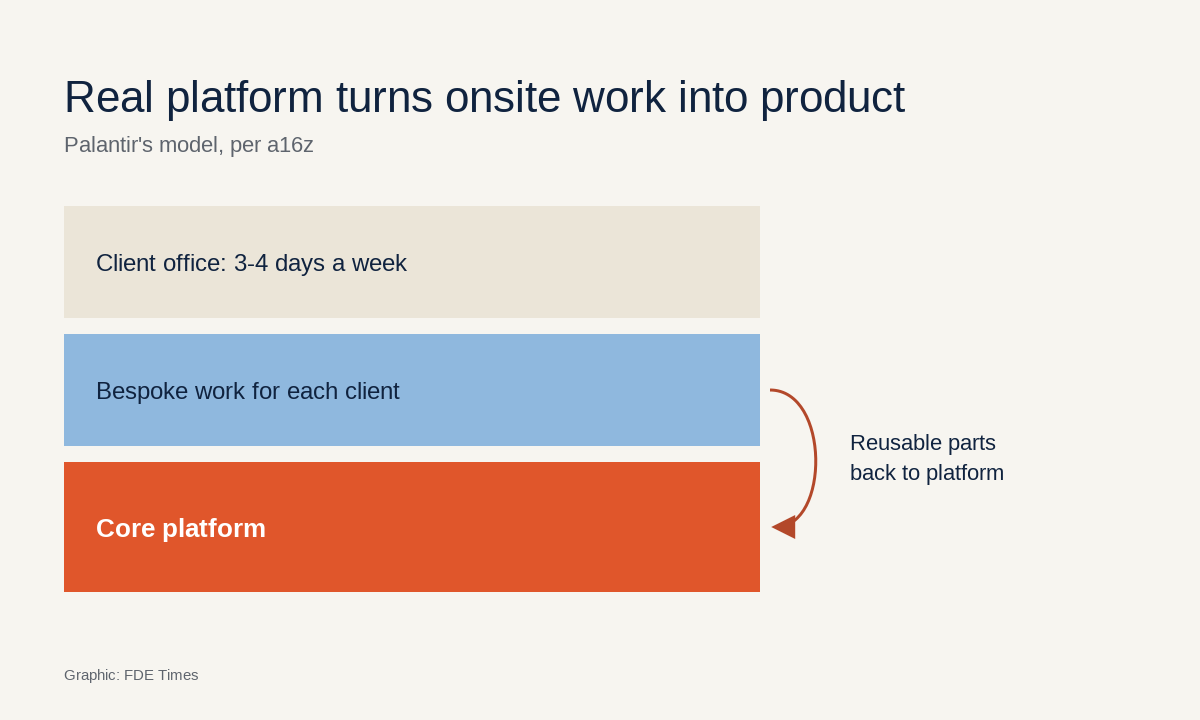
- According to a16z, the Palantir model works because a real platform sits beneath the custom work; without one, an FDE role can easily become plain services work.
Concept VC counted more than 111 companies founded by former Palantir employees. When it looked at the backgrounds of the people behind them, one job title came up more often than any other: Forward Deployed Engineer.
a16z calls this the “Palantir mafia”, a class of founders and operators formed by people who left the FDE role one after another. One example is Anduril, co-founded by two Palantir alumni, Brian Schimpf and Matt Grimm.
Whether Palantir simply got lucky matters less to a working engineer than a different question: what does a job train people to do when the people doing it keep leaving to start companies?
Those skills are worth building deliberately, whether or not you plan to found anything. It is just as important to recognize when a role carrying the FDE title has stopped training them.
Most of the working week happens at the client
Nabeel Qureshi, a former Palantir engineer, recalls that FDEs often had to “go onsite” and work from the client’s offices three to four days a week. a16z, looking in from outside, describes the same pattern: FDEs embedded inside the client organization, often for months.
Do the arithmetic on a five-day week. Three to four days onsite means 60% to 80% of your time hearing about problems directly from the people who have them, rather than through a ticket or a PM’s summary. An engineer based at headquarters usually receives problems through several layers of intermediaries.
That is precisely what early-stage founders lack. They need to know which problems hurt enough that someone will pay to fix them, and they need to know fast. Three to four days a week, sustained over months, is an amount of exposure to real problems that few engineering roles offer.
The hardest skill to teach is not in the code
Qureshi is direct about why he believes former FDEs often become good founders. In his view, good founders have an instinct for reading the room, group dynamics and power, and that is one reason people who have done the FDE job tend to build companies well.
There is reason to think this skill is hard to develop at headquarters, where the power structure is already drawn on the org chart. At a client site the opposite holds. The person who signs the contract is not necessarily the person who decides whether the system gets used.
Take a hypothetical case. A vice president sponsors the project, but the data sits with an operations lead who sees the project as a threat to their team.
An FDE who reports only to the vice president will watch the pipeline slow down without knowing why. An FDE who reads the room will sit down with the operations lead in the first week and turn that person into the first user.
This instinct is trained one meeting at a time. Founders need it when selling to their first customer, hiring and negotiating with investors.
Palantir filters at the hiring door
The work does not explain the whole story. Qureshi argues that Palantir’s hiring selected for a particular kind of person: someone capable of thinking independently. He also sees the company’s culture of tolerating disagreement as something inherited from the “PayPal mafia”.
a16z adds the rest: Palantir spent more than a decade recruiting and training unusually strong generalist engineers. Hiring and daily work pushed in the same direction. The company chose people who were already self-directed, then put them in a role that forced them to direct themselves every day.
Nobody can cleanly separate how much came from selection and how much from the work. For an engineer planning a career, the distinction is still useful: you cannot choose whether you would have passed Palantir’s hiring bar, but you can choose the environment you put yourself in.
From the FDE’s job to the founder’s job
Each habit Qureshi and a16z describe in FDEs maps to a specific founder task. The last column shows how to practice each habit before you hold an FDE seat.
| FDE habit | Corresponding founder task | How to practice from your current role |
|---|---|---|
| Onsite 3-4 days a week, for months | Finding a problem painful enough that customers pay | Ask to shadow the support or sales team one day a month |
| Reading the room, the group and the power | Selling to the first customer, hiring, negotiating | After every meeting, note who actually made the decision |
| Self-directed, not waiting to be assigned work | Nobody assigns you work | Take on a vague problem and write the scope yourself |
| Custom work on top of a shared platform | Deciding what becomes product | Split each project’s code into a custom part and a reusable part |
The last row is the easiest to overlook, and the most important.
Not every FDE seat produces founders
a16z sets out a condition that many companies copying the FDE model ignore: Palantir works because a real platform sits beneath the custom work. a16z is talking about the business model, but the same condition very likely shapes what FDEs learn.
A reasonable reading runs like this. With a platform underneath, every piece of custom work raises a question: which part only this client needs, and which part deserves to become a general feature? Answering that question is product judgment, which a founder uses every week.
Without a platform underneath, everything is custom, and what you learn is how to deliver on time rather than how to see a product.
So when reading an FDE job ad, look for three signals: clearly stated onsite or client-facing time, ownership over deployment outcomes, and a concrete feedback channel to the product or platform team.
In the interview, ask directly when FDE-written code last made it into the platform. If the interviewer struggles to answer, you have your answer.
On your CV, do not just list the clients you deployed for. Write which part of that custom work was reused for a second and third client. A line like that shows the reader that you can tell one-off work from work worth turning into product.
The so-called Palantir mafia came out of a way of working: putting independent thinkers in client offices for months, on a platform real enough that every lesson had somewhere to go. You can look for a role like that, or build one where you already work.
Was this article useful?
Thanks for the feedback!
3 sources
- Reflections on Palantir · 2024-10-15
- Behind The People: Palantir
- The Palantirization of everything · 2026-01-16