Hive sells a few lines of code, then hires an FDE to deliver it
Hive's job listing and API docs show where the real work sits: around the call, in choosing sync or async and wiring it into the client's workflow.
In brief
- Hive advertises an API integration that takes only a few lines of code, yet its FDSE must own the entire delivery for its most strategic partners.
- The hard work sits around the call: choosing sync or async, turning the client's moderation policy into code, and working out how much reviewer work a score threshold creates.
- The role is both the main contact for enterprise clients and the person handling urgent tickets; Hive's homepage has announced a rebrand to Deploy, so read the latest listing.
Hive’s homepage promises developers they can integrate its API “with just a few lines of code”. The same company is hiring a Forward Deployed Software Engineer (FDSE) to own the entire delivery process for its most strategic partners.
The two messages do not contradict each other. When the product is an AI model called through an API, an FDE’s value lies in everything that surrounds that call inside the client’s production systems.
For anyone aiming at an FDE role at a company that sells AI as an API, reading this listing alongside Hive’s API documentation shows what the daily work looks like and what a hiring manager wants to see on a CV.
One caveat before opening the listing: Hive’s homepage has announced a rebrand to Deploy. A newer posting describes Deploy as an “intelligence infrastructure platform”, infrastructure that gives developers and businesses access to open-source models. Read the latest version and ask about the product’s scope in the first interview.
A few lines of code is the easy part
The listing names the areas Hive works in: content moderation, deepfake detection, brand protection and sponsorship measurement. On the homepage, the moderation section lists categories such as NSFW, hate speech, violence and CSAM. These are the models an FDSE would help clients plug into their platforms.
According to the listing, the hire will be the main point of contact for multiple enterprise clients and must build complete integrations that deliver results for them. A support role is rarely handed ownership of delivery from start to finish. This one is.
The reason is plain. Enterprise clients are perfectly capable of calling an API themselves; what they lack is someone to turn that call into a moderation flow that runs reliably on their real data, inside their real processes.
DataCamp puts it precisely: a platform’s value only shows once it is connected to the client’s workflow, and making that connection is the FDE’s job.
Sync or async is the first architectural decision
Hive’s API documentation separates synchronous (sync) and asynchronous (async) requests under the v2 endpoint. The two options map to two very different integration architectures, and choosing the wrong one costs the client later.
Sync calls suit places where a decision must exist before content appears, such as blocking an image the moment a user hits upload. Async calls suit large backlogs or long content such as video, where results arrive later. The client’s system then has to handle callbacks, retries and the state of each task on its own.
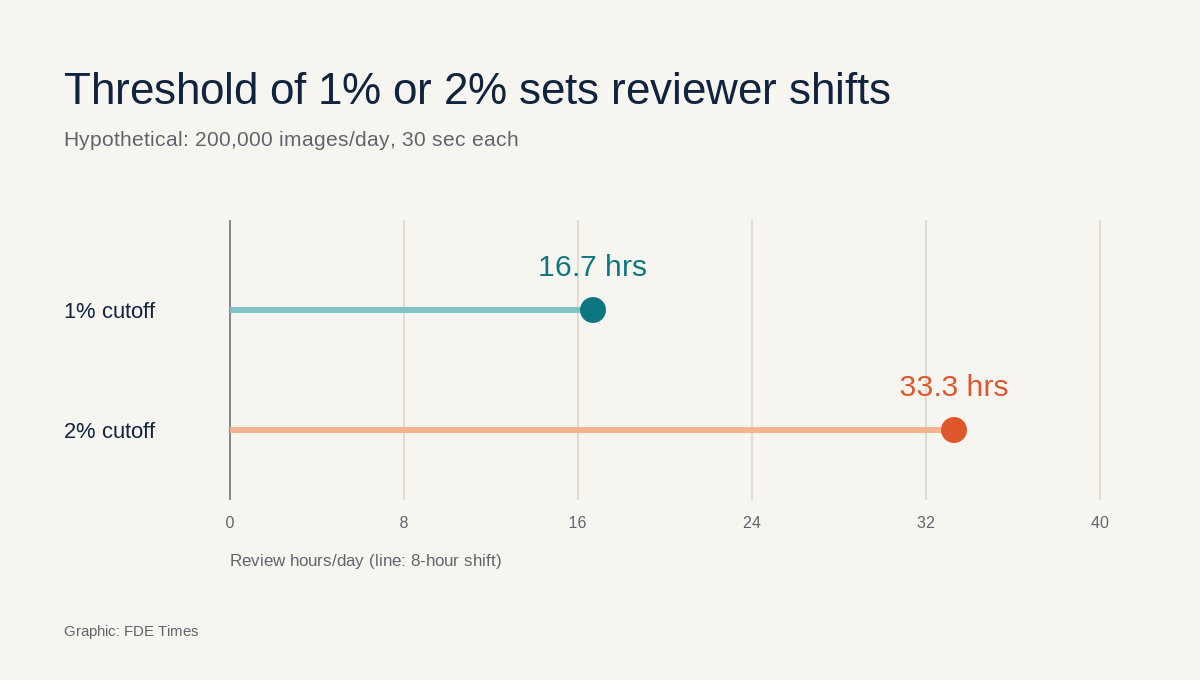
A hypothetical example makes the numbers concrete. A marketplace receives 200,000 images a day and decides to send the 1% with borderline risk scores to human reviewers. That is 2,000 images a day.
If each image takes a reviewer 30 seconds, the total is 60,000 seconds, or about 16.7 hours a day: more than two eight-hour shifts. Raise the rate to 2% and the figure becomes about 33.3 hours. A score threshold is therefore also a staffing decision for the client’s trust and safety team.
The client’s policy has to become code
In the same example, the marketplace may want each category to trigger a different action. Images flagged for CSAM are blocked immediately, suspected violence goes to a review queue, and mild NSFW content is simply logged.
Who sits down with the client, writes those rules out in words and then turns them into testable code? For a role that owns delivery, the most sensible answer is the FDSE.
This is where the homepage’s “few lines of code” meets reality. The API call is still a few lines, but the matrix of categories, thresholds, actions and sync or async paths can pull in hundreds of lines of logic. That logic needs tests, logging, and an engineer the client can go back to when results look odd.
The table below links each promise in the product and the listing to a concrete skill worth practicing.
| What the product and listing say | Skill to practice |
|---|---|
| Integration in “a few lines of code” | Designing API clients with timeouts, retries and idempotency |
| Sync and async requests in the docs | Queues, webhooks, handling asynchronous failures |
| Main point of contact for enterprise clients | Writing short design docs, presenting trade-offs to non-technical people |
| Handling clients’ urgent technical tickets | Reading logs, isolating faults quickly, writing incident reports |
Client-facing, and on call for urgent tickets
The listing is not only about building. It also assigns the rapid handling of clients’ urgent technical support tickets, which means the person who builds an integration is also the one called when it breaks.
The newer listing under the Deploy name asks for experience in technical customer support and in adjusting solutions while working directly with clients. DataCamp uses exactly this line to separate FDEs from pre-sales solutions engineers: the FDE usually owns delivery to production after the contract is signed.
Built In calls the FDE a hybrid role that bridges complex technology and clients actually being able to use it. In interviews, then, candidates are likely to be asked how they would explain a technical trade-off to a non-technical person, as well as how to write a function.
Prepare a specific story, such as a time you read a third-party API’s documentation, found where it did not fit your own system and led the conversation to resolve it.
What to practice before applying
The most worthwhile portfolio project is a small moderation service with both paths. The sync path blocks at upload; the async path works through a backlog with callbacks and retries. Add a README explaining why each type of content takes the route it does.
Include in the README a calculation like the marketplace example above: which threshold sends how much content to reviewers, and how many hours of work that costs. An FDE hiring manager will see at once that you think about the people behind the API, not just the response codes.
On a CV, the line “integrated REST APIs” says almost nothing.
A line such as “designed an async pipeline for a content backlog, with retries and status tracking, then handed it over to the client’s operations team” shows you went all the way from design to handover, the kind of end-to-end ownership Hive’s listing is looking for.
Companies selling AI through APIs will keep advertising that integration takes only a few lines of code. The work behind those lines still needs someone to do it, and that is where the FDE fits in these companies.
Was this article useful?
Thanks for the feedback!
6 sources
- Forward Deployed Software Engineer (Hive, General Catalyst job board)
- Forward Deployed Software Engineer (Hive/Deploy, General Catalyst job board)
- Hive
- Hive API documentation
- What Is a Forward Deployed Engineer? Role, Skills, and Why It Matters · 2026-07-17
- Software Keeps Getting Smarter. Forward Deployed Engineers Make Sure Customers Keep Up. · 2026-02-18