Decagon split its FDE role into lanes, and the boundaries matter most
Wherever an agent's configuration has to leave the UI, Decagon treats that gap as product work, a reflex worth learning for any engineer picking a lane.
In brief
- At Decagon, agent software engineers originally owned each deployment end to end; at scale the work was split across roles such as APM, ADE and agent builders who configure agents through the UI.
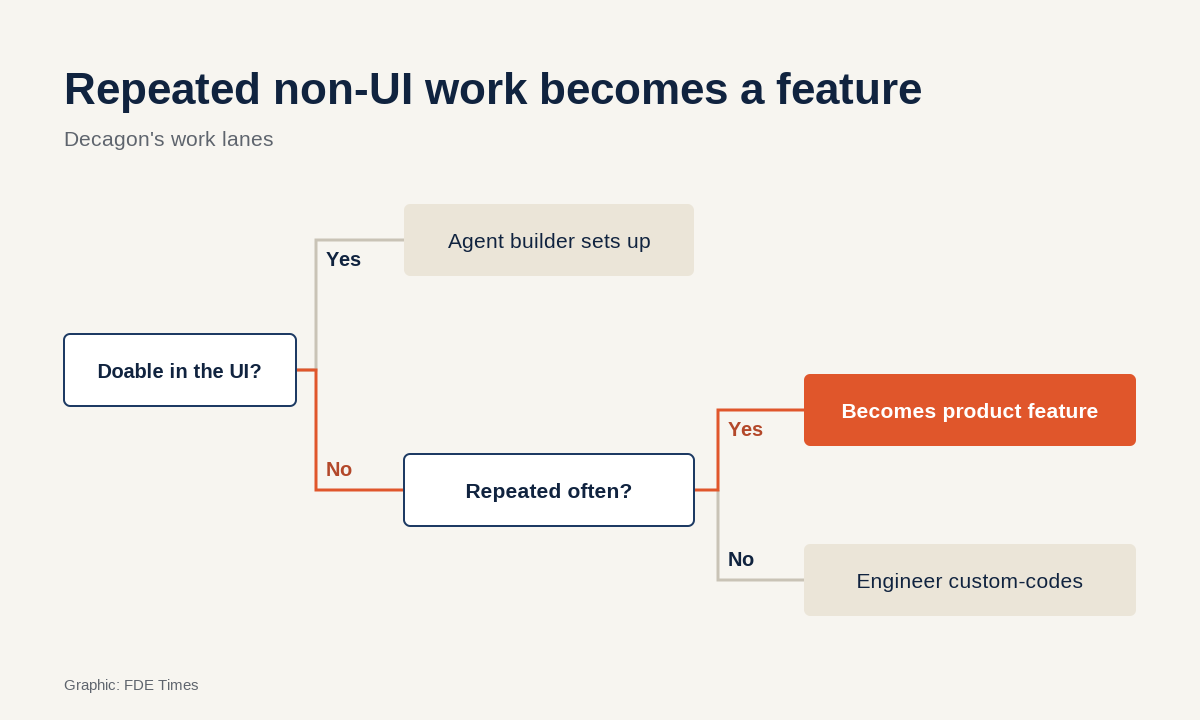
- The boundaries between lanes serve as a product signal: any configuration work that has to happen outside the UI is something the product should learn to do.
- For engineers, the skill worth investing in is counting repeated custom requests and turning them into self-service paths.
Twenty-five hand-written custom integrations in, Decagon’s engineers decided to stop and build a self-service path instead. Sunny Rekhi, the company’s CTO, recalled that moment in a talk at AI Engineer about how the FDE role at Decagon has changed.
StartupHub’s account of the talk says Decagon grew from 50 to 500 employees in a single year, and ties that growth to a restructuring of the FDE role. The engineer who once carried each deployment alone has given way to several specialized lanes, each with its own name and scope.
The consequences for job seekers are practical. At a company that has split the work this way, the hard hiring question is often not whether you can do FDE work but which lane you fit, and whether you know where that lane ends.
One person doing everything does not scale
According to the AI Engineer write-up edited from Rekhi’s talk, agent software engineers handled entire deployments in the early days. In June 2025 Decagon also announced an “Agent Engineer” role, a very broad position spanning engineering, product and go-to-market, following an agent’s whole life cycle from customer discovery to tuning in production.
That all-in model had a cost. Katherine Xiao, Decagon’s Director of Implementations, calls the original approach the “orchestrator” model. She describes each customer generating an endless stream of requests, all of them flowing to the engineering team, and says it was clear early on that this would not scale.
The reason is easy to see. If every request from every customer has to pass through an engineer, headcount in engineering has to grow in step with the customer count. A company that grows its staff tenfold in a year can hardly make every small change to an agent wait in line at an engineer’s desk.
From the 25th integration to 80%
One way out came from the engineers themselves. As Rekhi tells it, after writing custom integrations over and over, they spotted a recurring pattern and chose to build a path customers could use on their own.
Xiao writes that the Agent Development team, set up more than six months before her June 2026 post, has cut custom engineering work per agent by 80%. The figure is self-reported by the company. Xiao also says Agent Development Managers now own nearly all of the agent building that used to require engineers.
Take a hypothetical agent to see what 80% means. If its customization once took ten engineer-days, it now takes two. With the engineering team unchanged, the same time budget covers five times as many agents, which is precisely what the orchestrator model lacked.
Many lanes, named differently by each source
The role names shift slightly each time Decagon describes how it divides the work, so the full picture has to be pieced together. According to the AI Engineer write-up, Rekhi splits the generalist work into two lanes. Agent builders configure agents mostly through the UI, while agent software engineers sit on the front line, fielding product requests from enterprise customers.
The company blog adds another layer. Alex Lewis, formerly a Senior Agent Product Manager and now manager of the Agent Deployment Engineering (ADE) team, writes that complex deployments need different kinds of depth. That led Decagon to form the ADE team: customer engineers who work alongside APMs and customers and own the technical build of the agent.
Lewis draws the line plainly: the APM leads the customer relationship and the larger changes on the customer’s side, while the ADE turns that customer context into an agent ready for production.
A listing for an Agent Deployment Engineer in Australia on a16z’s job board gives the role end-to-end execution of agent builds for strategic customers, working closely with Agent PM, Agent Success, Engineering and GTM.
The table below combines these descriptions. Agent builders and Agent Development Managers are mentioned in different places and are never said to be the same role, so they get separate rows. The last column offers practice suggestions for readers, not descriptions from Decagon.
| Role | Described by | What it owns | Skills to build if you are aiming for it |
|---|---|---|---|
| Agent PM (APM) | Alex Lewis | Leads the customer relationship and larger changes on the customer’s side | Customer discovery, managing expectations, reading a customer’s operating processes |
| Agent builder | Sunny Rekhi | Configures agents mostly through the UI | Conversation flow design, writing evals, deep knowledge of the tool’s limits |
| Agent Development Manager | Katherine Xiao | Owns nearly all the agent building that once needed engineers | As above, plus managing progress across many builds |
| Agent Deployment Engineer | Alex Lewis, job listing | Turns customer context into a production-ready agent; end-to-end builds for strategic customers | Systems integration, handling real customer data, debugging in production |
| Agent software engineer | Sunny Rekhi, Kathryn Zhou | Front line for enterprise product requests; turns one-off requests into core improvements | API design, abstraction, writing code for the shared product |
The boundary is the most valuable part
This division could look like simple tiering: less technical people work in the UI, engineers handle the hard parts. The telling detail is that Decagon uses the boundary itself as a sensor. According to the AI Engineer write-up, whenever configuration has to go outside the UI, that boundary is treated as a signal for product development.
It is the same reflex the engineers showed at the 25th integration, now built into how roles are assigned. The sensible reading: wherever a configurator has to call in an engineer, that spot is a candidate for the UI to learn to handle itself.
This fits how Rekhi positions the engineering lane. He states that at Decagon, forward-deployed engineering is product engineering, with the same engineering standards, the same reporting line and often the same team.
Kathryn Zhou, an agent software engineer at the company, writes that large customers’ specific requests are treated as opportunities to improve the core product, citing the company’s work with Block as an example.
If you work on the front line, ask yourself a harder question than whether the customer’s request is solved: will this solution help the next customer without anyone writing more code?
Choose your lane before the company chooses for you
The growth and efficiency figures here come from Decagon itself or from a secondhand account, and there is no clear timeline for each step.
Even so, the pieces add up to a sequence worth studying: engineers owning whole deployments, requests piling up in engineering, self-service tooling arriving, and the work then splitting into lanes.
When reading a job listing, look at which teams the role works with. When the list runs long, as with APM, Agent Success, Engineering and GTM, the work has likely been divided, and you need to say clearly which lane you stand in.
If you are aiming for the engineering lane, the skill most worth investing in is spotting repetition. Log every time you have to write code outside the standard tooling for a customer. When the same kind of request shows up a third or fifth time, propose turning it into configuration or a feature.
On a CV, a line such as “consolidated N custom integrations into one customer-configurable connector,” with N as your real number, says more than ten lines listing technologies. It shows an interviewer exactly the reflex Decagon’s team had when it reached its 25th hand-written integration.
The generalist role is still the way into the profession. But Decagon’s story suggests that an FDE’s lasting value lies in knowing which work should never have to be done by hand again.
Was this article useful?
Thanks for the feedback!
7 sources
- how decagon is redefining forward deployment · 2026-06-22
- Decagon's CTO on Forward-Deployed Engineering · 2026-07-28
- How Forward Deployed Engineering is done at Decagon
- Getting closer to the build: How I helped create agent deployment engineering · 2026-08-12
- Inside Agent Engineering at Decagon · 2026-05-11
- Introducing the Agent Engineer: Where AI meets real-world impact · 2025-06-05
- Agent Deployment Engineer (Decagon) · 2026-11-16