FDE job ads spell out the travel but rarely say who pays for it
Before comparing two offers, pin down the travel expense policy, because every cost the company does not reimburse comes out of your own pocket.
In brief
- FDE job ads usually state a travel rate of 25–50% but seldom say who pays; Genlogs is a rare case that commits to 100% reimbursement.
- A benefits line such as a commuting budget or an all-expenses-paid offsite does not answer the question of who pays for customer trips.
- In the US, unreimbursed business travel is now barely deductible for most employees, so ask explicitly and get the answer in writing.
Foxglove’s FDE job ad is blunt: the role requires 25–50% travel to customer sites.
Just below, the benefits list includes all-expenses-paid company offsites and a $300 monthly budget for commuting or workspace.
But not a single line says who pays for the flights and hotels when you fly out to a customer.
Foxglove is not unusual. Tungsten Automation’s ad for an FDE (Churn Prevention) states 30–40% travel for strategic on-site engagements with customers and says nothing about costs. Relevance AI puts “Travel Required” in the job title itself and may send you onsite for up to three months, yet it too is silent on who pays.
For an FDE, travel is a core part of the job. An industry guide on fde.academy estimates the rate is typically 25–50%, depending on the company and the sector.
So when you set two offers side by side without knowing the expense policy, the salary figures you are comparing may be wrong. Ask about travel costs first, then talk about pay.
Every ad states the rate, almost none says who pays
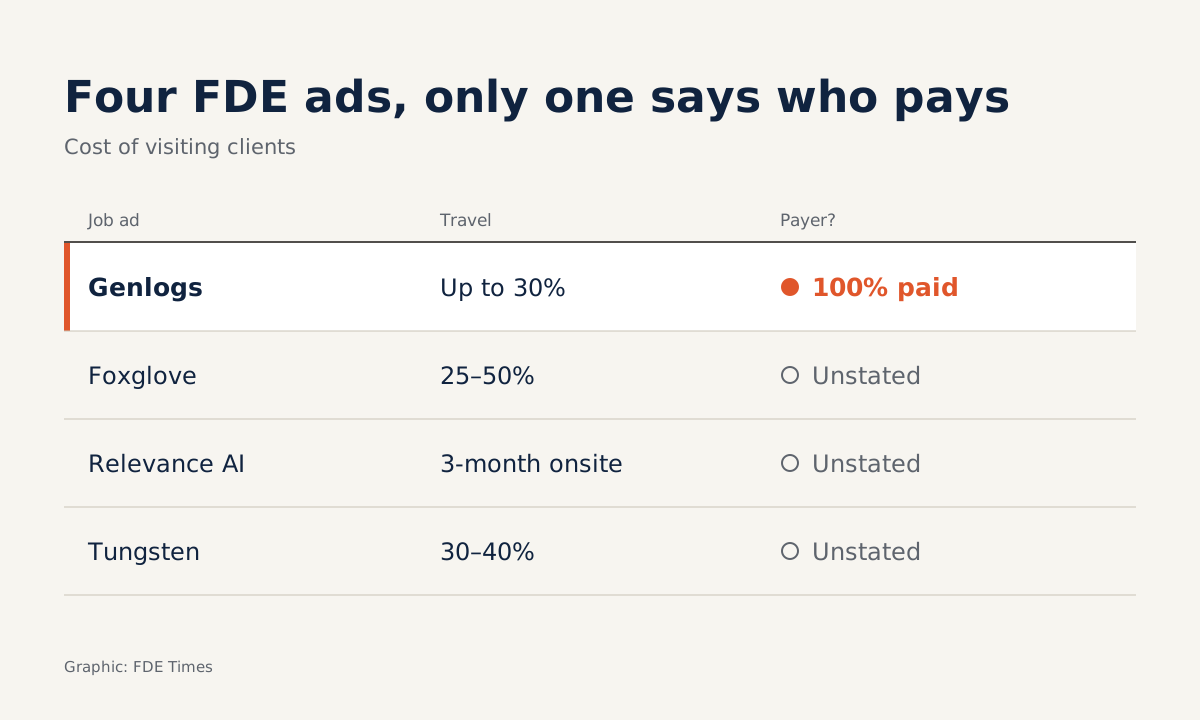
Put four FDE job ads next to each other and the pattern is clear. The travel rate is stated fairly precisely. Only one ad spells out the expense policy.
| Job ad | Travel rate stated | Expense line in the ad | Customer travel costs addressed? |
|---|---|---|---|
| Genlogs | Up to 30% | 100% reimbursement for all approved company travel and spending | Yes |
| Foxglove | 25–50% to customer sites | All-expenses-paid company offsites, $300/month for commuting or workspace | No |
| Relevance AI | No rate given, onsite for up to three months | Pre-tax deductions for public transit fares and commuter parking | No |
| Tungsten Automation | 30–40% for strategic onsite engagements | None | No |
Genlogs stands out because two pieces of information sit together: a travel ceiling (“up to 30%”) and a commitment to reimburse 100% of costs for approved trips. There is both a limit and someone responsible for the bill, so candidates know the terms they are accepting. The other three give you only half of that.
The way the rate is expressed also varies. “Up to 30%” is a ceiling. “25–50%” is a range whose upper end is double its lower end. In the comparison table in the fde.academy guide, Palantir is listed at about 25% of time onsite with customers, but that page does not say who pays for travel or whether there is a per diem either.
A benefits line can mislead you
The trap here is not that the ads are silent, but that some lines look as if they answer the question. Relevance AI’s ad has an expenses item: you get pre-tax deductions for public transit fares and parking. That is a daily commuting benefit, not the cost of flying out and living next to a customer for three months.
Foxglove is the same. An “all-expenses-paid offsite” is an internal company gathering. The $300 monthly budget is for commuting or workspace. Both are real benefits, but neither says anything about the travel that may take up half your working time.
The skill needed here is the one an FDE uses with customers every day: separating what is written from what you are assuming. When you read a customer’s requirements document, you ask what each line actually commits to. The benefits section of a job ad deserves the same scrutiny.
Unreimbursed costs are money you really lose
US tax rules show why this is no small matter. According to IRS Publication 463, if an employee accounts fully to the employer, is reimbursed in full and returns any excess, neither the expenses nor the reimbursement need to appear on their tax return. This is the logic of an “accountable plan”, a reimbursement policy backed by proper documentation.
When the company does not reimburse, two rules in the same document lead to one outcome: you bear the cost. Because miscellaneous itemised deductions subject to the 2% floor are suspended, unreimbursed business travel expenses are no longer deductible for most employees.
On meals specifically, Publication 463 states that the 50% limit still applies when they are not reimbursed, including meals on business trips.
Consider a hypothetical calculation. In a five-day working week, 30% travel is about a day and a half per week. If on each travel day you pay for a $40 dinner yourself without reimbursement, ten such weeks come to 15 days, or $600 out of your own pocket, before taxis or excess baggage.
At 50%, the same calculation gives 25 days and $1,000 after ten weeks; a three-month onsite stint like the one in Relevance AI’s ad pushes the figure higher still.
Tax rules differ from country to country, so if you work outside the US, ask a tax professional where you live. But the main point holds everywhere: unreimbursed costs come straight off your real income.
Five questions to ask before comparing salaries
The first is the simplest: who pays for customer travel, the company or the customer, and is it reimbursed in full? Genlogs has written “100%” into its ad, so that level is a reasonable expectation, not a favour. If the recruiter answers “it depends on the project”, ask how the most recent project was handled.
The second is cash flow: do you have to front the money and wait for reimbursement, or does the company book travel and issue a corporate card? How long does reimbursement take? An engineer who has just changed jobs and has to front several flights in a row is giving the company an interest-free loan.
The third is per diem versus actual expenses. A per diem is a fixed daily amount, easy to calculate but possibly not enough in an expensive city. Reimbursement of actual costs is more accurate, but you must keep receipts and file claims through the proper process, in the manner of the accountable plan described above.
The fourth drills into the word “approved”. Genlogs’ commitment applies only to “approved” travel and spending, so for any offer with a similar condition you should ask: who approves, is approval before or after the trip, and which items are typically rejected?
A policy that is generous on paper but has an opaque approval process can still leave you paying.
The fifth is for long onsite stints. Three months at a customer site means asking about long-term accommodation, flights home mid-stint, and whether “25–50%” is measured by the week, the quarter or the year. An annual average can hide a quarter in which you are barely home.
Asking the right questions is itself a show of competence
Many candidates hesitate to ask about money for fear of seeming difficult. For an FDE role the opposite is true: someone who clarifies terms before committing is exactly the person you want to send to a customer. The way you ask about travel policy, calmly, specifically and in writing, shows an employer in advance how you will approach customer discovery.
In practice, send your questions to the recruiter by email rather than only asking verbally, and ask for the expense policy to be included in the offer letter or attached as a policy document. When comparing two offers, do not simply line up two salary figures. Compare salary minus the costs you estimate you will pay yourself, based on each employer’s travel rate.
If you are building a portfolio or preparing for interviews, you can describe this very approach as an example of reading requirements and clarifying scope before starting work. It is the skill FDE employers look for, and you have just applied it to your own contract.
The travel rate tells you how much time you will spend away from home. Who bears the cost is usually something you only find out by asking.
Was this article useful?
Thanks for the feedback!
6 sources
- Why Do Forward Deployed Engineers Travel? · 2026-07-25
- Forward Deployed Engineer @ Genlogs | Venrock Job Board
- Full-Stack Engineer, Forward Deployed @ Foxglove | Eclipse Job Board
- Forward Deployed Engineer - Travel Required
- Forward Deployed Engineer – Churn Prevention
- Publication 463 (2025), Travel, Gift, and Car Expenses