Red Cell wants FDEs who own the job until the customer signs off
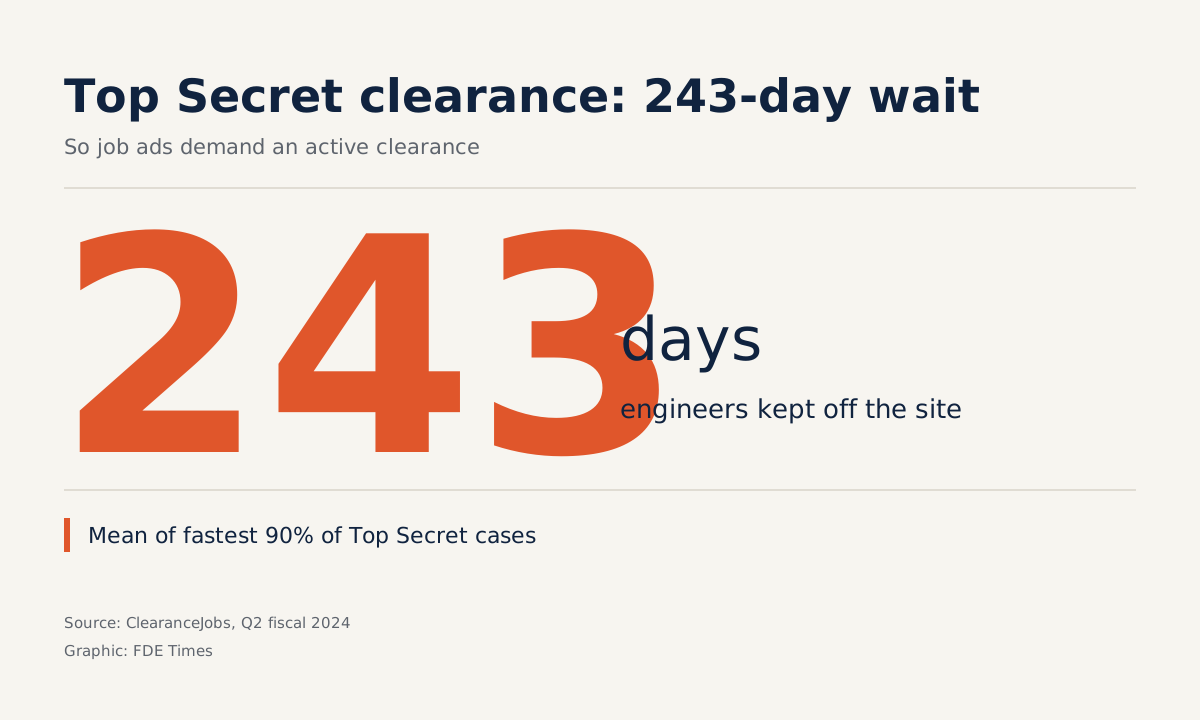
The way in is an active clearance, and at Top Secret level even the fastest 90 per cent of cases took an average of 243 days.
In brief
- Red Cell Partners' FDE posting makes the engineer responsible from prototype to production, through deployment and on to customer acceptance.
- The version of the posting reviewed requires US citizenship and an active Secret clearance. A similar role at Vannevar Labs requires TS with SCI eligibility.
- According to ClearanceJobs, in the second quarter of fiscal 2024 the fastest 90% of Top Secret cases still took an average of 243 days.
Most Forward Deployed Engineer postings describe what you will build. Red Cell Partners’ FDE posting for its federal and national security work goes further: the engineer is responsible for taking the product from prototype to production, and then through deployment and “customer acceptance”, the stage at which the customer formally signs off.
The role sits inside a new national security incubation effort at Red Cell that is operating in stealth. The company describes itself as a company builder that creates, runs and scales the “mission-critical” businesses of the future.
The person hired is therefore closer to a founding engineer in a young venture than to a contractor picking up work on a programme that has run for years.
Whether or not you plan to apply, the posting rewards a close reading on two counts. It redefines what “done” means for an FDE. And it shows that the ticket into defence work is measured in days of waiting and in citizenship, not only in skill.
“Done” is when the customer signs, not when the code runs
Many engineering roles stop at production: the system is live, the dashboard is green, the ticket is closed. Deployment in the customer’s environment goes one step further. Acceptance is different in kind, because the person who declares the work “done” is no longer you but the customer.
Imagine building a report-aggregation tool for a military unit. The prototype impresses in the demo, and in production it runs smoothly on sample data.
Deployed onto the customer’s network, it meets an old file format nobody mentioned, an approval step wedged into the middle of the pipeline, and an end user who finds the summary missing the one field he needs most.
An engineer whose responsibility ends at production treats those three issues as “new requirements” and passes them to someone else. An engineer responsible through acceptance has nowhere to pass them: each is an unmet criterion, and the project is not finished until the customer signs off.
So the first job at the customer is not drawing up an architecture. Sit down with the person who will sign off and write down, in their words, what must be true before they sign, each criterion paired with a check both sides can run. That list is your real technical contract.
Vannevar shows this is a template, not an exception
Vannevar Labs’ FDE posting describes almost the same model: engineers design, build and own software deployed directly into the customer’s environment, and act as the main technical point of contact. The two postings differ mainly in the way in.
| Aspect | Red Cell Partners | Vannevar Labs |
|---|---|---|
| Context | New national security incubation effort, in stealth, inside a company builder | FDE role for customers with security requirements |
| Scope of responsibility | From prototype to production, deployment and acceptance | Software deployed directly into the customer’s environment, engineer as main technical point of contact |
| Clearance | US citizenship, active Secret clearance (in the version reviewed) | Active TS, with SCI eligibility |
| Location | Preference for the Washington, DC area, Northern Virginia or places with many military installations | Remote, with 20–30% travel to work in person with mission owners |
The biggest thing they share is not technology. Both want engineers close to real users, one by choosing people who live near military hubs, the other through a heavy travel schedule. It is hard to see acceptance through by email alone.
The word “active” shifts the wait onto the candidate
It is easy to assume every defence FDE role demands TS/SCI. The version of the Red Cell posting reviewed lists only Secret, although some versions on other aggregator sites reportedly list a higher level, so the requirement varies by version. Vannevar is explicit: you must hold an active TS and be eligible for SCI.
The word to watch in both postings is “active”. The companies do not write “able to obtain a clearance”; they want you to hold one already. The reason is time: ClearanceJobs reports that in the second quarter of fiscal 2024 the fastest 90% of Top Secret cases still took an average of 243 days, and the remaining 10% took longer.
That figure applies directly to roles like Vannevar’s; Red Cell’s Secret level has different processing times. But the logic is the same. A venture that needs someone in front of the customer early, to carry a prototype through to acceptance, will not want to pay for all those days an engineer cannot yet get on site.
The conclusion for those without a clearance is blunt: however good your skills, roles that require TS stay closed to you for months. If you already hold a clearance and have carried a project through acceptance yourself, you are exactly the combination both postings are looking for.
What if you are not a US citizen?
Many readers will stop at that line, and that is fine.
The lesson worth keeping is the scope of responsibility: any customer who must sign off in front of their own superiors or regulator needs exactly the kind of engineer Red Cell and Vannevar describe.
That changes how you write a CV. “Deployed an analytics system for a client” tells a recruiter very little. “Owned an analytics system from prototype to customer acceptance sign-off, against five criteria agreed in the first week” shows you understand “done” the way the customer does.
When reading a job description, search for “acceptance” and “own delivery” and note where the responsibility stops. A posting that stops at production is hiring a builder; one that reaches acceptance is hiring someone to own the outcome. For the second kind, have a story ready about a project that nearly failed sign-off and how you handled it.
A clearance depends on citizenship and on a process outside your control. The habit of writing acceptance criteria on day one is the opposite: with any customer, in any country, you can start practising on your next project.
Was this article useful?
Thanks for the feedback!