NCS wants more than 300 FDEs in two years. Who will guide the 200-plus new engineers?
News reports of NCS's plan do not say who will be in charge of the new engineers. That is the first thing to ask when you meet a fast-growing FDE team.
In brief
- NCS wants to grow its iFDE team from 100 to more than 300 people in two years, by retraining existing staff and hiring from outside.
- News reports of the plan do not name anyone in charge of guiding the new engineers, so the quality of mentoring is the big question for newcomers.
- The "domain-savvy" part of the iFDE definition suggests a CV should show real business constraints, not just a list of frameworks.
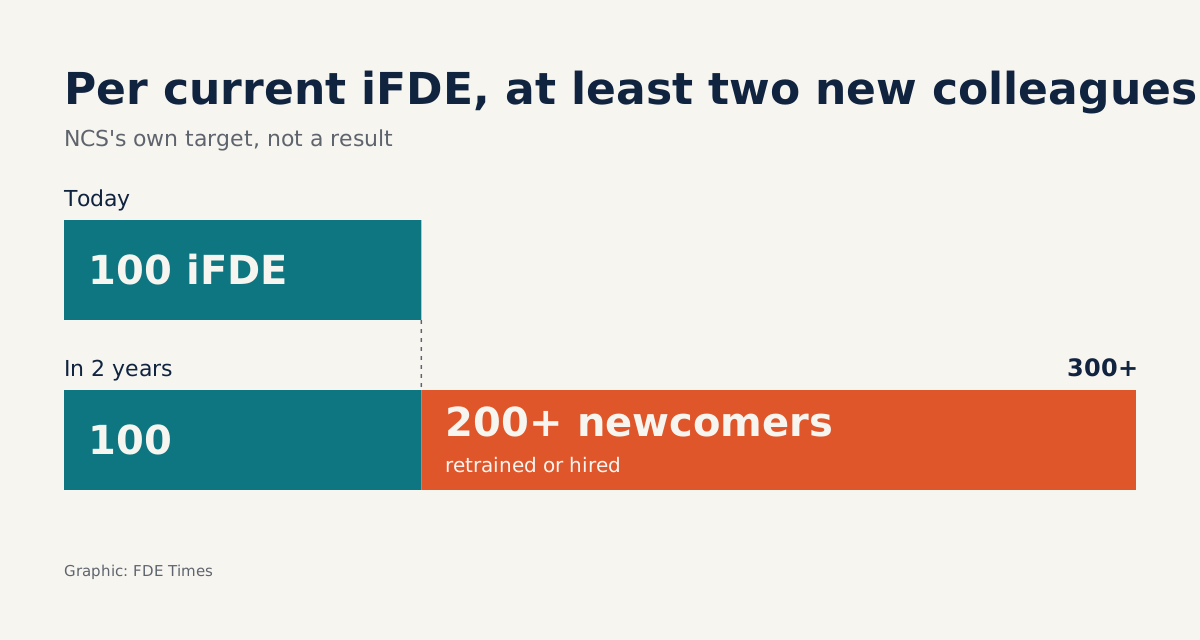
NCS wants more than 200 additional AI deployment engineers within two years, and not all of them will come from the job market.
In late October the company launched its AI Mission Centre, along with a pledge to grow its iFDE team, its forward-deployed engineers, from 100 people to more than 300. The figure comes from NCS’s own press release, so for now it is a target the company has set itself, not a result.
The new engineers will come from two places: existing employees who are retrained, and hires from outside. Liew, the NCS representative quoted in the company’s release, called the expansion an investment in its “greatest asset”.
Edward Chen, NCS’s chief AI officer, spoke at the launch, but reports of the event do not name anyone responsible for the new cohort of engineers.
If you are hoping to move into FDE work, the plan shows that internal retraining is another way into the job, although here that route is open only to people who already work at NCS.
The plan is also tied to a larger ambition. “We want Singapore to be where the world comes to see AI working at scale,” Liew said. If that happens, the way NCS organises its iFDE team will be worth watching for engineers in other countries too.
Tripling a team is a mentoring problem
Break the figure down by month. Adding 200 people in 24 months works out at an average of more than eight a month, and every current iFDE would be matched by at least two new colleagues.
That calculation is not NCS’s plan, but it points to the risk you should care about. By NCS’s own definition, iFDEs work inside the client’s team, so new engineers will very likely learn the job there. If they are sent into the field too fast, job titles will grow faster than skills.
So when you meet a team expanding like this, do not just ask how many people they are hiring. Ask how retrained staff and outside hires are split, who will work alongside you on your first project, and how long it takes before you own part of the client work yourself.
Where will “vendor-agnostic” be tested?
NCS describes iFDEs as domain-savvy, vendor-agnostic AI specialists who work inside the client’s own team. This is NCS’s own term, so it may not match exactly how the rest of the industry uses the label.
The promise deserves a close reading because NCS also has a platform of its own. Sunshine.core is presented as a “sovereign-ready” platform for building, running and governing enterprise agents; put simply, it is built for clients who need to keep control of their own data and systems.
The two need not conflict: a company can own a platform and still choose tools to fit the client’s needs. The test lies in specific cases. When a client’s problem is better suited to another tool, are iFDEs free to say so? Ask the recruiter for an example that has actually happened.
Domain knowledge means knowing the cost of each kind of error
The “domain-savvy” part of NCS’s definition only becomes clear in a concrete case. Imagine you are given a system that detects foreign objects on an airport runway; this is a hypothetical example, not an NCS project.
A false alarm can send the operations team out to inspect the runway, while a miss is a safety risk. The alert threshold therefore cannot be settled on a single model metric; you have to sit down with the operators to learn how costly each kind of error is.
That is what your CV should show. Pick an area you already know, such as healthcare data, operational systems or manufacturing.
Instead of listing frameworks, describe a constraint that real users faced, the technical decision you made because of it, and how you verified the result.
A headcount target is not a system running in production. What counts after two years is not 300 people, but how many of those engineers have put a system into the hands of a client’s real users.
Was this article useful?
Thanks for the feedback!
6 sources
- NCS aims to build workforce of more than 300 AI engineers by 2028 · 2026-11-02
- NCS launches AI Mission Centre, commits to building a workforce of more than 300 Forward-Deployed Engineers · 2026-10-29
- NCS Opens AI Mission Centre, Plans 300 AI Engineers · 2026-10-29
- NCS Launches AI Mission Centre, Plans 300 Forward-Deployed Engineers · 2026-10-29
- NCS launches AI Mission Center
- NCS Opens AI Mission Centre in Singapore, Plans to Expand AI Engineering Workforce to Over 300 · 2026-10-30