Kuken Kogyo cuts drawing lookups from half a day to 4.5 minutes
The 90% annual saving is a forecast, not a measurement, and an FDE should never put the two in the same sentence.
In brief
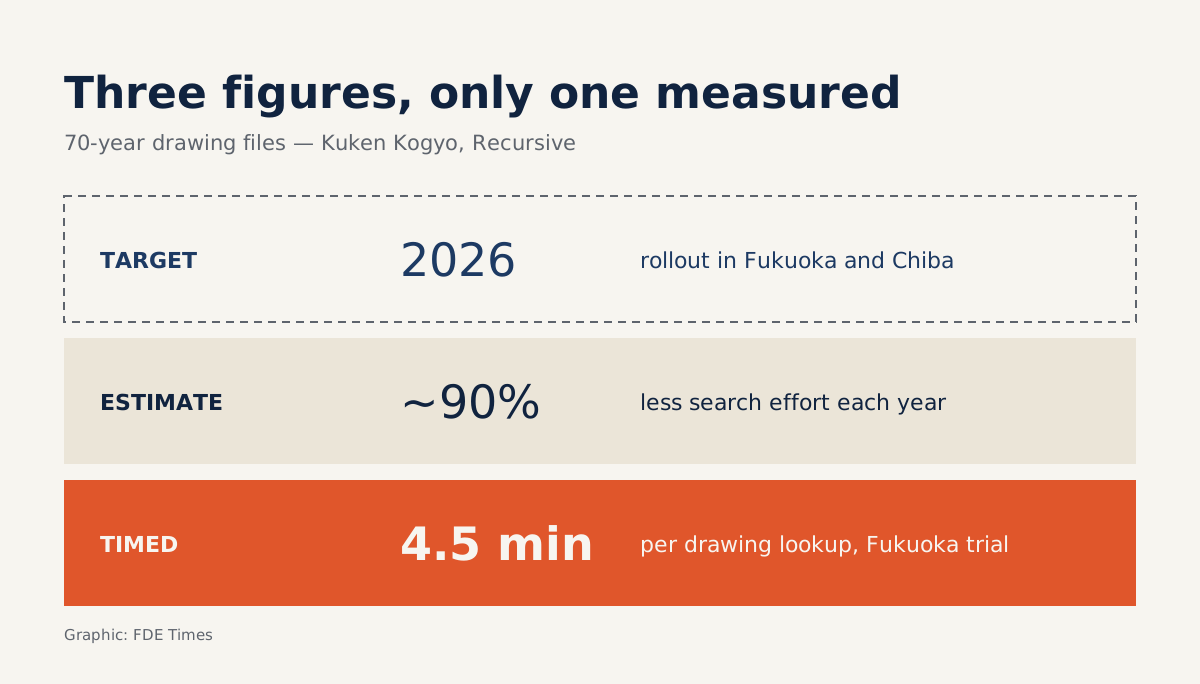
- In the pilot at the Fukuoka plant, each drawing search took 4.5 minutes on average. It used to take anywhere from tens of minutes to half a day.
- The saving of about 90% of annual search effort is an estimate based on last year's data, not a measured result.
- Full rollout at the Fukuoka and Chiba plants during 2026 is still a target.
At Kuken Kogyo’s Fukuoka plant, finding an old drawing in an archive built up over more than 70 years used to take anywhere from tens of minutes to half a day. In a pilot of the system the company developed with Recursive, the average fell to 4.5 minutes.
Kuken Kogyo is an air-conditioning equipment maker headquartered in Fukuoka and the market leader in cooling towers in Japan. Recursive is an AI solutions company based in Shibuya, Tokyo.
According to MONOist, the system is built on the OpenAI API and does two things: it searches drawings and it checks them. Recursive published the pilot results on 4 November in a joint development announcement.
For FDEs the news is worth reading for two reasons. This is exactly the kind of project you are likely to be handed at a manufacturing customer. And the way the two companies presented their numbers shows clearly where measured results end and promises begin.
Which numbers were measured, and which are forecasts?
Read closely, the announcement contains three kinds of figures. The 4.5 minutes is a real measurement from the Fukuoka pilot, as South Korea’s TokenPost reported separately. Even so, the Japanese outlet covering the project still describes this average as “expected”.
The second figure is a reduction of about 90% in annual search effort. That is an estimate based on last year’s data, not a measured result. The third kind is the rollout schedule: Kuken Kogyo aims to put the system into full use at its Fukuoka and Chiba plants during 2026. That remains a target, not a confirmed timeline.
A hypothetical calculation shows where the 90% might come from. Suppose a lookup used to take 45 minutes on average. Then 4.5 minutes is exactly 10% of the old time, a 90% reduction.
But that arithmetic holds only if the number of lookups per year stays the same, conditions at Chiba match those at Fukuoka, and engineers actually switch to the tool. None of those assumptions can be tested until the system is fully deployed.
Why drawing archives are FDE territory
A factory that has run for more than seven decades holds drawings and technical documents that no off-the-shelf model has seen. To solve this problem you have to sit next to the engineers and watch what they look for and why it takes half a day.
The first discovery question to ask is: when engineers start a search, what do they remember about the drawing? If they remember a product code, a customer name or the year of the project, the problem leans towards cleaning and exploiting metadata.
If all they remember is something like “a part that looks like this”, you need search by visual similarity, which is much harder and more expensive.
The quick way to find out is to record the first clue in every real lookup you time. Only then decide how the system should search. That is the job of the person sent on site, not of a product team sitting far away.
One detail stands out: the system also checks drawings rather than stopping at search. If you take on a similar project, expect the customer to want the next step in the workflow automated as well once search works. Ask about that step in the very first discovery session.
How to report pilot results honestly
The first thing to do at a customer is to measure a baseline before writing a line of code: time real lookups and record the range. The joint announcement published by Recursive carries weight precisely because it gives a reference point of “tens of minutes to half a day”. Without that baseline, the 4.5 minutes proves nothing.
When you put a project like this on your CV or describe it in an interview, use the same three layers: where it was tested, what was measured, and which parts are still estimates. A good FDE recruiter will probe exactly there. A candidate who separates these layers from the outset shows they understand that proving value is harder than building a demo.
Kuken Kogyo’s real test will come at Chiba, where the 4.5-minute figure has to be measured again from scratch.
Was this article useful?
Thanks for the feedback!