At OpenAI, an FDE's job ends only when customers use the product
The San Francisco posting requires up to 50% travel and makes adoption, not handover, the engineer's own responsibility.

In brief
- OpenAI's San Francisco FDE posting gives the role technical ownership of several deployments, from prototype to stable production.
- The role is also responsible for adoption, and asks for 5+ years' experience, experience with LLMs and up to 50% travel.
- OpenAI's deployment business is growing its FDE headcount fast, including through acquisitions such as Northslope in July 2026.
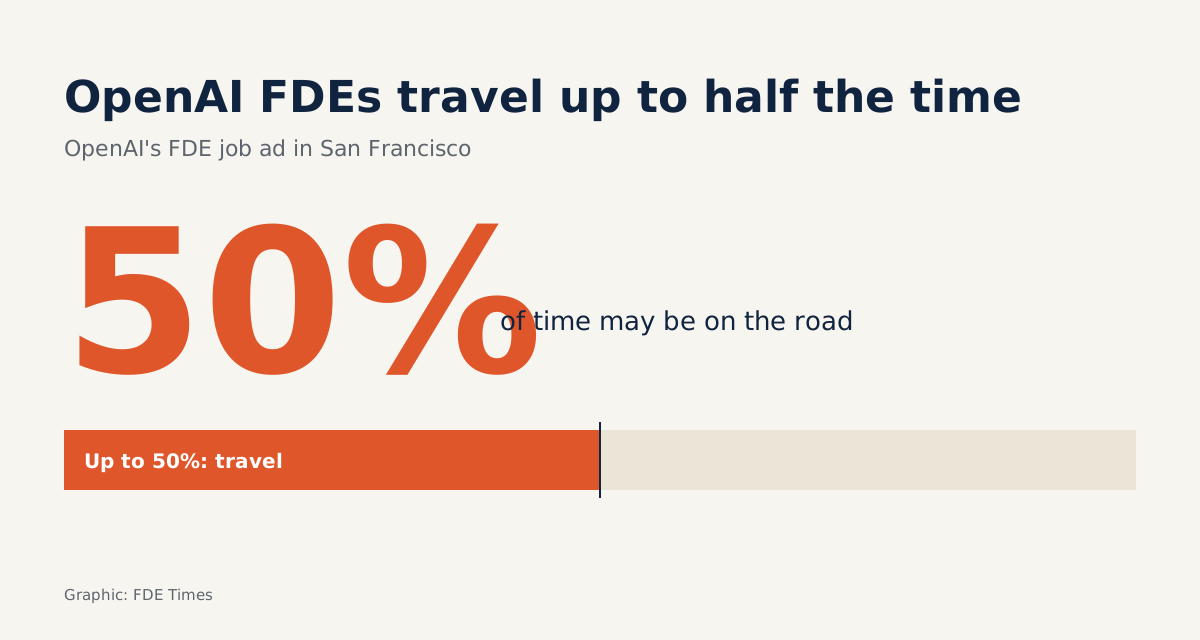
Up to 50% of the time is spent travelling. OpenAI’s posting for a Forward Deployed Engineer in San Francisco states this plainly, as a firm requirement. That one line says a lot about the job: half your working time may be spent in the customer’s office, not your own.
OpenAI has also just published a post on what forward deployed engineering means at the company.
If you work as an FDE or want to move into the role, this job description repays a close reading. It shows what a leading model company measures when it judges an engineer who works with customers.
The work is not finished when the code runs
The posting gives the FDE technical ownership of several deployments, from the first prototype until they run stably in production. The next sentence is the more interesting one: the FDE must work closely with customer teams, understand what they need, and then guide them in putting what has been built to use.
Picture building an agent for a customer’s insurance claims department. The demo works by week two, and the system reaches production in month three. If staff are still handling claims by hand because they do not trust the agent’s output, then by the adoption requirement in the posting, the job cannot be counted as done.
Adoption is therefore part of the engineer’s work, not someone else’s problem after handover. On joining a project, the first thing to ask is who will use the system every day, and to agree from the outset what sign will show that they are using it.
Not support, not account management
An analysis of OpenAI’s deployment model on DEV Community makes the point directly: an FDE is not a support engineer, and not an account manager either.
The author describes the FDE as someone with a long-term attachment to the customer, who both builds hands-on and acts as a bridge between the capabilities of the most advanced models and the operational reality of a business.
This is a community view, not an official OpenAI definition, but it is consistent with the posting.
AI Weekly takes a similar view: FDEs are people who work inside the customer’s organisation. According to the site, OpenAI’s deployment business is growing its FDE headcount partly through acquisitions, specifically the purchase of Northslope, a company with roots in Palantir, in July 2026.
AI Weekly argues that OpenAI is building its FDE team so quickly that long-established consultancies could not keep pace if they relied on hiring alone.
For job seekers, that cuts two ways. The demand for hires is real and growing. But the advantage will most likely go to people who have taken systems into production, not those who stopped at the demo.
Read the posting as a skills checklist
The posting asks for 5+ years of experience and experience working with LLMs or generative models. If you are short on years, what you can control is the quality of your evidence. A CV line such as “built a RAG pipeline in Python” says almost nothing.
Go back to the insurance claims agent above.
The rewritten CV line might read: “Took a claims lookup agent from prototype to production; the claims department uses it daily in place of manual lookup; tracked the weekly share of claims handled through the agent.” That sentence answers all three questions the posting implicitly asks: did it reach production, who uses it, and how much.
The travel requirement deserves serious thought too. If spending half your time at customer sites does not suit your circumstances, raise it directly in the first round with any company hiring FDEs, in any country.
OpenAI may define the FDE in many ways. But if you read the posting as an exam question, the one to have an answer ready for is this: is anyone actually using a system you have built?
Was this article useful?
Thanks for the feedback!