How to write an RFC the client's change board won't send back
Change boards ask the same few questions about every change, so answer them up front, then push for repeatable deploys to be approved automatically.
In brief
- According to the Accelerate research, external approval is associated with slower releases and is not associated with a lower change failure rate, but FDEs still have to work within the client's process.
- CABs ask the same few questions over and over, so an RFC that answers risk, impact, schedule, implementation and rollback in advance gets through quickly.
- Over time, ask for repeatable deploys to be classed as standard changes, backed by peer review and a pipeline.
The Accelerate research set out to measure whether external change approval goes hand in hand with safer production. It found no sign that it does.
As Harness summarizes it, external approval was associated with longer lead times, less frequent deploys and slower recovery from incidents, while it was not associated with a lower change failure rate.
That is a correlation, not proof of cause. But it is enough to show that an extra approval step does not automatically make production safer.
FDEs, however, do not get to choose the client’s process. At many large enterprises, your deploy still has to go through a Change Advisory Board, or CAB, whatever the data says. The familiar story: the code is done, the demo works, and then the RFC is sent back at the end-of-week meeting because the “rollback is unclear”. That costs another meeting cycle.
The skill here is asking for approval in a way that lets reviewers decide after a single read, and then gradually moving repeatable changes off the meeting agenda. Arguing with the board will not get a deploy out a day sooner. A well-written RFC can, and across many meeting cycles it shapes the timeline of the whole engagement.
What does a CAB actually want to know?
DORA, the research group that studies software delivery performance, says plainly that centralized approval through a board can cause delays and tends to come with errors, and that heavyweight approval processes like these often slow releases down.
According to Octopus, CAB meetings often slide into rubber-stamping, with everyone asking the same one or two questions about every item. For an FDE, that is useful: if the questions are predictable, you can answer them in advance.
AWS’s documentation on change management sets out the standard: a change request must contain enough information for the person with authority to approve or reject it. AWS’s sample RFC template includes identified risks, impact, schedule, implementation and a rollback plan. Rollback is basic: every request must have one.
Read those five sections as five questions from someone who knows nothing about your system. What could break? Who is affected if it breaks? When will it happen? How will it be done? If it breaks, how do you go back? One missing answer is enough for them to push it to next week.
An RFC rewritten from scratch
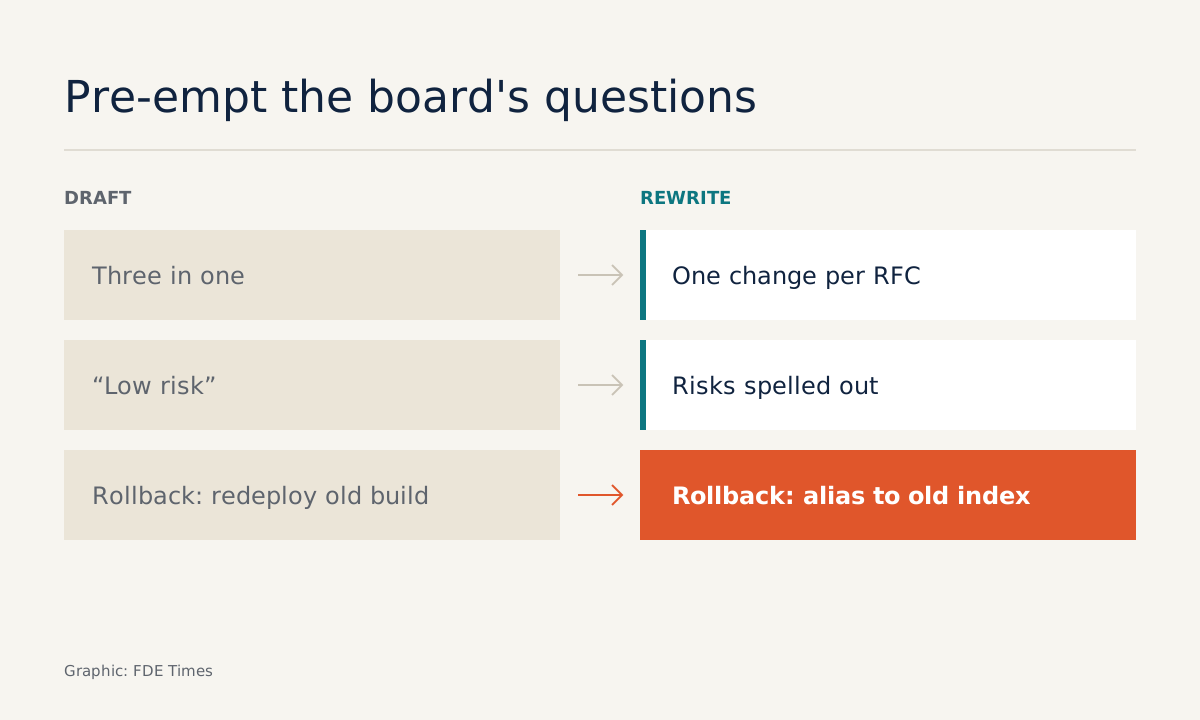
Take a hypothetical example. You need to ship an update to a client’s internal support agent: a new prompt, a new document source added to the retrieval index, and a version bump to the library that calls the model. The first draft lumps all three into a single RFC that reads “agent upgrade, low risk, rollback by redeploying the old version”.
That draft will almost certainly come back with questions. “Low risk” is an assertion, not evidence. “Redeploy the old version” does not say how documents already added to the index will be removed. And three changes in one place leave the reviewer unsure what exactly they are being asked to assess.
The first step is to split. Octopus recommends reviewing small sets of changes, and the advice holds for CABs too. Three changes become three RFCs, or at least three independent sections, each with its own rollback. The RFC for the index change would look like this:
RFC: Add the HR policy document set to the support agent's retrieval index

Identified risks
- The agent may cite outdated documents if the new set overlaps with the existing one.
- Indexing time increases; while it runs, queries still read the old index.

Impact
- Only users of the internal support agent. No business databases are touched.
- No change to access rights; the documents belong to a group already cleared for reading.

Schedule
- Tuesday, off-peak. On call: [FDE name] and [client engineer name].

Implementation
1. Build the new index in parallel, without overwriting the old index.
2. Run the fixed eval suite against the new index; switch only if it meets the agreed threshold.
3. Point the alias at the new index.

Post-deployment checks
- Rerun the sample question set and compare results with the previous run.

Rollback
- Point the alias back at the old index (kept intact for at least 7 days). One command, no redeploy needed.

Peer review
- Link to the pull request approved by [reviewer name].
Look at the rollback section. It makes no vague promise; it describes one specific, reversible action, because the deployment design left a way back: the old index stays intact and only the pointer changes. If you cannot write a rollback section that short, the problem lies in the deploy design, and no amount of wording in the RFC will fix it.
From the meeting table to standard change
A good RFC only gets you through one meeting at a time. The long-term goal is to need fewer meetings. AWS defines a standard change as one that is familiar, low risk and well understood, and so does not need a formal review and approval process. AWS also recommends that repeatable, low-risk tasks be classed as standard and approved automatically.
Prompt updates and scheduled index refreshes are strong candidates. After a few smooth passes through the CAB with the same RFC template, you have the evidence for a proposal: this type of change always follows the same steps, rolls back the same way and has never caused an incident.
That proposal needs something to replace the board’s stamp. DORA suggests peer review, recorded directly on the team’s development platform, to meet the requirement for segregation of duties.
The Harness piece supplies the other half: a lightweight approval process based on peer review, paired with a deployment pipeline that detects and blocks bad changes on its own. The eval suite that runs before the alias switch in the example above is one piece of that pipeline.
What about emergencies? AWS notes that emergency changes must still follow a documented process, only through a smaller approval group called the Emergency CAB (ECAB). Ask in advance who sits on the client’s ECAB and how to reach them, rather than waiting until production goes down at midnight.
The mistakes that kill an RFC in the room
Many FDEs only learn the meeting schedule and the RFC deadline once the code is finished, so one missed cycle costs a whole week. Ask about it in the first week of the engagement, the same way you ask for data access.
The second mistake is bundling. An RFC containing five changes forces the reviewer to accept or reject all five, and a single vague item is enough to send the whole package back. The third is a token rollback, along the lines of “restore the previous version”, for changes that touch data or schemas and cannot actually be reversed.
The fourth is subtler: bringing the Accelerate numbers into the meeting to prove the CAB is useless. The data has value, but the people in that room are accountable for their production systems.
Use it as the foundation for a standard change proposal, not as a weapon. Finally, do not abuse the emergency route to dodge the meeting schedule. Do that and you lose trust, which is what you need to get fast approvals later.
Turning this skill into an edge when job hunting
When reading FDE job listings, phrases such as “regulated environments”, “enterprise customers” or “change management” signal that the role will involve a CAB. On your CV, do not just write “deployed to production for clients”.
Write that you built an RFC template and moved a type of repeatable change from manual to automatic approval. That sentence shows an interviewer you understand the client’s system as well as your own code.
At each new client, the first thing to do is ask to see a recently approved RFC. It tells you what this board values faster than any introductory meeting, and with it in hand, your first RFC can follow the format they are used to reading.
Was this article useful?
Thanks for the feedback!