A client asks when a feature ships. How much can an FDE promise?
The safe answer depends on where the item really sits on the roadmap, and only the product team gets to commit to a date.
In brief
- Only say "it will ship" when the item is locked and the product team has confirmed it; otherwise, never say "coming soon"
- Before answering, ask the client what they will use the feature for, because the underlying need often differs from the request
- Every request goes through the product team that owns that area, and any custom work for the client must be clearly flagged as not maintained indefinitely
A line such as “we expect to ship that in Q2”, even said in passing, becomes the client’s expectation. Rework drew that lesson while writing guidance for customer success teams on discussing the roadmap without overpromising.
The guidance was written for CS, but it applies in full to FDEs. You sit beside the client and fix their pipeline, and when a need surfaces in the middle of a debugging session, the client turns to the technical person sitting right there and asks. An offhand answer given in that moment can be remembered longer than any slide.
Promising too easily carries a real cost. Umbrex’s FDE Playbook warns of a specific commercial risk: the client assumes the custom work built for them will be supported forever.
Meanwhile, many vendors state in writing that they promise nothing. Optimizely’s roadmap disclaimer says the roadmap is not a commitment to deliver any code or functionality, and that items may not ship as planned or may not ship at all; DocFusion has an almost identical line.
So a casual “it’ll be there next quarter” in the field creates precisely the kind of expectation those documents are written to avoid.
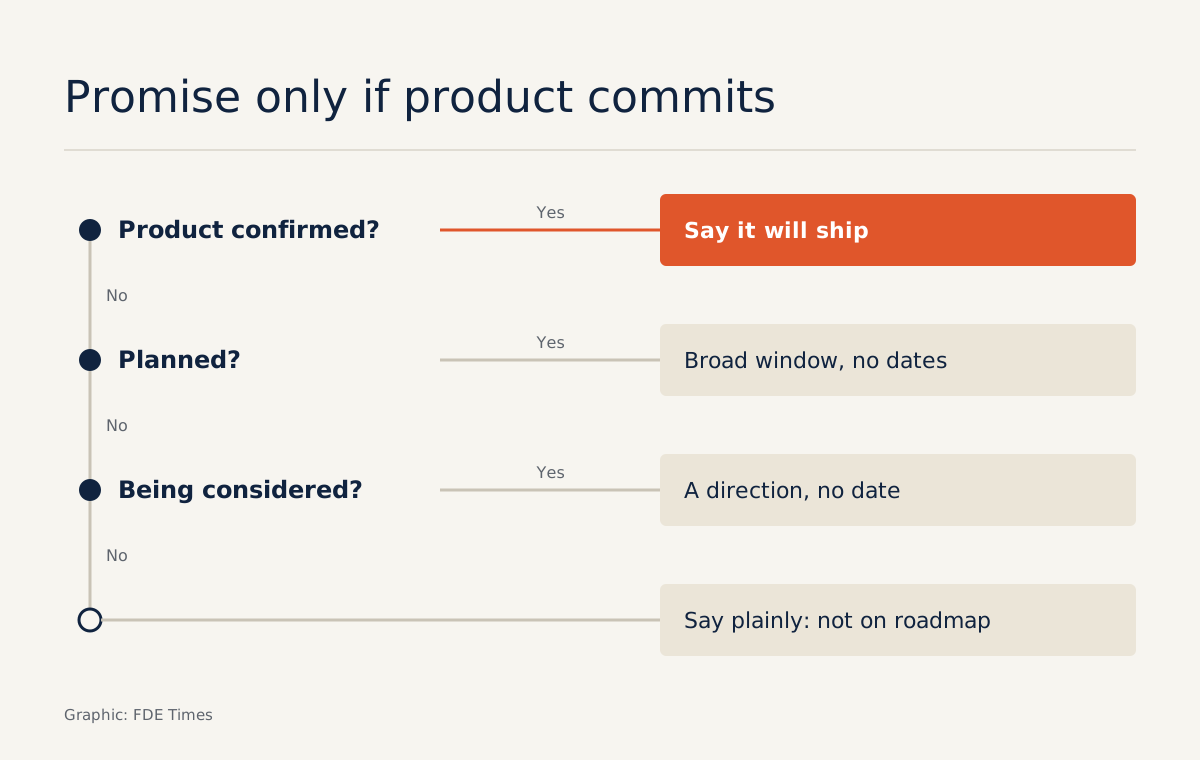
The item’s status decides what you can say
ProductPlan points out that sharing a roadmap is not a promise, implied or explicit, to deliver a specific function on a specific date. A roadmap shows the client the company’s strategy and direction; it does not guarantee delivery dates.
The safest approach is to answer according to the item’s real status, whatever the mood in the room. The table below pairs each status with a model answer, along with phrases to avoid.
| Status | What to say | What to avoid |
|---|---|---|
| Locked, confirmed by the product team | “This has been confirmed for Q2. I can tell you it will ship.” | Adding a specific date the product team has not set |
| Planned, not locked | “This is on the roadmap for the second half of the year. I won’t give you a date I can’t personally stand behind, but it is a prioritized item.” | “Coming soon”, “it’s nearly there” |
| Under consideration | “The product team is looking at this. It reflects our current direction and could still change, so there’s no milestone yet.” | “Coming soon”, “probably in the next release” |
| Not on the roadmap | “This isn’t on the current roadmap. I can walk you through what we’re focusing on instead.” | “I’ll push for it”, “it shouldn’t be long” |
The second row is the hardest to say, because the client wants a number. Aha! advises sharing externally only the timelines the company is comfortable committing to, and avoiding a false sense of certainty. Mind the Product suggests another option: using Now/Next/Later labels to show priority order without tying anything to a date.
A broad time frame, paired with a plain statement that you are not giving a date, beats a specific date that later has to be withdrawn.
Ask what the client needs before answering
The table only works once you know what the client is really asking for. A feature request is often a solution the client has devised for a different problem. So the FDE’s first step is to dig out the underlying need.
Take a hypothetical case. The client’s head of operations asks: “When will the system have an Excel export button?” Instead of checking the roadmap straight away, you ask back: “What do you do with the export afterwards?” He explains that every Monday he compiles the weekly figures and pastes them into an email to the director.
You ask further: “Which numbers does the director look at, and does she ever need them midweek?” It turns out there are only three metrics, and the director wants them on a regular schedule. The underlying need is a recurring report that reaches the right person; the export button is just the route he thought up to produce it.
Only now do you check the status. Suppose export is not on the roadmap: you use the answer from the last row of the table, then move to what the client actually needs: “Export isn’t in the current plan. But if what you need is these three metrics landing in the director’s inbox every Monday, we can look at whether there’s a way to do that within the project scope.”
If you build a stopgap script to send the report, say clearly from the start which engagement scope it falls under and who maintains it after handover. Umbrex writes that a custom build nobody owns should not be treated as supported.
The misunderstanding about support lasting forever usually starts with exactly these workarounds: built with great care, but never clearly labeled as time-limited.
Umbrex also sets out an easy-to-remember boundary: FDEs should not create long-term obligations to the client without review. A verbal promise such as “we’ll look after this script for the long haul” needs approval from someone with the authority to give it.
Route requests to product without going around it
When the meeting ends, your job is only half done. AgileLab’s FDE handbook states bluntly that FDEs are not a shortcut around the product roadmap. PostHog’s handbook describes a similar practice: when a client is blocked by something only the product team can fix, the FDE hands the work to the team that owns that area.
So the ticket you file should carry the underlying need, not a verbatim copy of the client’s words. In the example above, a good ticket records who needs it, what they are currently doing by hand, how often, which three metrics, and the workaround in place.
A PM reading a ticket like that can compare it with requests from other clients, something a single line saying “client X wants Excel export” cannot support.
Do not expect one ticket to change the priority order. Your value lies in gathering evidence: when several different clients describe the same underlying need, your ticket starts to carry weight.
Mistakes that turn words into promises
A common mistake is saying “we’re already working on it” just to keep the meeting upbeat, while the item has not been locked. That line is really a variant of “coming soon”, and as Rework observes, the client will remember it as an agreed milestone.
Guessing a date from what you overheard at standup, then stating it as though the product team had set it, also turns internal rumor into a commitment to the client.
A harder mistake to spot is escalating through senior leadership to force the product team to take on your client’s request. You might win once, but you lose the trust of the very people who will have to maintain that feature.
The last mistake is building a workaround without stating how long it will last, so the client comes to see it as part of the product. Insight Partners notes that at its best, the value of FDE work compounds over time; at its worst, it creates technical debt.
Bringing this skill to interviews and your CV
If you are preparing for FDE interviews, have a story ready about a time you had to turn down or narrow a client’s request.
Tell it in four beats: the original request, the question you used to find the underlying need, your answer based on roadmap status, and how you passed it to the product team. A story like that shows you can hold a boundary while keeping the client satisfied.
On your CV, do not just write “worked directly with clients”. Spell out that you turned raw requests into tickets that captured the underlying need, or that you scoped workarounds before handover.
When reading job postings, check whether the role describes feeding client feedback back to the product team; if it does, put that story first.
The next time someone asks “when will it ship?”, ask the client one question before you answer. That question often reveals a way to meet the client’s need without promising anything.
Was this article useful?
Thanks for the feedback!
10 sources
- Optimizely product roadmap Q3 2023 (Disclosure and Safe Harbor)
- Product Roadmap Disclaimer (DocFusion) · 2023-01-05
- Your Product Roadmap Is a Plan, Not a Promise
- How CS Communicates Roadmap Without Overpromising: A Framework for Honest Conversations · 2026-05-04
- Turning Field Work Into Product Leverage (The Forward Deployed Engineer Playbook, Umbrex)
- Forward-Deployed Engineering (AgileLab / Witboost handbook) · 2026-11-16
- How to communicate your product roadmap to customers (Aha!) · 2024-05
- A Roadmap Doesn't Have to Lead to Broken Promises · 2017-11-28
- Working with product engineering - PostHog Handbook
- A day in the life: How four companies run FDE motions · 2026-07-27