Your client's shadow AI is a requirements list, not a crime scene
A blame-free interview turns the risk of leaked data into the first list of use cases for the project.
In brief
- The client's staff have almost certainly pasted data into public chatbots before you arrive
- A ban cannot recall data already sent and does not remove the work need behind it
- Each paste is a use case with a data type and a frequency, so build an inventory and replace it with an approved tool
Picture your first week at an insurance company. You are interviewing the claims team to design an internal assistant when the team lead says, quite casually: “We already summarise the reports. We just paste them into ChatGPT.”
The room goes quiet for a few seconds, and someone glances at the person from IT. How you react in those seconds decides whether the discovery session goes any further. Look alarmed or reproachful, and nobody will tell you anything true from then on.
The scene is not unusual. A TELUS Digital survey found that 68% of employees use personal AI accounts at work, and 57% of those admit to entering sensitive information.
PagerDuty’s 2026 shadow AI survey found that 34% of office workers had entered customer data or information into public AI tools, and 31% had entered financial information or confidential documents and strategy.
An FDE bringing AI into a company almost always arrives after pastes like these have already happened.
A ban cannot recall data already pasted
The most familiar reaction is to ban it. In 2023, after a Samsung engineer accidentally leaked sensitive internal source code by uploading it to ChatGPT, the company issued a memo banning generative AI tools. Its stated reason was that data sent to chatbots stays on the servers of the companies running the services.
The concern is well founded, but a ban only stops future pastes; it cannot recall what has already been sent. Nor does it make the morning pile of reports needing summaries disappear. Without a replacement tool the need remains, and people will most likely move to quieter workarounds.
There is usually no policy to lean on, either. IBM’s 2025 Cost of a Data Breach report found that 63% of breached organisations had no AI governance policy to manage AI or prevent shadow AI. You may well be the first person to ask the question systematically.
When you need to win over the sponsor, there is also a cost argument. The same report found that high levels of shadow AI added USD 670,000 to the average global cost of a data breach. Bringing AI use into the open is therefore worth more than banning it and letting it go underground.
Every paste is a use case
The core idea is simple: shadow AI tells you both where the risk lies and what users actually need.
Each time an employee pastes data into a chatbot, it gives you four things that any workshop struggles to extract: which task is eating time, what data is involved, how often it happens, and what quality of result they already consider good enough.
Seen this way, your role changes. You are not there to catch mistakes. You are taking stock of what users are already doing, then moving it somewhere controlled.
Work out a number in advance
Suppose the claims team has 40 people. Use the TELUS rates as a rough estimate, not a measurement: 68% of 40 is about 27 people using personal AI accounts. Of those, 57% have entered sensitive information, or about 15 people.
The number is not for a report; it helps you ask the right questions. Once you assume that as many as 15 people may have pasted sensitive data, you stop asking “is anyone using it?” and start asking “what for, and with which kind of data?”
A script for the conversation
Before the conversation, agree the boundaries with the project sponsor and the client’s security contact. You collect tasks and data types, never names.
If you come across tightly regulated data such as medical records or account numbers, you report it to exactly one person agreed in advance. That boundary is what makes your promise of no blame credible.
Open with a line that disarms defensiveness: “I’m not here to check up on anyone. I want to know which tasks are heavy enough that people have had to find their own tools, so the new tool can take exactly those off your hands.”
Then ask five questions, in order. “What do you most often ask AI to do?” “What do you paste into it: reports, emails or spreadsheets?” “Roughly how many times a week?” “What kind of result do you find usable?” “If you couldn’t use that tool from tomorrow, which work would slow down?”
The last question is the most valuable. It tells you which work really deserves priority, and shows the sponsor what a ban would slow down. Record the answers in an inventory like the one below:
| Task | Tool, account type | Data type | Frequency | Risk | Next step |
|---|---|---|---|---|---|
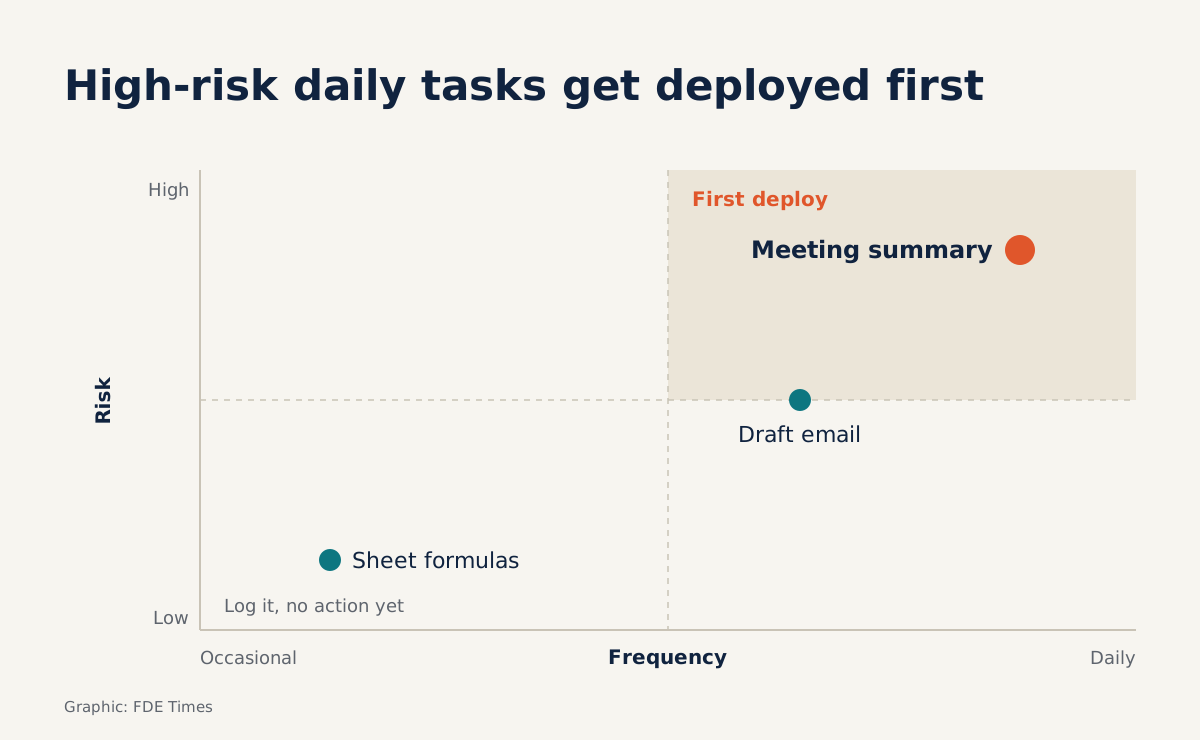
| Summarise loss adjuster reports | Public chatbot, personal | Policyholder information | Daily | High | First use case for the internal assistant |
| Draft replies to customers | Public chatbot, personal | Names, policy numbers | Several times a week | Medium | Ready-made templates with data masking |
| Rewrite spreadsheet formulas | Public chatbot, personal | No customer data | Occasionally | Low | Note it; no action needed yet |
From inventory to approved tool
Once the inventory exists, sort the rows by the risk and frequency columns. The row that is both high risk and done daily is the scope of the first deployment. The reason is practical: replace it and you remove the biggest risk while gaining daily users straight away.
As for data already sent, leave it to the client’s security team to assess and decide how to handle. Give them the inventory; do not draw your own conclusions about the consequences or promise anyone the data is safe.
When you build the replacement tool, design access controls in from the start. Do not save them for the end of the project. According to IBM, 97% of organisations that had an AI-related security incident said they lacked proper AI access controls. That figure covers AI incidents in general, but it shows where the gaps usually are.
The final step is to write a short policy with the client: which data types may go into which tools. A policy written from a real inventory will fit reality far better than one drafted from scratch.
Mistakes that cost you trust
The most common mistake is recording names. Let a single name slip into a report for management, and every later interview will yield only safe answers. The second is handing everything to security on the grounds that it is out of scope, when it is this very inventory that defines the real scope.
The third is casually proposing a ban to get it over with, without offering a replacement tool. The fourth is the easiest to make because you cause it yourself: pasting client logs or sample data into a personal AI account to debug faster. At that point you become a row in your own inventory.
How this skill goes on a CV
If the FDE job ads you are targeting mention AI governance, security review or working with a client’s security team, put this skill near the top. On a CV, write it in terms of results: for example, that you inventoried unapproved AI use across a team of a given size, and which use cases were moved onto a controlled tool.
In behavioural interviews it also makes a strong story: a sensitive situation, a promise of no blame that you kept, and a deployment that came out of it. An interviewer will see that you can deliver the engineering and keep the client’s trust.
The few seconds of silence after “we already paste it into ChatGPT” are when you get the most honest information of the whole discovery session. Do not let them pass with a frown.
Was this article useful?
Thanks for the feedback!
4 sources
- 2025 Cost of a Data Breach Report: Navigating the AI rush without sidelining security
- Shadow AI: The Hidden Threat to Enterprise Security
- Samsung bans ChatGPT among employees after sensitive code leak · 2023-05-02
- L'intelligence artificielle parallèle est à l'œuvre au sein de votre organisation. · 2026-06-11