When a client asks 'build or buy?', the right answer is often both
Four tests help an FDE split a system into layers and give an honest verdict, even when that verdict does not favour their own product.
In brief
- The question worth answering is which layers to buy and which to build, not which of the two to pick outright.
- Four tests apply: does the layer differentiate the client, how fast do they need it, what is the total cost including licences and maintenance, and do they have the people and data.
- An FDE who defends their own product loses trust; one who advises on the outcome the client needs keeps the client for the long run.
At some point there will be a meeting where someone on the client side looks straight at you and asks: should they build this themselves, or just buy it from your company? You are the vendor’s engineer, so everyone in the room can guess what you will say. That is why your next answer decides how far they still trust you.
The easiest reflex is to defend your company’s product. The second reflex, just as wrong, is to say “it depends on you” and change the subject. There is a third way: use four tests, go through the system layer by layer, and state the conclusion even when it does not favour your product.
Why defending the product costs you the client
Clients do not pay to have you sitting next to them. They pay for outcomes. An analysis on the Substack Enterprise Context Management argues that clients accept hands-on support when it gets them to value faster, but will not mistake that support for the result itself.
An FDE who is product-centred rather than outcome-centred will soon be found out.
The numbers do not support building on instinct either. A 2025 study by MIT NANDA, as reported by Fortune, found that buying AI tools from specialised vendors or partnering with them succeeded about 67% of the time. Internal builds succeeded only about a third as often.
That does not mean buying is always right. The same Substack analysis warns of a risk an FDE should raise unprompted: an engineering team embedded at the client can gradually become a permanent implementation department, quietly turning into part of how the client operates.
Being candid about this risk, even when it concerns you, is the quickest way to make the client believe everything else you say.
The right question is which layers to buy and which to build
According to “Build vs. buy AI: A CIO’s decision matrix” on TechTarget, the real question is rarely an outright choice between the two. It is which parts of the AI stack to buy and which to build in order to keep a differentiating advantage.
HatchWorks describes the most common hybrid: buy the platform, then build the client’s customisation and proprietary AI on top.
So the first thing to do when you hear the question is not to answer it straight away. Draw the system as layers, usually the model platform, the data processing layer, the business logic layer and the user interface. Then apply the four tests to each layer.
Four tests, in order
Differentiation. An EY executive advises that if a capability is tightly tied to the client’s industry and is what puts them ahead of competitors, building the data and proprietary AI should be the default. HatchWorks offers a quick test: if the client’s competitors can buy the same thing, it is unlikely to become the client’s competitive advantage.
Speed. The TechTarget piece observes that when speed is decisive, buying almost always wins. But HatchWorks notes that a quickly built demo can mislead decision-makers. The question to ask is how long until it runs on the client’s real data, not how long until there is a demo.
Total cost. Buying has its own cost curve, because licence and subscription fees rise with scale. Building means carrying maintenance, and HatchWorks stresses that maintenance is not a side issue but the very price of owning software. A comparison is only fair when both kinds of cost are counted.
Readiness. Darshan Naik of Capgemini argues that people, the readiness of the business side and data are the biggest factors in success, and are often underestimated. A layer worth building is still not worth building now if the client has nobody to maintain it.
Applying it to a concrete case
Imagine an insurer that wants to use AI to process claims. They ask whether they should build the whole thing themselves. You split the system into four layers and go through each test:
| Layer | Differentiating? | Speed | Cost to scrutinise | Recommendation |
|---|---|---|---|---|
| Model platform | No, competitors can buy it | Available at once if bought | Licence rises with claim volume | Buy |
| Document extraction | Low | Faster to buy | Fee charged per document | Buy, test on real claims |
| Claims rules and data | High, industry-specific | Slower but worth it | Maintenance carried by the client | Build |
| Staff interface | Medium | Depends on the team | Light maintenance | Use off the shelf, customise over time |
The claims rules and data layer is where the client can actually beat its competitors. This insurer’s experience of handling claims is something competitors cannot buy, so that is the layer worth investing people and time in. But the fourth test forces a further question: who on the client side will maintain these rules after you leave?
The break-even point matters more than today’s price
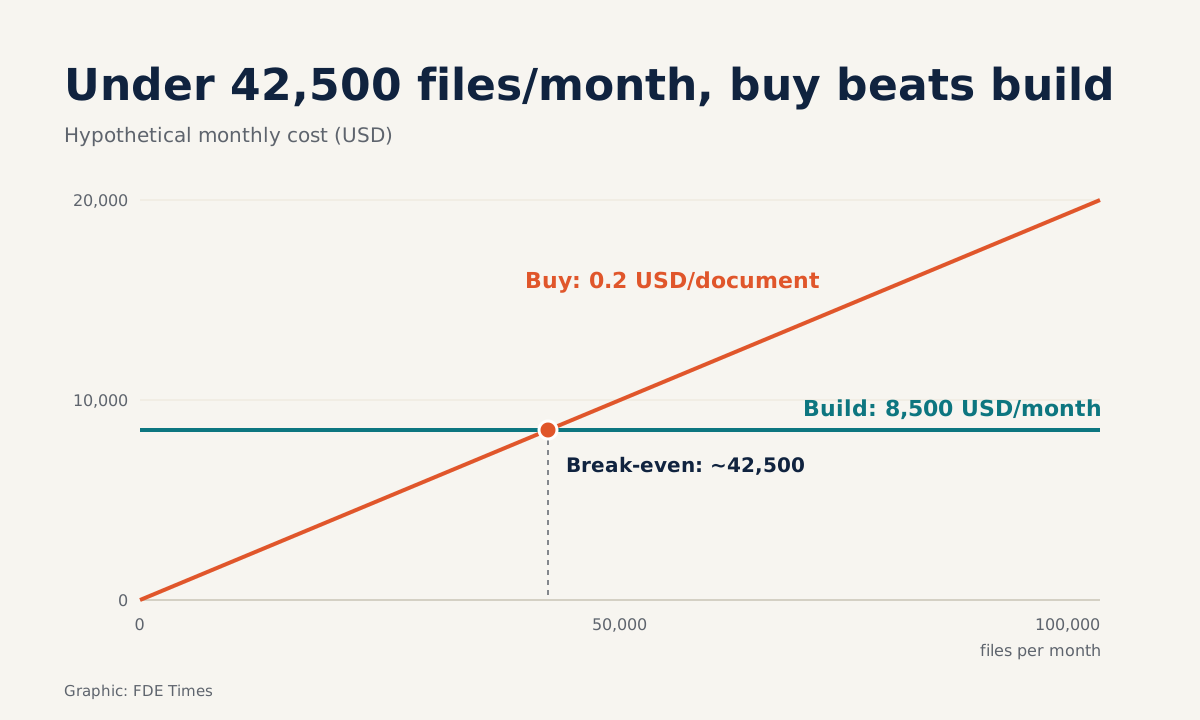
The document extraction layer is where the arithmetic deserves care. The following figures are entirely hypothetical, purely to illustrate the method. Suppose the bought service costs $0.20 per document and the client handles 10,000 claims a month, or $2,000 a month.
The build option, also hypothetical: $60,000 in up-front build cost, plus $6,000 a month for maintenance and infrastructure. Spreading the build cost over 24 months of use adds $2,500 a month. The total cost of building is therefore about $8,500 a month, almost unchanged by claim volume.
Break-even is where $0.20 times the number of claims equals $8,500, or about 42,500 claims a month. At 10,000 claims, buying costs less than a quarter of building.
If the client rolls out company-wide and reaches 100,000 claims, the bought service costs $20,000 a month, more than twice the cost of building.
So the right recommendation is neither “buy” nor “build”, but: buy now, and revisit once volume passes about 40,000 claims a month, provided the client has someone to maintain it by then. You give the client a threshold to watch, not an opinion.
A script for the meeting
When the client asks, steer the question towards outcomes: “Before we discuss buying or building, what result do you need to have this quarter?” That tells you how much speed matters.
Next: “If your competitors had exactly this tool, where would you still be ahead of them?” This reveals which layer truly differentiates.
The next two questions target cost and readiness: “When volume grows tenfold, who pays for the increase?” and “When the vendor’s engineers pull out, who on your team will maintain what you build?” Finally, raise the risk of depending on the vendor’s engineering team yourself, including your own team.
Common mistakes
The first mistake is answering for the whole system with a single word, “buy” or “build”. The second is letting a demo decide instead of a test on real data. The third is comparing the licence price with the up-front build cost and forgetting maintenance, or the reverse, forgetting that licences grow with scale.
The hardest mistake to spot is advising the client to build a layer that genuinely differentiates them when they do not yet have the people or the data. Right on strategy but wrong on timing is still wrong.
Turning it into an advantage when job hunting
Before an FDE interview, prepare a story about a time you put the client’s outcome ahead of your product’s short-term interest. A four-test table you actually used, with a recommendation for each layer and a break-even point, turns that story into evidence.
On your CV, write in terms of outcomes, for example: “Advised the client to buy the platform and build the business rules layer, with a plan to hand maintenance over to the client’s team.”
This week’s exercise: take a project you know well, split it into layers, fill in the four-test table, then try to defend every cell in front of a colleague playing a difficult client.
An FDE who has once said “you should buy this part from someone else” will be trusted more when advising that the rest go to their own team.
Was this article useful?
Thanks for the feedback!