'I'll come back on Thursday' earns more trust than a guess
Clients can tell at once when you are guessing, and what they remember is whether you came back when you said you would.
In brief
- Clients notice when you guess about what a system can do, so guessing is riskier than admitting you don't know yet.
- A good "I don't know yet" states what you know, where the gap is, and a return date you are certain to keep.
- Credibility is built from a record of keeping your word over time, so keep both the date and the substance you promised.
A meeting room at the client’s office. The head of operations asks you whether the agent your team is deploying can read scanned Japanese invoices as accurately as English ones. Six people turn to look at you, and you don’t know the answer.
Those few seconds are the hardest test a new FDE faces. The first instinct is to say “yes” to look competent, or to offer a figure that sounds plausible. The skill to practise is saying “I don’t know yet, I’ll come back on Thursday” in a way that raises your credibility rather than lowering it.
Fde.academy notes that experienced FDEs say “let me confirm and get back to you” more often than new engineers feel comfortable with. In front of a room full of stakeholders the phrase can sound weak, but it is almost always the more trustworthy answer.
Why does guessing cost you?
The quickest way to lose trust is to be preoccupied with yourself. When you are busy thinking about how you look, you stop really listening to the person in front of you. A guess made to sound clever serves the speaker, not the client.
Conversely, when clients see that you genuinely care about their problem, they trust you far more readily. You think you are saving face, but the client sees someone more worried about their own image than about the client’s pile of invoices.
Amit Koth, who writes about the technical depth the FDE role demands, puts it more bluntly: clients know very well when someone is guessing about what is feasible and what actually works. Guessing wrong in front of the people who run the system every day is therefore not a safe bet.
Four sentences instead of one guess
Honesty alone is not enough; the answer also has to be useful and focused on a solution. That is why “I don’t know” cannot stand on its own. It needs to come with what you already know, what you will do and when you will come back.
Applied to the Japanese invoice example, your answer might go like this:
“For scanned English and German invoices, my team has measured on real data and the results are stable.”
“For Japanese, I haven’t seen anyone run it on scans like yours, so I don’t want to give you a number without a basis for it.”
“I’ll take 50 of your sample invoices, run a test and ask the model team about the limits with vertical Japanese text.”
“On Thursday morning I’ll send you the results, with a recommendation for what to do next.”
The 50 invoices and the Thursday deadline are only examples; the structure is what matters. Sentence one proves you have real knowledge. Sentence two marks out exactly what you don’t know, narrowly and specifically; sentence three shows the client what you will do; sentence four is the commitment.
This rhythm is not unique to FDE work. The Influential PM suggests a very similar line for product managers: “I don’t know, but I’ll find out and get back to you by the end of the day.” Even in financial advice, practitioners have found that very few clients expect their adviser to be a perfect encyclopaedia.
The commitment matters most
Note sentence four: you commit to a date for an answer, not a date for a feature. Fde.academy criticises FDEs who make promises to clients without first checking with their own team. “I’ll come back on Thursday” avoids that trap, because the only thing you commit to is something you control.
So choose the date by working backwards. If the model team usually takes two days to respond, don’t promise tomorrow. Thursday is only a good promise if, even when the results are incomplete, you still have something to bring, such as “we’ve run 50 samples, here is the most common failure, and we’re waiting on the model team.”
The condition attached is simple: if you promised an answer on time, deliver it. Trust rests on character and intent; credibility rests on evidence and a track record built over time. Every commitment kept adds another line to that record.
From the meeting room to Thursday morning
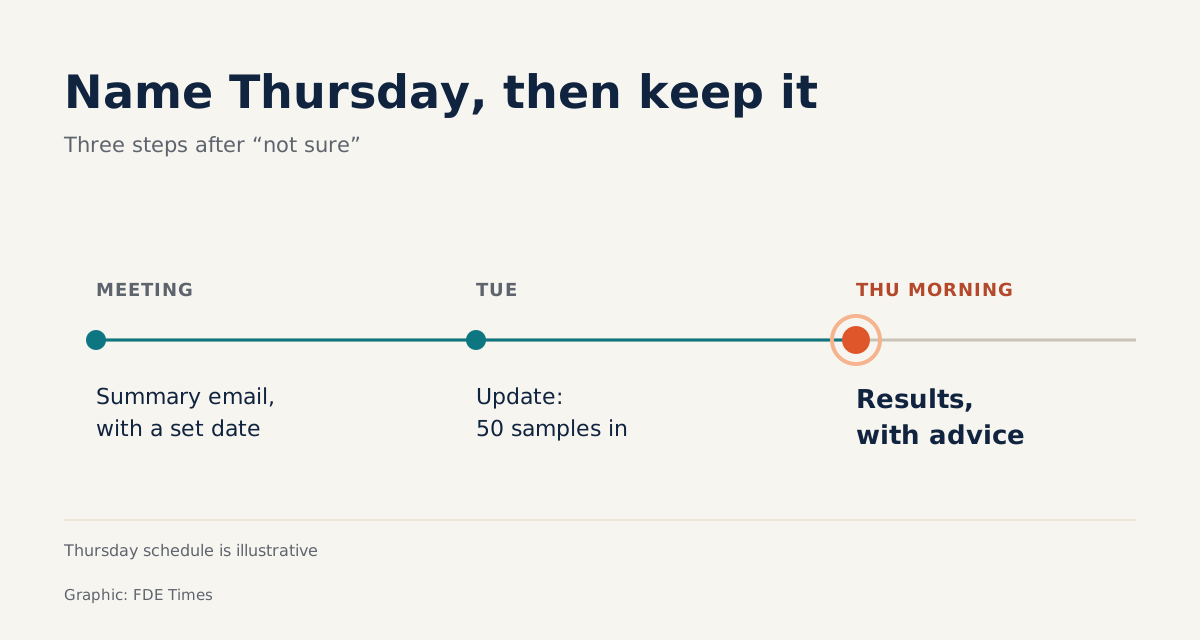
That same afternoon, send an email summarising the meeting, with the question about Japanese invoices on its own line, alongside the Thursday date. What you said in the room is now a written commitment that both sides can see.
On Tuesday, send a short note: “Received the 50 samples, running now, the model team will reply today.”
On Thursday morning, the most important thing is to honour the commitment you made in the meeting, both in timing and in substance. Don’t open with an apology for not knowing earlier; going away to find out and coming back is a normal part of the job.
Mistakes that make “I don’t know” backfire
The first is leaving out sentence one. Without it, the client hears only a gap, and starts doubting even the parts you genuinely know well.
Next is the vague promise: “let me look into it and get back to you.” It has no date and no owner, so nobody can track it.
Worse is keeping the date but bringing back an answer that has been “polished” to save face: on time but wrong in substance, which is simply the guessing trap again, three days later.
The last mistake is using the phrase too often. If you defer every question, the client will wonder why you are in the room at all. The four-sentence script is only persuasive when, most of the time, you can answer on the spot.
Practise before you walk into the room
This skill is hard to use for the first time in front of a client, so rehearse it. Ask a colleague to play the head of operations and fire five questions at you about your product, mixing ones you know with ones you don’t.
For each question you have three seconds to decide: answer now, or use the four-sentence script. Your colleague scores you on four boxes: did you state what you know, was the gap narrow enough, was the next step specific, was the date realistic.
The box most often missed is sentence two. “I’m not sure about Japanese” is still too broad; “I haven’t seen anyone run it on scans of vertical Japanese text” is a gap you can actually close before Thursday.
Show this skill to employers
If an interviewer asks about a time you didn’t know the answer in front of a client, don’t dodge it. Prepare a real story that contains all four sentences, with the date you set and the result when you came back.
On your CV, don’t write “good client communication.” Write one specific line about how you track open questions owed to clients and answer them on time. A measurable skill is always more credible than an adjective.
The next time you are asked something you can’t answer, don’t treat it as a moment of embarrassment. It is a chance to make a small promise and keep it.
Was this article useful?
Thanks for the feedback!
6 sources
- 10 Mistakes New Forward Deployed Engineers Make · 2026-07-24
- Forward deployed engineer: Why this role demands real technical depth · 2025-11-14
- Is Self-Orientation Killing Your Trustworthiness · 2010-10-05
- Six tips to become a trusted advisor to your customer · 2023-05-24
- The Art of Saying "I Don’t Know" Without Losing Credibility · 2025-07-11
- Saying 'I Don't Know' With Confidence In Client Meetings – And Still Strengthen Trust · 2025-07-23