Where is the data processed? Your storage region can't say
Where data is stored and where the model runs inference are separate settings, and a client's security review needs evidence for both.
In brief
- A workspace or resource region only tells you where data sits at rest. Where the model runs inference is a different setting.
- On Anthropic, inference_geo defaults to "global". Azure Global deployments and Bedrock global profiles can also route worldwide, so you have to pick the right type.
- Clients don't need promises. They need config pinned in code, logs that record the actual inference region, and a list of what the commitment doesn't cover.
OpenAI’s data residency documentation contains a sentence every FDE should know by heart: regional storage does not mean regional processing. It points to the exact gap where security reviews most often come unstuck.
The client’s legal team asks “where is our data processed?”, and the easiest answer is to point at the region of the workspace or resource. That answer holds for data on disk. It says nothing about which servers the prompt is sent to so the model can generate a response.
Get this wrong and the project can stall at approval. Worse, the system can go to production on a commitment you cannot keep.
The client is really asking two questions
The first is where data sits at rest: uploaded files, conversation history, stored outputs. The second is where prompts and responses are processed during inference. The two questions have different answers, and providers configure them in different places.
Anthropic splits them into two independent settings. Workspace geo determines where data is stored at rest and where auxiliary endpoints such as image transcoding or code execution run. Inference geo determines where the model runs inference, and it is set per request.
Microsoft Foundry on Azure is equally explicit across every deployment type. Data at rest stays in the Azure geography you selected. Where inference is processed depends on the deployment type.
Four providers, four sets of names
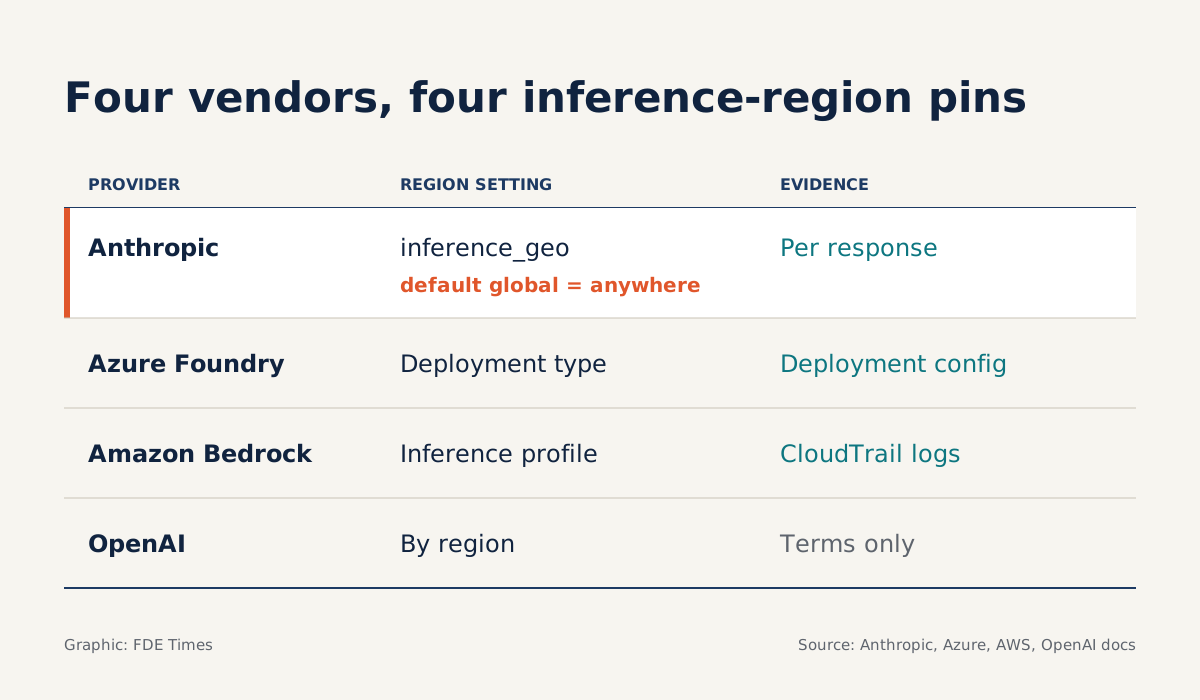
Anthropic is the place to start, because its default shows the risk most clearly. The default value of inference_geo is “global”, meaning inference may run in any region to optimize performance and availability. If nobody changes it, the honest answer to the client is “anywhere”.
| Provider | Storage at rest | Inference | Evidence |
|---|---|---|---|
| Anthropic | Workspace geo, chosen when the workspace is created, cannot be changed | Per-request inference_geo: “global” or “us” | usage.inference_geo in the response |
| Azure Foundry | The selected geography | Global: any region. Data Zone: US, EU or APAC. Standard: within the selected geography | Deployment type |
| Amazon Bedrock | Check separately with AWS | Cross-Region can leave the source Region. Geographic profiles stay within one geography | additionalEventData.inferenceRegion in CloudTrail |
| OpenAI | Regional storage available | Regional processing in the US and Europe (EEA and Switzerland), some models in Australia, India, Japan | Read the terms: system data is out of scope |
Each row hides a detail that is easy to miss. On Azure, Standard and Regional Provisioned deployments process data within the geography the client chose, but can still move it between regions in that geography for operational reasons. If the client’s contract names a specific region, say so up front.
For Bedrock, AWS recommends geographic inference profiles when a client has data residency requirements. A global profile can send requests to any commercial Region in the world. With OpenAI, system data may be stored and processed outside the selected region, and the provider may temporarily store customer content outside the region to operate the service.
A worked case, end to end
Take a hypothetical client: a US insurer that requires policy data never to leave the United States, and you are using Claude through Anthropic’s API. The first step happens before any code is written. Workspace geo is chosen when the workspace is created and cannot be changed afterward, so creating the wrong workspace means starting over.
At the time of writing, the only workspace geo option in the documentation is “us”, so storage matches the requirement. Inference has to be pinned on each request, and it should be pinned in code rather than relying on someone remembering to click the right button in the console:
body = {
    "model": MODEL,
    "max_tokens": 1024,
    "inference_geo": "us",   # run inference only on US infrastructure
    "messages": [{"role": "user", "content": prompt}],
}
resp = call_messages_api(body)

geo = resp["usage"].get("inference_geo")
audit_log.write({"request_id": resp["id"], "inference_geo": geo})
if geo != "us":
    alert("Inference ran outside the committed region")
The logging line is what turns a promise into evidence. The response carries a usage.inference_geo field showing where inference actually ran. Record it next to the request id, and when the client’s auditor asks, you have data to hand over instead of a line on a slide.
Then work out the cost for the client. For Claude 4.6 models and later, US-only inference is priced at 1.1 times the standard rate, applied to every token type: input, output, cache writes and cache reads. Every 100 units of token spend today becomes 110, and caching will not help you avoid the difference.
If the client later moves to Bedrock, the logic stays the same; only the place you configure it changes. You choose a US geographic inference profile instead of a global one. The evidence lives in CloudTrail in the source Region: every cross-Region request is logged, with an additionalEventData.inferenceRegion field.
A process for your own project
Start by rewriting the client’s requirement as two separate lines: where data at rest must live, and where inference must run. At this point you often discover the client was only thinking of the first. Ask whether the requirement stops at country level, at a regional bloc such as the EU, or names a specific region.
Next, map each line to a specific provider setting, recording both the setting name and its value. Pin that value in code or in infrastructure as code, then add a runtime check that reads the evidence field, as in the code above.
The final step should be a short paragraph listing what the commitment does not cover or what needs separate checking. For OpenAI, that is system data. For Azure Standard deployments, it is movement between regions within the same geography for operational reasons.
For Anthropic, auxiliary endpoints such as image transcoding or code execution follow workspace geo rather than inference_geo, so check them separately. Give this paragraph to the client before they find it themselves: disclosing early is always easier than having it surface mid-audit.
Common mistakes
The most common mistake is answering with the workspace region and calling it done, while inference is still on the global default. Another is assuming an Azure Standard deployment means exactly one region. It only keeps data within one geography.
The costliest is creating the workspace before the residency requirement is settled, given that workspace geo cannot be changed. And do not forget to tell the client about the price uplift, or the first month’s invoice becomes a meeting nobody wants to attend.
Exercise: an EU client on Azure
Fill in a two-column Storage / Inference table for a client that requires data never to leave the EU and uses Microsoft Foundry. The Storage column is straightforward, since data at rest stays in the selected Azure geography. The Inference column is where the thinking is.
Write down which deployment type is ruled out immediately (Global, because it can process in any region), which keeps processing in the EU (Data Zone EU), and what you would say if the client insists on a named region. If you can fill all three cells without reopening the documentation, you are ready for the real review.
Where this skill belongs on a CV
When an FDE job posting mentions clients in heavily regulated industries such as finance, healthcare or the public sector, expect a residency question in the interview. A good answer separates storage from inference and names the settings of at least two providers.
On a CV, a line such as “designed residency configuration and inference-region audit logging for LLM calls” carries far more weight than a generic “compliance”. It tells a recruiter you have sat in the room with a client’s security team and come out the other side.
Whoever asks “where is our data processed?” wants to know whether you really understand your own system. A two-part answer, backed by a log line as evidence, is the fastest way to earn their trust.
Was this article useful?
Thanks for the feedback!