HPE Private Cloud AI: the five layers to understand before you reach the customer
A customer buying a turnkey AI stack does not put you out of work. The hardest part is still ahead: connecting the system to real data, real teams and real security constraints.

In brief
- Buying turnkey only shortens installation. Connecting the system to the customer's data, people and security constraints is still the deployment engineer's job
- Split the stack into five layers (hardware, data, NVIDIA AI Enterprise, AI Essentials, operations) and ask the customer one key question at each
- Go from constraints to features: settle air-gapping and multi-tenancy first, then choose models and blueprints
The contract is signed. In a few weeks a rack of GPU servers will be installed in the customer’s datacentre, along with the promise that this is “AI in a box”. You are the person who has to turn that box into an application running on their real data.
HPE Private Cloud AI is a textbook example of this kind of project. HPE and NVIDIA co-developed the stack and sell it in four configurations, each sized for a different type of AI workload.
Analysts at Constellation Research have observed that a turnkey stack like this is very attractive to business leaders. They also warned that early uptake is unlikely to take off quickly, because most customers are still experimenting.
The gap between “bought it” and “can use it” is where FDEs earn their living. You might work for the hardware vendor, for an integration partner, or for an AI startup whose product has to run on a customer’s on-premises infrastructure.
Whichever seat you are in, the skill is the same: look at a turnkey product and identify which decisions the customer still has to make.
Turnkey only means the pieces fit together
A turnkey product solves one problem: the components have been tested to work together. It does not tell you where the customer’s data lives, which team gets how many GPUs, or by what route models are allowed into the internal network. Only the customer can answer those questions, and you are the one who has to ask them.
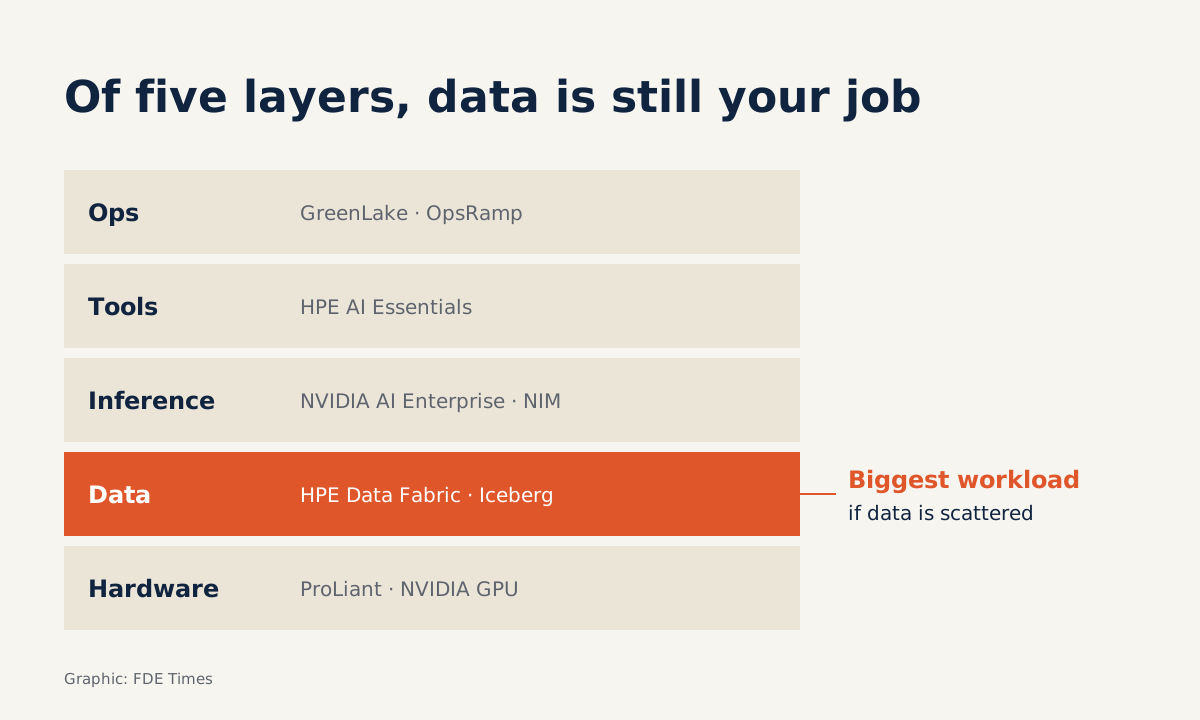
To ask the right questions, take the stack apart layer by layer. In HPE Private Cloud AI, the bottom layer is HPE ProLiant servers, supporting NVIDIA L40S and H100 NVL GPUs and the GH200 NVL2 platform.
Above that sits NVIDIA AI Enterprise, which includes the NIM inference microservices. Next comes HPE AI Essentials, a curated set of AI and data tools managed through a unified control plane.
The remaining two layers are the easiest to overlook. HPE Data Fabric is the data layer, and since the March 2025 release it can act as an Apache Iceberg endpoint for AI engineering work. Operations run through HPE GreenLake, with an OpsRamp AI copilot that helps IT teams monitor workload performance.
The five-layer map and the questions that go with it
For each layer in the table below, the last column is the question to bring to the discovery session.
| Layer | Components | Question for the customer |
|---|---|---|
| Hardware | ProLiant, L40S / H100 NVL / GH200 NVL2 GPUs | Is the main workload inference, fine-tuning or both? Which of the four configurations has been chosen? |
| Data | HPE Data Fabric, Iceberg endpoint | Is the source data already in an Iceberg lakehouse, or still scattered across several systems? |
| Inference | NVIDIA AI Enterprise, NIM | Which models are needed, and how are models allowed into the internal network? |
| Tooling | HPE AI Essentials, NVIDIA blueprints | Is there a prebuilt blueprint close to the use case? |
| Operations | GreenLake, OpsRamp, air-gapped, multi-tenancy | Must the system be fully cut off from the internet? How many teams will share it? |
A worked scenario: a search assistant for a bank
This is a hypothetical scenario. A bank buys Private Cloud AI and wants a question-answering assistant over its internal documents. Two teams will share it: risk management and customer service. The security department requires that the system have no route to the internet.
Start with the hardest constraint. The June 2025 release added an air-gapped management mode for customers with strict data privacy requirements.
So the plan must list, from the outset, everything that would normally be pulled from outside, such as model weights, microservice images and updates, and agree with the customer’s security team how each item is brought inside and who signs off.
Next comes the starting point. The platform supports pre-validated NVIDIA blueprints for common workloads, so look for a blueprint close to document question answering instead of building from scratch. A blueprint gets you a working version early. What decides quality is still the data.
At the data layer, assume the bank has already loaded its policy documents and risk reports into a lakehouse as Iceberg tables. Data Fabric can now act as an Iceberg endpoint, so you may well be able to reduce copying data elsewhere. That is something to verify with the customer’s data team before it goes into the plan.
If the data is still scattered across several systems, consolidating it will be the largest workstream of the project, and you should tell the customer so in the first week.
Finally, resource partitioning. The multi-tenancy feature lets an organisation partition and allocate resources by team. Agree in advance on each team’s quota and on a rule that the customer service team cannot retrieve risk reports. Get the design wrong at the start, and fixing access rights on a live system later is very costly.
The order to work in
Go from constraints to features. First settle the network policy (air-gapped or not), then settle the boundaries between tenants, and only then choose models and blueprints. Do it the other way round and you can easily finish a polished demo only to discover it is not allowed to connect to what it needs.
If the customer is still experimenting, do not push straight to production. HPE has a developer edition, launched in March 2025, positioned as a starting point for AI development and including 32TB of integrated storage.
The company also runs a try-before-you-buy programme in Equinix data centres. Use these options to validate the use case before the customer orders a large configuration.
When scaling comes up, remember that HPE has committed to the platform scaling across multiple GPU generations. Still, record which parts of the application depend on a specific GPU type, so the next upgrade does not turn into a new project.
Common mistakes
The most common mistake is trusting the word “turnkey” and promising a handover date before knowing where the data lives. The second is choosing a GPU configuration on instinct, when the GPU type determines the system’s size and which workloads fit.
The third is treating air-gapping as a checkbox, when it changes the whole process for updating models later. The fourth is letting every team share a single resource pool “to move fast”, then having to split it once real users arrive.
The last is ignoring the operations layer: if the customer’s IT team does not know how to monitor the system through GreenLake, you will be the one getting the midnight call.
Putting this skill on your CV
When reading FDE job descriptions, look for words such as on-prem and air-gapped. They suggest the product has to run inside the customer’s infrastructure, sometimes fully cut off from the internet. Words such as multi-tenant, NIM or Iceberg tell you the specific stack you will be working with.
On your CV, avoid vague lines such as “deployed AI solutions”. Describe a specific constraint you handled, such as bringing a model into an environment with no internet access or designing quotas for several teams on one GPU cluster, and say clearly what you did about it.
The first customers to buy an AI box often do not yet know what they will do with it. The deployment engineer who knows to ask the right five questions at the five layers is the one who helps them find the answer.
Was this article useful?
Thanks for the feedback!
4 sources
- Hewlett Packard Enterprise and NVIDIA Announce Co-Developed AI Solutions · 2024-06-18
- HPE unveils Private Cloud AI, broad Nvidia partnership aimed at genAI workloads · 2024-06-18
- HPE, Nvidia broaden AI infrastructure lineup · 2025-03-19
- HPE Launches AI Factory Solutions Powered by Blackwell GPUs and Gen12 Servers · 2025-06-24