On FDE teams, data scientists are graded on the client's results
Microsoft, Scale AI and Prima Mente are all hiring for this branch of the job, and its core skill is choosing the right metric before choosing the model.
In brief
- Microsoft is hiring a Senior Data Scientist - FDE for a multidisciplinary team that judges models by metrics tied to real business outcomes, with about 25% travel.
- Only Prima Mente uses the exact title Forward Deployed Scientist; Scale AI uses a hybrid Data Scientist/Engineer title that owns the entire data lifecycle.
- The skill that defines this branch: measure a model by how many actions the customer can take per cycle, such as customers retained given the calls they can make.
One sentence in Microsoft’s listing for a “Senior Data Scientist - FDE” deserves a slow read: you will evaluate the team’s models using metrics tied to real business outcomes. The listing also says plainly that this is not the kind of work you finish and hand over. For a data scientist used to submitting a notebook with an AUC score attached, that is a very different job.
The branch is slowly acquiring a name of its own, though every employer labels it differently. Of the three companies discussed here, only Prima Mente, an AI biology lab, uses the exact title “Forward Deployed Scientist”.
Microsoft writes “Senior Data Scientist - FDE”, while Scale AI uses the hybrid title “Forward Deployed Data Scientist/Engineer”. According to ITPro, Microsoft aims to place more than 6,000 AI specialists and engineers inside customer organizations.
If you are a data scientist hoping to move into FDE work, or an FDE who regularly deals with models, the skill to practice sits in that first line of the job ad. This article explains what the branch does, then walks through choosing a metric from start to finish.
Three companies, one kind of work
Microsoft describes its team as a multidisciplinary group of software engineers, data scientists, TPMs and designers, working in small pods with short feedback loops. The role is customer-facing and requires travel about 25% of the time. You sit next to the people who use the model instead of just reading the tickets they file.
Higher up, Microsoft’s Principal Account-Aligned FDE Data Science position is an engineer embedded with the customer, acting as the lead technical owner for a strategic account.
It asks for at least five years of experience delivering projects directly to customers, in professional services or consulting.
Prima Mente shows the other direction of the work. Its Forward Deployed Scientists embed the Pleiades model with early partners to test research and product hypotheses, then carry what they learn from deployment back into the R&D roadmap.
It also asks for experience deploying ML/AI in tightly regulated, high-stakes environments, along with compliance and data governance.
Scale AI leans toward engineering: the person in this role architects and builds data solutions for the customer’s hardest problems and owns the entire data lifecycle, from ingestion to insight.
The three descriptions share one idea. A model is only worth something when it changes something on the customer’s side.
Does a higher AUC mean a better model?
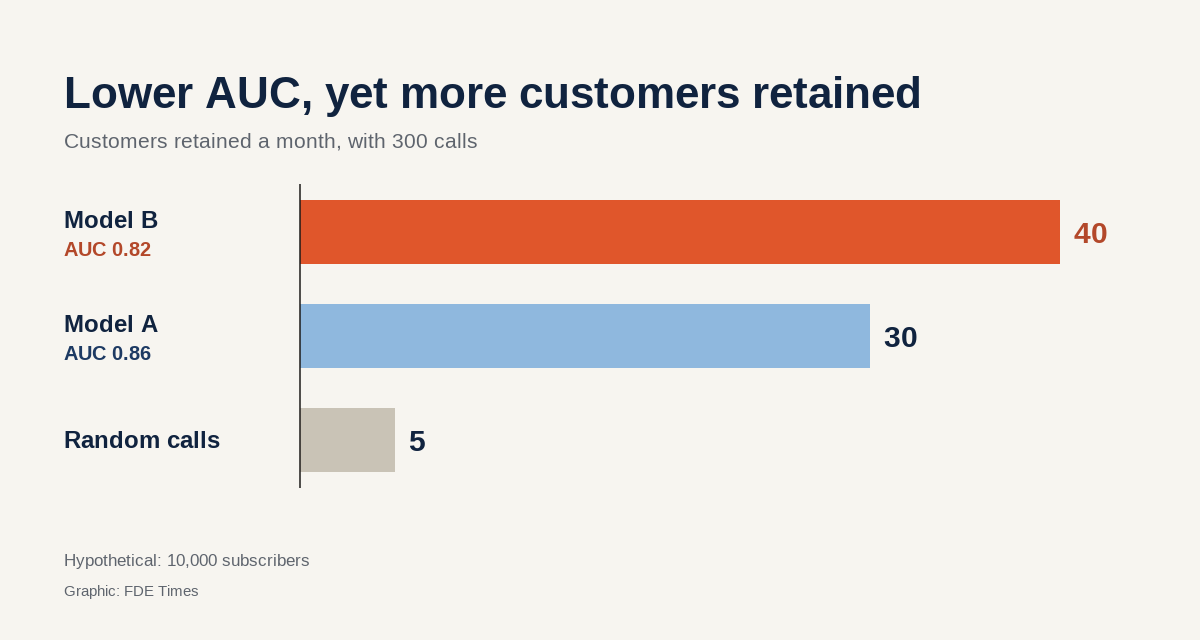
A hypothetical example shows what Microsoft’s requirement means in practice. Take a telecom operator with 10,000 subscribers, 500 of whom leave each month. The customer care team can make at most 300 calls a month, and in their experience, for every three about-to-leave customers they call, they keep one.
You have two models. Model A has an AUC of 0.86; model B has an AUC of 0.82. Judged by the offline leaderboard alone, you would pick A. But the care team only ever uses the top 300 rows of the list, so the right question is: of the 300 highest-scoring people, how many are actually about to leave?
Suppose A puts 90 churners in the top 300 and B puts 120 there. Calling 300 people at random would hit only about 15, because the churn rate is 5%. Divide by three: A keeps 30 customers a month, B keeps 40, and random calling keeps 5. The model with the lower AUC brings in 10 more customers each month.
The reason is that AUC grades the ranking across all 10,000 people, while the customer acts only on the top of the list. The code below is what you should write before training your first model:
import numpy as np

def churners_in_top_k(scores, labels, k):
    # k = number of actions the customer can take per cycle (calls per month)
    top = np.argsort(scores)[::-1][:k]
    return int(labels[top].sum())

def customers_saved(scores, labels, k, save_rate=1/3):
    # Convert into a unit the customer understands: customers retained
    return churners_in_top_k(scores, labels, k) * save_rate
When you report to the customer, the first line reads “40 customers retained per month, versus 5 with random calls”. AUC goes in the appendix for the technical team.
Doing it yourself in five steps
Start with what the customer will do. Ask who will do what when the model produces a result, and how many times they can do it in a cycle. That number, such as 300 calls, is your k.
Next, ask for the conversion rate, such as keeping one customer for every three called. If the customer does not know, record it as an assumption and propose a small trial to measure it.
Then build the crudest baseline you can, such as random calls or the rule the operations team already uses, because the customer will compare you with how they work today.
The fourth step is to write the business metric function before training, so every model experiment is scored against the same yardstick. Finally, track that number after deployment. Microsoft states that this is not finish-and-hand-over work, so the fourth week after go-live is when the metric is actually verified.
Common mistakes
The most common mistake is optimizing a metric over the whole dataset when the customer only handles a slice of it. The second is forgetting that the customer’s capacity can change: if the care team grows to 600 calls, a model that wins at k = 300 may no longer win, so report the metric at several values of k.
The third shows up in tightly regulated environments, exactly the kind Prima Mente mentions: keeping customer data to polish a model without first asking the compliance team. In this branch, data governance is part of the problem from day one.
The last is keeping the lessons to yourself. Prima Mente writes into the job description that deployment lessons must flow back into the R&D roadmap. If every customer has to rewrite its own top-k function, that is a signal for the product team.
Showing this skill when you apply
When reading job ads, look for phrases such as “customer-facing”, “business outcomes”, “travel” or “entire data lifecycle”. They tell you the position belongs to the deployment branch, whether the title says Data Scientist or Engineer.
On your CV, rewrite each project around three points: what the customer used the model’s output to do, how many times they could do it, and which number changed.
“Chose the model by customers retained with 300 calls a month” is more convincing than “achieved an AUC of 0.86”. In interviews, describe a time you picked the model with the lower offline score and explain why.
A good data scientist knows which model is more accurate. A good Forward Deployed Scientist knows what the customer will do on Monday morning with the first 300 rows of the list.
Was this article useful?
Thanks for the feedback!
6 sources
- Senior Data Scientist - FDE (Microsoft, via AnitaB.org jobs) · 2026-06-05
- Principal Account-Aligned FDE Data Science (Microsoft, Built In NYC)
- Forward deployed engineers are big tech’s latest gambit to drive AI adoption · 2026-07-06
- Forward Deployed Scientist (Prima Mente, Built In)
- Forward Deployed Scientist (Prima Mente, Antler jobs)
- Sr. Forward Deployed Data Scientist/Engineer (Scale AI, Accel jobs)