The CTO asks if it works. The CFO asks what it saves
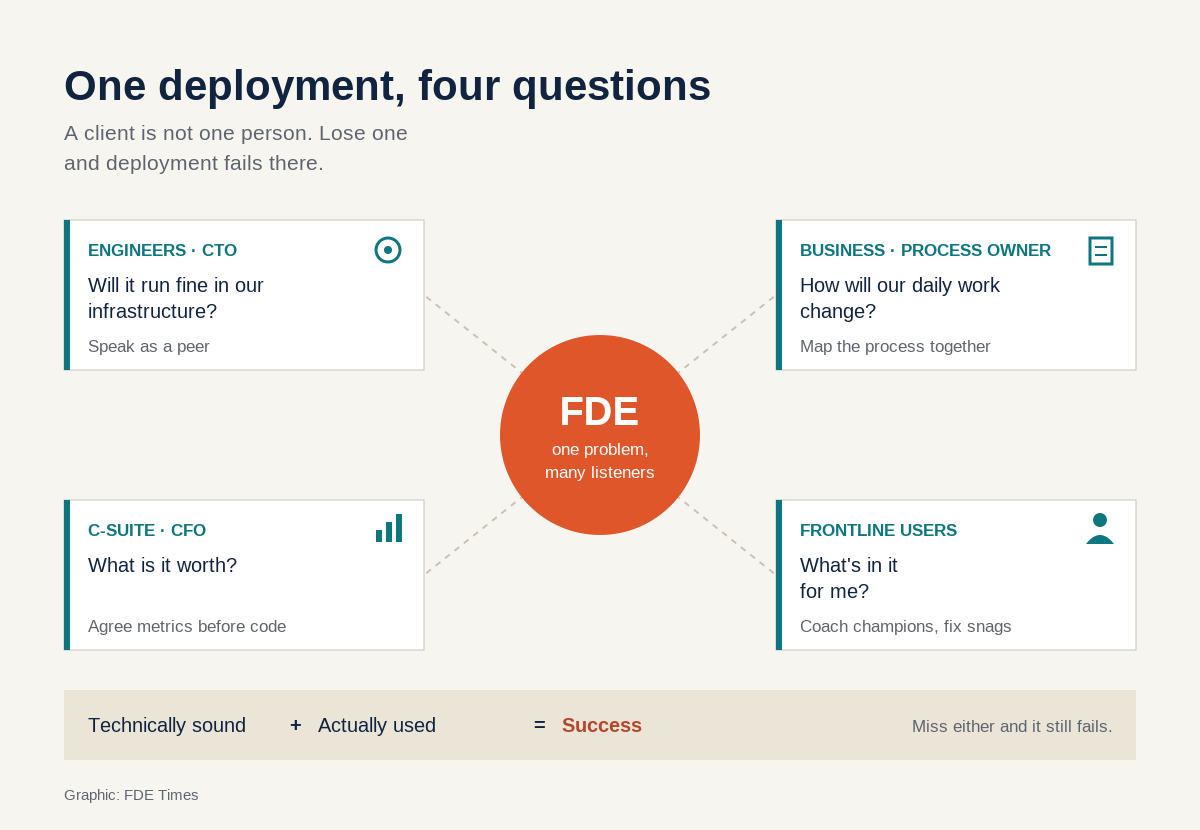
Client deployments involve at least four people with four different questions, and an FDE who answers only one of them will see the project stall at the demo.
In brief
- FDE job ads from Stilla and Palantir say plainly that you work with both frontline users and the executives who make decisions. MongoDB wants its FDEs to be a trusted technical partner to the client's engineering leaders.
- Each group has its own question. The core skill is translating the same trade-off into each group's language.
- A deployment succeeds only when it is technically sound and people actually use it. That means the success metric has to be agreed before any code is written.
Stilla’s job ad for a Founding FDE says you might run a working session with the CTO in the morning and then present the business case to the CFO over lunch.
Palantir describes its Forward Deployed Software Engineer role in similar terms: the person who owns relationships with every stakeholder, from users struggling with their daily work to the executives who make decisions.
So a Tuesday in the job can look like this. At 9am you sit with the client’s CTO going through the API of their ERP system. At lunch the CFO asks what the system will save the company. At 4pm an accountant admits she has not opened the tool once all week.
For a developer used to taking tickets from a single product manager, this is the biggest shock of moving into FDE work. Nobody stands in the middle translating for you any more. That translation is the skill to learn: one technical problem, several audiences, each needing a different answer.
Each group is really asking a different question
The first step is to stop treating “the client” as one person. An FDE’s client usually involves at least four roles, and each brings its own question into the meeting.
The technical team, meaning the CTO or engineering leads, asks whether the system will run reliably in their infrastructure. MongoDB describes its Staff FDE role as a “trusted technical advisor” to the client’s engineering leaders. You have to speak to them as a peer, not as a salesperson.
The business team, the people who own the processes, asks how the tool changes their daily work. Executives ask what it is worth. Frontline users ask the simplest question and the hardest to answer: what do they gain by changing how they work?
Paraform defines stakeholder management at exactly this point of tension: building relationships with executives while keeping frontline teams aligned. Drop either end and the deployment fails at that end.
This is not a slogan. According to one account of the history of the FDE role, Palantir paired a technical lead with a client-facing lead precisely because of those two goals.
Worked example: one trade-off, three presentations
Take an agent that reads supplier invoices for the accounts department of a retail chain. One technical decision has to be settled: does the agent approve invoices on its own when its confidence passes a threshold, or must every invoice go through a human reviewer?
A high threshold means fewer errors, but more invoices are pushed back for manual handling. A low threshold automates more, but raises the risk of paying the wrong amount. That is the whole problem, yet each listener needs to hear it differently:
| Audience | The question they are really asking | How the FDE presents it |
|---|---|---|
| CTO, technical lead | Is it controlled and traceable? | Precision at each threshold on the real invoice set, how the audit log is written, how to roll back when the agent approves wrongly |
| Chief accountant (process owner) | How much will my team still check by hand? Who is accountable for mistakes? | How many invoices the team still reviews each day, how “suspect” invoices are surfaced, who gives final approval |
| CFO | Is it worth the effort? | A metric agreed in advance, such as the number of days to close the books at month end, plus an acceptable level of risk |
Notice that nobody is given a distorted version of the truth. All three receive the same trade-off; only the unit of measurement changes. The article on the history of the FDE role says FDEs must patiently explain technical trade-offs to non-technical people. The word “patiently” matters, because you will often be explaining it for the third time.
To keep the three conversations from drifting apart, collect them in a single document. A one-page definition of success might look like this:
Problem: Month-end close is slow because invoices are entered and reconciled by hand
Current process: (described by the accountants themselves, not relayed by a manager)
Success metric: ... (the number the CFO has agreed to)
Decision-maker: ...   Champion: ...   End users: ...
Agreed trade-off: auto-approval threshold = ..., reason ..., signed off by: ...
Out of scope for this phase: ...
Five steps to do it yourself
Step one is to map the four roles with real names, in the first week. Step two is to run discovery with both sides. Stilla expects FDEs to work with both the technical team and business stakeholders to understand exactly what the client wants. Ask only the CTO and you will end up with an elegant architecture sitting on a process you do not understand.
Step three is to map the process and agree on the metric before writing code. Paraform describes this as running discovery sessions, mapping the organization’s workflows and defining what success looks like before implementation. Paraform calls it value scoping: identifying measurable outcomes that are enough to prove the deployment is worthwhile, before engineering resources are committed.
Step four is to use working sessions instead of slides. Stilla writes that FDEs lead hands-on working sessions with business stakeholders and executives to align on goals. Open their real data and adjust the threshold in front of them. A decision they settle themselves will hold far better than one you propose by email.
Step five is to look after adoption. Stilla describes this part bluntly: coach the champions, then track down every user who is stuck until their use case works. This usually requires being there in person, which is why MongoDB states that candidates must be willing to travel to client sites up to 30% of the time.
The mistakes that quietly kill deployments
The most common mistake is talking only to people like yourself. Developers tend to feel comfortable sitting with the CTO and avoid the meeting with the accounts department. The result is a system that works correctly and that nobody uses.
The second mistake is the opposite: sticking only to the executives. A director’s signature does not mean you have users. That is why Paraform puts keeping frontline teams aligned into its very definition of stakeholder management. The logic is simple: after go-live, the people who open the tool every day are them, not the director.
The third mistake is leaving the success metric undefined. If the CFO has not agreed to a number before you code, you will be judged by a different number at the review. The fourth is using jargon with non-technical people.
“Precision of 0.97” means nothing to a chief accountant; “your team will still review roughly this many invoices a day” does.
A subtler mistake is misreading your own role. Paraform distinguishes the deployment strategist, who acts as a product manager for the client’s problem, from the FDE, who handles technical execution. If your team has someone in the strategist role, work with them rather than competing for the work. If it does not, you have to do that part yourself.
Putting the skill on your CV and into interviews
When reading an FDE job description, look for phrases such as “executives”, “business stakeholders”, “champions” or “on-site”. They tell you how much time you will spend outside your editor. If a job labeled FDE barely mentions any of them, ask directly in the interview how much client contact the role involves.
On your CV, do not just write “built a reconciliation module”. Write which department you worked with, what metric you agreed with them, and how many people actually use the tool. Many Vietnamese developers who work in outsourcing or on internal banking projects have sat with business clients without ever counting it as experience.
This week’s exercise
Take your team’s most recent technical decision: choosing a cache, changing a data sync schedule, or setting some threshold. Write three explanations, each no longer than three sentences, for the three audiences in the table above. Then ask a non-technical person to read the one meant for executives.
If they come back with “so is it good or bad?”, you know which part to rewrite.
Code makes the system work correctly. Whether each person on the client side keeps using it depends on how you work with them.
Was this article useful?
Thanks for the feedback!
5 sources
- Founding Forward Deployed Engineer @ Stilla | General Catalyst Job Board · 2026-08-06
- Palantir Technologies - Forward Deployed Software Engineer (London, United Kingdom)
- Staff Forward Deployed Engineer (MongoDB, via AlleyCorp Job Board) · 2026-08-01
- Forward-Deployed Engineer vs. Deployment Strategist: What's the Difference? (May 2026) · 2026-05-14
- The Rise of the Forward Deployed Engineer: History, Myths, and Why It's Back