Scope creep or discovery? Three tests for every new client request
Say yes to every request and the project's margin disappears; refuse them all and the client loses the reason it chose you over an off-the-shelf product.
In brief
- Freezing the SOW and billing for every change does not suit FDE work, but saying yes to everything slowly eats the margin and delays go-live.
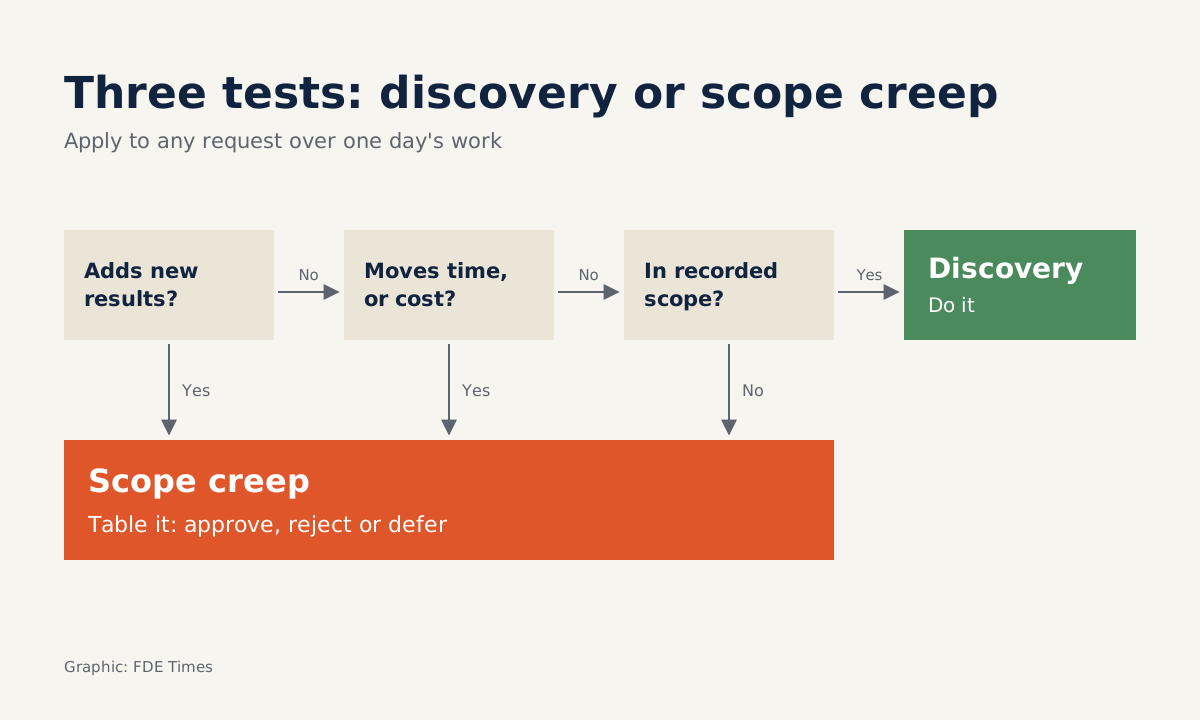
- Do not ask whether a request is a change. Ask whether it clarifies the outcome the client bought or adds a new one, whether it moves time and resources, and whether you have a written record to check it against.
- Every significant change needs a written summary the same day, ending in one of three decisions: approve, reject or defer.
Three weeks into a project, the invoice-reading agent you deployed for a client is running on real data and the head of operations is delighted. Then she asks for one more thing: “While you’re at it, could it also check invoices against our supplier contracts? It shouldn’t take long.”
Questions like this decide the fate of a good many FDE projects. Say yes, and you may have just taken on two weeks of work nobody is paying for. Say no, and you may have just shut the very door the client opened to help you understand their problem better.
This chapter shows how to answer that question on solid grounds, rather than on instinct or out of awkwardness.
Why can’t an FDE just freeze the SOW?
According to Tandem’s blog, an FDE spends roughly half their time with the client understanding the problem and the other half building a solution for that specific client. Working this way, requirements changing midway is normal, because sitting next to the client is exactly what produces new understanding.
That is also why the standard professional-services response, freezing the SOW and charging for every change, does not suit FDE work, in Tandem’s view. Going the other way is just as dangerous, and both mistakes have very concrete consequences.
Call every change “discovery”, and the engagement slowly absorbs blocks of unpriced work until the margin is gone and go-live slips. Call every change scope creep, and you turn the client into the user of a standardized product, when they chose you precisely because you would build for them.
Three questions instead of a gut feeling
Tandem proposes a set of tests to replace the question “has the request changed?” The three below are enough to handle the example in this chapter.
The objective test asks: does the new request clarify the outcome the client bought, or add a new one? The adjustment test asks: does the request shift time, cost or resources without a corresponding adjustment?
The record test asks: can you point to what was scoped, what was said and what was delivered?
Tandem advises running the tests on any request that costs more than a day of work. The threshold makes sense: smaller jobs should simply get done smoothly, while larger ones must go through the filter.
Good scope is written before day one
The record test only works if you have something to check against. Stopping scope creep therefore starts when the scope is written, well before any new request arrives.
A piece by TimeTackle stresses that a good SOW must state plainly, without diplomacy, what you will not do. The out-of-scope list often matters as much as the list of deliverables. That scope should be signed off by the stakeholders before work begins.
Baytech Consulting adds another piece: every feature and every milestone needs objective criteria for confirming that it is “done”.
For the invoice project above, you might write: “The agent correctly extracts the amount, date and supplier code from the sample invoice set provided by the client; out of scope: matching against contracts, payment approval, handwritten invoices.”
A worked example, start to finish
Say that in the same week you receive two requests. Request A: “The agent misreads skewed scanned invoices, please fix it.” Request B: the contract-matching question from the top of this article.
For request A, the objective test gives a clear answer: skewed scans are still part of the invoice set the client supplied, so this clarifies the outcome already bought. It may take a few days, but it falls within the plan for meeting the signed “done” criteria, so the adjustment test raises no alarm either.
The record test is fine too, because the scope document names the dataset. This is discovery; do it.
Request B is a different matter. Contract matching is a new outcome, it sits squarely on the out-of-scope list, and it would push back go-live without extra time or people. This is scope creep, though that does not mean it must be refused. It needs to be put on the table and decided in the open.
The change-control process TimeTackle describes requires analyzing the impact on time, budget and technical risk before deciding. Baytech runs every request through a standard form and records the outcome: approved, rejected or deferred to a later phase. Put together, your change log might look like this:
| Field | Request A | Request B |
|---|---|---|
| Description | Read skewed scanned invoices | Match against supplier contracts |
| Objective test | Clarifies the outcome bought | Adds a new outcome |
| Adjustment test | Within the plan for the “done” criteria | Delays go-live without extra resources |
| Record test | Matches the signed dataset | On the out-of-scope list |
| Impact | A few days, low risk | Time, budget and technical risk need a separate estimate |
| Decision | Approved, start now | Deferred to phase 2, awaiting client confirmation |
With this table in hand, the conversation with the head of operations changes. Instead of a refusal, she hears: “Yes, here is the cost and here is when.”
Write it down the same day, even if it is just a message
According to FDE Academy, good FDEs turn every significant scope change into a short written summary on the same day, even if it is only an informal note.
A message such as “Summary of this afternoon’s meeting: contract matching moves to phase 2, we’ll send an estimate on Monday, could you confirm?” is enough.
The reason to do it immediately is technical debt. FDE Academy also notes that technical debt typically arises when expanded scope is quietly absorbed instead of acknowledged. The mechanism is easy to see: when nobody acknowledges the extra work, the old deadline stays put, and the thing left to flex is usually code quality.
When you are forced to take a shortcut, write one sentence at that moment about what you skipped and why. For example: “Skipped retry on accounting API timeouts because the client needs a demo on Friday; must be added before go-live.” A sentence like that rescues whoever takes over, and sometimes rescues you three months later.
Common mistakes
The most common mistake is running the tests in your head without writing them down, so when the argument comes there is nothing to point at. The second is writing a scope that lists only the work to be done and leaves the out-of-scope section blank, so every new request looks like it is “probably in scope”.
The third is treating every change as the enemy. Request A in the example is the kind of feedback that makes the product better, and refusing it throws away the reason the client hired an FDE. The last is leaving decisions hanging: every request needs exactly one status, approved, rejected or deferred.
Where to practice this, and how to show it
You do not need an FDE title to practice. If you work in outsourcing or on a product team, every “can you just add this” ticket from a PM or client is an exercise in running the three tests.
When reading FDE or solutions engineer job descriptions, look for lines about working directly with clients or managing change requests; those are the places to have a story about this skill ready.
On your CV, instead of writing “worked with clients”, write a sentence with an outcome, for instance that you split an unplanned request into a later phase and still hit the go-live date.
In interviews, describe a time you told a client “not yet” and the relationship got stronger. That story persuades better than any claim to be “a good communicator”.
Clients will always ask for more, and a good FDE project should be asked for more. Strong practitioners do not dodge those requests: they answer quickly, put it in writing, and every time can point to the outcome the client actually bought.
Was this article useful?
Thanks for the feedback!
4 sources
- Scope creep vs discovery: the 4 tests that tell an FDE which one is happening · 2026-09-07
- How a Forward Deployed Engineer Manages Enterprise Scope Creep Without Creating Tech Debt · 2026-07-10
- How to Prevent Scope Creep and Protect Project Profitability · 2026-02-23
- How to Prevent Scope Creep in Software Projects: Baytech Consulting's Proven Strategy