The deal is signed. What does the FDE own before renewal?
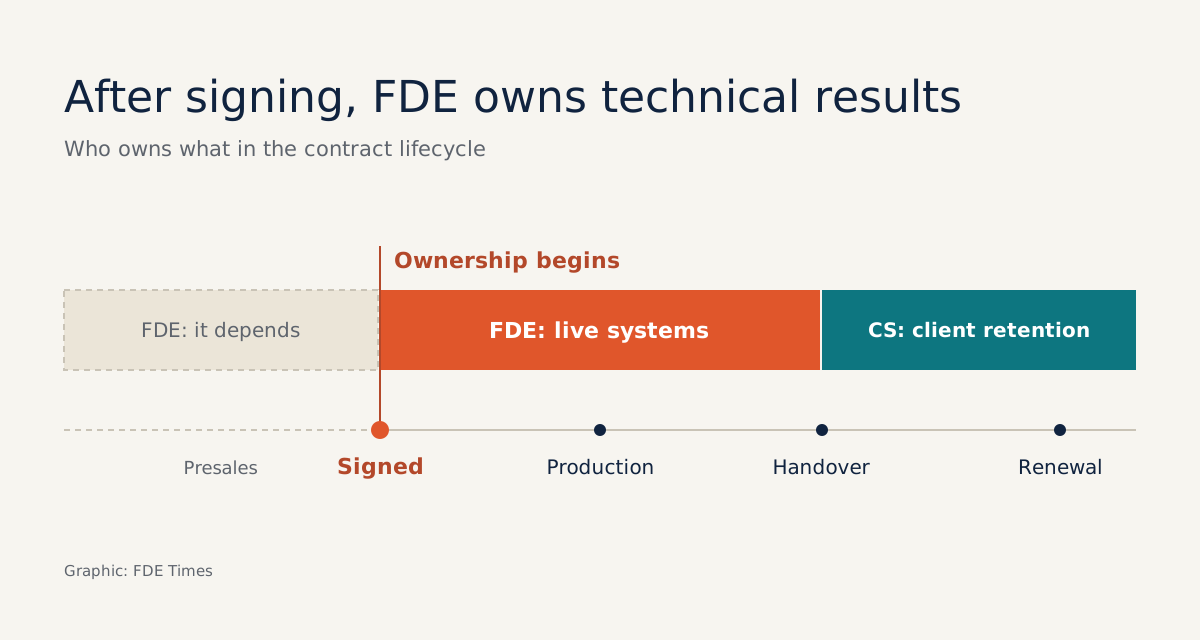
Presales depends on the company, but after signature every stage, from scoping to production to handover to Customer Success, has something the FDE must deliver.
In brief
- Where presales ends varies by company: PostHog keeps its FDEs out of presales, while a Pluto job post puts them in it.
- After signature, the FDE owns the technical outcome: a system running for real in production, plus feedback carried back to the product team.
- Customer Success holds the relationship and the renewal, but the evidence that wins the renewal comes from the customer using what the FDE built.
The contract runs to a single line of scope: “automate document processing”. The customer is a logistics company that wants an agent to read its import paperwork, and on Monday morning the account executive sends a message: “Deal’s signed, you’re on site next week.”
Take that hypothetical engagement as the running example. The first question is not which model to use. It is which parts of the work, between now and the customer’s renewal decision, belong to the FDE, which to sales and which to Customer Success. Get that wrong and there are two ways it ends: either the FDE absorbs the whole customer relationship, or the FDE builds the system and vanishes.
The skill is knowing what must be delivered at each stage of the contract. With that clear, working with sales and CS gets smoother, job descriptions become easier to judge, and the CV starts to read the way FDE recruiters want.
Presales: some companies assign it to FDEs, some do not
The first thing to check in a job description is whether the FDE steps in before signature at all, because it varies by company. PostHog’s handbook says plainly that the FDE engagement begins where pre-sales ends, and its FDEs do not currently do presales. Kunal Ganglani also places the FDE in the post-signature phase, separate from the solutions engineer.
A Pluto FDE job post, by contrast, asks for direct work with customers in both pre-sales and post-sales engagements. That role follows the customer from proof of concept, through the pilot, to putting the system into production.
So assume nothing when reading a JD. Look for the phrases “pre-sales”, “proof of concept”, “pilot” and “post-sale implementation”, then ask directly in the interview: does the FDE take part before the deal is signed, and if so, what does that stage deliver?
If the job does include presales, what the FDE owns is an honest POC. It should prove exactly what the customer wants to see, and record the assumptions not yet tested so that whoever handles the implementation, possibly the same FDE, does not have to rediscover them from scratch.
After signature, the FDE owns the technical outcome
Once the deal is signed, the FDE is responsible for the technical outcome end to end, as Palantir’s job post describes the FDSE role, but within a clearly bounded scope. PostHog calls these scoped engagements, aimed at unblocking adoption or expansion.
“Scoped” is the key word. Underdog.io observes that customers rarely describe root causes; they describe symptoms. “Automate document processing” is a symptom. The first job is to turn it into a measurable requirement.
Back to the logistics customer. Say that after two days sitting beside the data-entry staff, it becomes clear most of their time goes on hand-typing invoices and packing lists from two large suppliers into the ERP. The brief sent back to the customer and to sales can be this short:
ENGAGEMENT BRIEF — Document-reading agent
Problem: invoices keyed into the ERP by hand
Scope: invoices + packing lists, 2 large suppliers
Out of scope: customs declarations
Output: agent writes drafts to the ERP, a person approves
Metrics: documents/day through the agent, manual-correction rate
After handover: CS + the customer's IT team
Before the brief is final, ask three questions in the same meeting. Does the ERP have an API for writing data, or does everything go through file imports? Who grants access, and how long does it take? On the customer’s side, who will approve the drafts each day?
The “Out of scope” line is the most valuable line in the brief. It locks the engagement’s scope, and it gives sales a ready answer when the customer asks about customs declarations: that is a follow-on engagement, not extra work squeezed in to finish.
The measure is production, not the demo
Stackmatix draws a clear line between the two sets of metrics. FDEs are measured by a system running for real in production and by the feedback they bring back to the product team. Customer Success is measured by retention, expansion and NRR.
Recruiting from Scratch describes FDEs as typically embedded with a customer for anywhere from a few weeks to a few months, handling deployment, customization and keeping the system running smoothly after the sale. A demo that runs cleanly in the meeting room, in other words, is not the finish line. The job is done when the data-entry staff use the agent every morning without an FDE sitting beside them.
Product feedback is the other half of the measure. Suppose both suppliers send skewed PDF scans and the agent keeps misreading the quantity column. The FDE patches it for this customer, but must also write it up as a clear ticket for the product team, because the next customer will very likely hit the same problem.
Renewal is not the FDE’s job, but it depends on the FDE
At many companies, CS and TAMs hold the long-term relationship, track account health and handle renewal. Even so, adoption, satisfaction and renewal often still appear on the FDE’s scorecard.
The two are not in conflict. An FDE’s success directly affects renewal rates and expansion opportunities: CS sits at the renewal table, but what they bring to it is evidence that the customer is using the system the FDE built.
That makes the handover a deliverable rather than a formality. When the work is done, the FDE returns the relationship along with a record of what was built, what the customer should do next and the follow-on work.
For the logistics customer, the handover note should include the number of documents per day going through the agent, the skewed-PDF ticket, and customs declarations listed as a candidate for the next engagement.
Four mistakes that let an engagement slip away
The first is holding on to the relationship. If the customer still calls the FDE about everything after go-live, CS loses sight of the account’s health and the FDE has no time for the next customer.
The second is a brief with no “Out of scope” line. Scope swells meeting by meeting, and by week five there are three half-finished pieces of work, none of them in production.
The third is measuring by demo instead of by usage. A smooth demo reassures everyone, but tells CS nothing about whether the customer actually uses the system every day.
The fourth is a handover that consists of a repo and nothing about what the customer should do next. CS then walks into the renewal meeting empty-handed, and nobody proposes the follow-on engagements.
Rewrite the CV around the lifecycle, not the stack
FDE recruiters read CVs looking for signs that the candidate has owned an outcome. A line such as “Built an LLM document-processing agent for a logistics customer” only shows the candidate can use the tools.
For the example above, a rewrite might read: “Led a 6-week engagement at a logistics customer: scoped 2 document types, put the agent into production in week 4, 70% of invoices from the 2 main suppliers now go through the agent, handed over to CS with 3 follow-on items.” The numbers must be real ones, but the sentence structure holds.
Developers who have never worked on a customer site can apply the same frame to an internal project: who the users are, how long it took to reach production, how many people actually use it, and who took over the handover. Those last two are usually where a developer’s CV goes blank.
This week’s exercise: take a current project and write a seven-line engagement brief like the one above, with a mandatory “Out of scope” line and an “After handover” line. If the last line cannot be filled in, it has just revealed who will get the call when the system breaks.
Was this article useful?
Thanks for the feedback!
7 sources
- Working with sales and CS - Handbook (PostHog)
- Forward Deployed Engineer (job post, Pluto) · 2026-06-28
- What Is a Forward Deployed Engineer in 2026 · 2026-03-04
- What Does a Forward Deployed Engineer Do? (Role + Salary Guide) · 2026-06-25
- Forward Deployed Engineer: The Hottest Role in AI-First Tech and Why It Pays So Well [2026] · 2026-05-09
- What Is a Forward Deployed Engineer? GTM Guide for Startups · 2026-09-03
- Forward Deployed Software Engineer (Palantir)