What "travel 50%" in an FDE job ad really means
The figure is rarely spread evenly across the week; it tends to arrive in long stretches during build and integration.
In brief
- Travel for FDE roles typically runs at about 25-50%, higher in government, defence, healthcare and industrial work.
- Travel comes in bursts tied to the phase of the engagement, and the longest one usually falls during build and integration.
- Working on-site four to five days a week within one area is not the same as flying everywhere, so separate the two when reading job ads.
You open an FDE job ad and see the line “travel up to 50%”. The first reflex is to wonder whether that means two and a half days away from home every week. In practice it almost never does. The percentage is a way of squeezing a very uneven work schedule into a single line of text.
Misreading that line can cost you in two directions. Some people take the job and only then discover they will spend three straight weeks at a customer’s factory.
Others pass on a good role because they assume “50%” means half their life. The skill required is specific: read the travel requirement, convert it into days, and ask the right questions before signing.
How much travel is typical?
Bloomberry analysed about 1,000 FDE job ads. It found that 68% of roles carried a travel requirement, and that levels of 50-75% were fairly common. For sales engineers, the equivalent figure is only about 20-40%. FDE Academy puts the level lower, at roughly 25% to 50% of the job overall, depending on the company and the industry.
Specific job ads fall within that range too. According to Uvik’s FDE index, roles at OpenAI list travel of up to 50%, Vercel 25-40%, Striim up to 50% and GWI about 30-50%. FDE Academy adds that deployments for government, defence, healthcare and industrial customers tend to sit at the high end.
There is one thing to watch, though. Uvik concludes that travel is not a universal feature of FDE roles, but a significant factor in only about a third of the ads it surveyed.
That is far from Bloomberry’s 68%, and the reason lies in what each one counts.
An ad that “mentions travel” is therefore not necessarily a role in which travel is central to the job, and you have to read closely to know which kind you are looking at.
On-site and travel are two different things
Palantir’s ad for a Forward Deployed Software Engineer on its US government work is a clear example. It requires candidates to work four to five days a week at the customer’s location, mainly in and around Colorado Springs. Palantir also describes working with customers, often right on site, to understand and solve their problems.
Measured by time spent at the customer, this is close to a full-time on-site role. But because the customers are concentrated in one area, you may still be home every night.
The same ad says only, in general terms, that you should be willing to travel as needed, with no percentage at all. In other words, a role that lists no travel rate can keep you at the customer’s site far more than a role that says “40% travel”.
Conversely, that 40% role might involve fewer days at the customer but have you flying between several cities and sleeping in hotels.
So when you read an ad, separate two axes: how much time you spend at the customer’s site, and how far that site is from your home.
Travel comes in bursts, not evenly by the week
FDE Academy suggests understanding travel as intense bursts, tied to the phase the engagement is in. The longest on-site stretch usually falls during build and integration, and can last anywhere from a few days to a few weeks.
The reason is simple: that is when you need access to the real systems, the real data and the real operators.
Bloomberry describes the FDE as a long-term embedded partner, often on site with the customer for weeks. It also offers a simple test to tell FDEs apart from similar roles: if you are at the customer for six weeks fixing production bugs, you are a Forward Deployed Engineer.
Put another way, sitting at the customer’s site for long periods is not a side effect of the job. For many companies, it is the job.
Turning “40%” into a real schedule
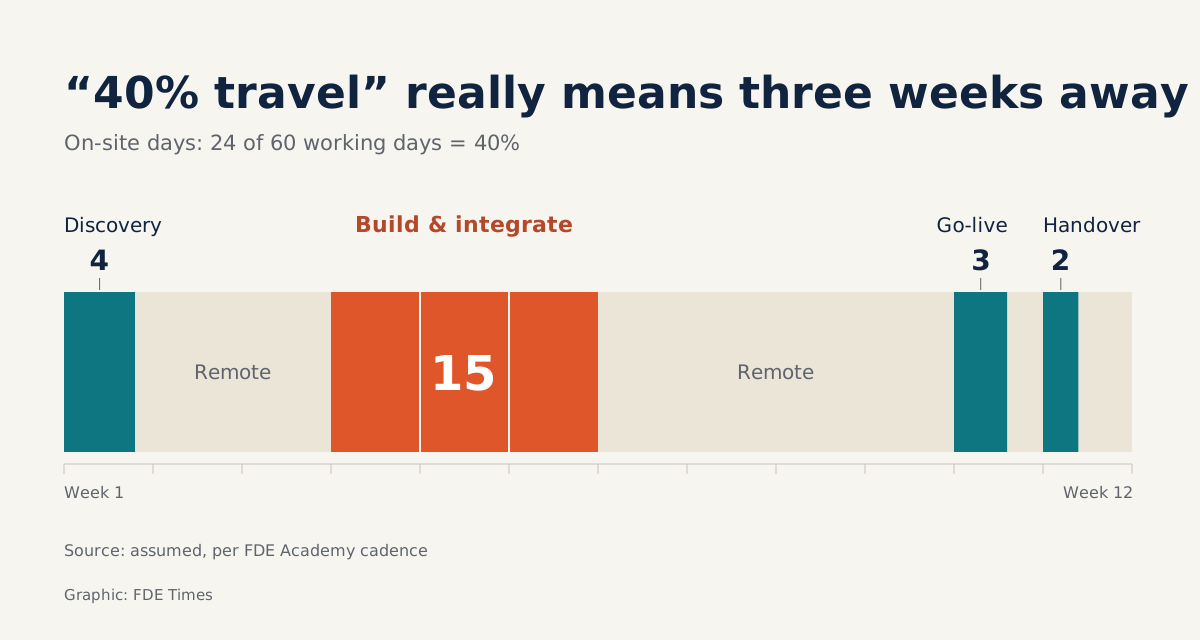
Imagine you take on a 12-week engagement with a 40% travel requirement. Twelve weeks is 60 working days, so 40% equals 24 days at the customer. The table below is one hypothetical allocation, based on the rhythm FDE Academy describes.
| Week | Phase | Where | On-site days |
|---|---|---|---|
| 1 | Discovery | At the customer | 4 |
| 2-3 | First version with sample data | Remote | 0 |
| 4-6 | Build and integration with the real systems | At the customer | 15 |
| 7-10 | Refinement, evals, bug fixes | Remote | 0 |
| 11 | Go-live | At the customer | 3 |
| 12 | Handover | At the customer | 2 |
That adds up to 24 days, exactly 40%. But what affects your life lies elsewhere: weeks 4 to 6 are three straight weeks away from home, while in weeks 2-3 and 7-10 you are at home entirely.
If you have young children or take evening classes, those three consecutive weeks are what needs discussing; the 40% figure tells you nothing.
Do this conversion for every job ad you are interested in. If the ad does not say how long an engagement lasts, that is the first question to take into the interview.
Step by step: reading and asking about travel
First, underline three pieces of information in the ad: the rate or number of days, the customer’s location, and the industry. If the role is in government, defence, healthcare or industrial work, plan for the high end. Next, assume an engagement of average length and convert the rate into days, as in the table above.
Then take questions about what has actually happened into the interview, not questions about policy. “How many days was the team’s longest on-site stretch last quarter?” will get you a far more honest answer than “Is there a lot of travel?”.
Also ask how long an engagement usually lasts, and which phases require the whole team to be on site.
Finally, the CV. Show that you have delivered work right in front of a customer, rather than writing a generic “worked with customers”. A line such as “three weeks on site integrating a data pipeline into the customer’s ERP system, resolving production bugs with the operations team” says far more.
Bloomberry notes that the “Builder FDE” group codes 70-90% of the time while travelling 30-50%, which means travel does not replace coding. You still code; you just do it next to the users.
Common mistakes
The most common mistake is dividing the percentage evenly across the weeks and planning your personal life around that. The second is taking “travel as needed” to mean little travel. Palantir’s ad says exactly that, yet the same ad requires four to five days a week at the customer’s site.
The third is confusing a local on-site role with a remote-friendly role that requires only the occasional flight. The fourth is shying away from asking about travel for fear of seeming uncommitted. The opposite is true: a candidate who asks specifically about the rhythm of an engagement shows they understand how the job works.
The travel figure in a job ad is only the starting point of a conversation. People who understand the job convert it into a concrete week-by-week schedule, and decide whether to take the role based on that.
Was this article useful?
Thanks for the feedback!