Rogo never published its FDE interview. Its job post fills the gaps
Beyond a reported medium-level coding round, the listed duties point to two skills to prove: running deployment infrastructure and advising finance clients.
In brief
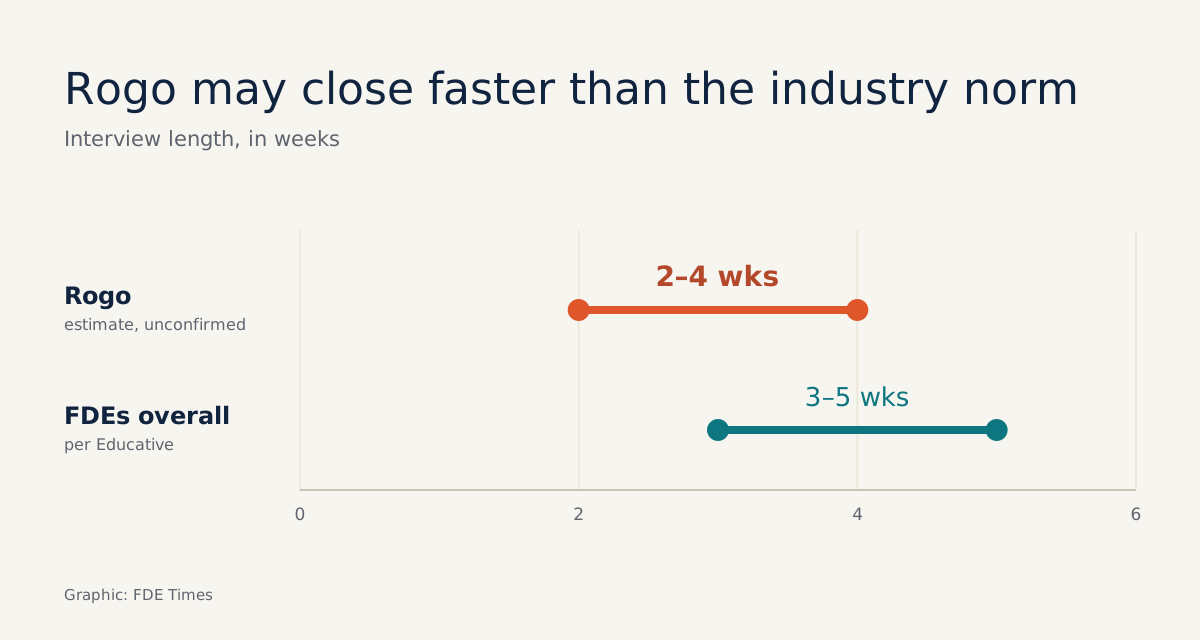
- Rogo has not published its process. According to one third-party source, the first round is most likely a recruiter screen, followed by a coding round, and the whole process takes about two to four weeks.
- The coding round is medium difficulty but demands clean, correct code and clear reasoning, so timed practice on medium problems pays off more than grinding hard ones.
- The job post gives FDEs the full infrastructure lifecycle and a technical-advisor role alongside clients, so have evidence ready for Kubernetes, IaC and how you work with customers.
A Rogo recruiter messages you to set up a call next week. You go looking for their interview process and find nothing. According to a guide from techinterview.org, Rogo does not publish its technical interview rounds and candidates rarely share them, so any description of the process is an educated guess.
That gap is less worrying than it sounds. For an FDE role, the job post already says a good deal about what they need from you. The effective way to prepare is to start from the real work of an FDE at Rogo and work out which skills you need to prove.
If you want to move into an FDE role at a vertical AI company, this way of reading a job post works at most companies, not just Rogo.
What is known, and what is only a guess?
Not much is known. According to techinterview.org, the first round is most likely a recruiter screen. After that comes a medium-difficulty coding round that favours clean, correct code and clear reasoning. From the first call to a decision takes about two to four weeks. Rogo has confirmed none of this.
To fill in the rest, you can look at the general pattern. Educative’s FDE course says FDE interviews typically run to 4 to 6 rounds over 3 to 5 weeks, depending on the company.
The common pattern includes a customer simulation round that tests active listening and the ability to synthesise needs. That is the industry’s general process, not Rogo’s, but it is a good enough frame to hold up against the job post.
Rogo’s job post is more explicit. FDEs own the full infrastructure lifecycle for Rogo deployments at customers, and work closely with strategic clients as a trusted technical advisor.
The listing on Thrive Capital’s careers page asks for 5–7+ years of experience, plus hands-on experience with Kubernetes and Infrastructure as Code (IaC) tools. The listing on Built In also mentions Terraform, Helm, automation scripts and building custom tools on Rogo’s API.
So the first job before the recruiter call is to put your CV next to the job post and find a concrete piece of evidence for each requirement. Any line without evidence is what you need to practise over the next few weeks.
What environment will you deploy into?
Rogo’s clients are investment banks and large financial institutions, including Rothschild & Co, Jefferies, Lazard, Moelis and Nomura. Rogo describes itself as a secure enterprise AI platform built by finance people for finance people.
That context shapes the interview directly. When an AI platform runs on a bank’s documents, almost any technical question can come back to where the data sits, who can access it and how errors are handled. In your answers, raise security and correctness before the interviewer has to ask.
The coding round is not hard, but it does not forgive sloppiness
techinterview.org advises spending most of your time on timed medium coding problems. Because clean, correct code is valued, invest in quality rather than grinding hard problems. Try a hypothetical problem set in a banking context, like the one below.
The problem: a data room holds a list of files, each with a name, a document category and a version number. Keep only the latest version of each file, then report which required categories are missing.
from dataclasses import dataclass

REQUIRED = {"financials", "contracts", "cap_table"}

@dataclass(frozen=True)
class Doc:
    name: str
    category: str
    version: int

def latest_versions(docs: list[Doc]) -> dict[str, Doc]:
    latest: dict[str, Doc] = {}
    for doc in docs:
        current = latest.get(doc.name)
        if current is None or doc.version > current.version:
            latest[doc.name] = doc
    return latest

def missing_categories(docs: list[Doc]) -> set[str]:
    present = {d.category for d in latest_versions(docs).values()}
    return REQUIRED - present
Run it on four files: Q3_PL versions 1 and 2 (financials), SPA version 1 (contracts) and NDA version 1 (contracts). The first function returns three files: Q3_PL version 2, SPA and NDA. The second reports that cap_table is missing.
The credit comes from what you say while you write. If the list is empty, all three categories are missing. If two copies share a version number, the code keeps the one that appears first, and you should ask the interviewer whether that is what they intend.
If a file changes category between versions, the category is taken from the latest version. State each assumption like this out loud rather than leaving it buried in the code. When you practise, write three tests for these three cases before you call the problem done.
Infrastructure: talk like someone who has run it yourself
No source confirms that Rogo has a separate design round. But the job post hands the infrastructure lifecycle to the FDE, so at some point you are likely to be asked about deployment, not just application architecture.
Picture the question: a bank wants to run the platform in its own isolated environment. How would you build and maintain it?
A good answer usually follows a sequence. First, you describe each client’s infrastructure in Terraform with shared modules, so it can be rebuilt and reviewed. Workloads run on Kubernetes, with separate Helm values for each client. Then you move on to version upgrades, monitoring and how you roll back when a deployment fails.
What the interviewer wants to hear is that you understand an FDE looks after infrastructure from the day it is built through to operation, rather than installing it and handing it over. If your CV has a line like “ran X client environments with Terraform and Kubernetes”, be ready to talk through that line in detail.
You should also have an example ready of a tool you built on a product’s API to solve a real customer problem.
When the interviewer plays the client
If Rogo follows the common pattern with a customer simulation round, that is where you show the technical-advisor role the job post describes. Before proposing a solution, listen to the whole problem and sum up the need in your own words. Then ask whether you have understood it correctly.
For questions like “tell me about a time you worked with a client”, you can build the story in four parts. Open with what the client doubted, then the evidence you built to test it. Next comes the point where you said plainly what you could not yet do, and finally the client’s decision.
A sample script, hypothetical, with all four parts: “The client’s IT team worried that deal data would leave their internal network. I set up a trial inside their environment and showed them the access logs so they could see there were no outbound connections.”
“There was one feature they asked about that I said clearly was not yet supported, along with a temporary workaround. In the end they agreed to trial it with a small group first, and expanded after the IT team checked the logs themselves.”
Admitting limits is worth more than you might think. Clients trust a technical advisor who dares to say “no” at the right moment, not one who agrees to everything. And the decision shows that your story has an outcome, not just effort.
A suggested plan and the common mistakes
The whole process may last only two to four weeks, so it is best to start preparing before the first call. The plan below is only a suggestion; stretch or compress it to fit your time.
Because coding is the only round that has been mentioned, give it most of your time. Every day, solve a timed medium problem and review your code as you would a colleague’s: variable names, structure, tests.
Alongside that, deploy a small service yourself with Kubernetes, Terraform and Helm, then practise presenting the design in 10 minutes. Finally, write out two or three client stories using the four parts above.
The most common mistake is practising hard problems and then submitting code that runs but is messy, when according to techinterview.org clean code is what gets rewarded. Another frequent one is treating infrastructure as another team’s job, when the job post gives that work squarely to the FDE.
Nor should you talk about AI in general terms and forget that the clients are investment banks. When a platform positions itself on security, you should answer like someone who puts security first.
Rogo’s process may change, but the duties in the job post are much less likely to. Prepare for exactly those duties, and whichever rounds come up, you will already have the evidence to answer.
Was this article useful?
Thanks for the feedback!
6 sources
- Rogo Interview Guide (2026): The AI Analyst Loop and What to Prep · 2026-07-22
- Forward Deployed Engineer – Rogo (Thrive Capital Portfolio Careers)
- Forward Deployed Engineer - Rogo | Built In
- Rogo raises $160m Series D to scale finance AI platform · 2026-04-29
- Rogo Announces $18M Series A Funding Round led by Khosla Ventures to Build Wall Street's First AI Analyst · 2024-10-01
- The Four Interview Rounds (Educative, Forward Deployed Engineer for AI Systems)