Agentforce FDE interviews at Salesforce want a consultant who codes
Blind accounts describe a consulting-style onsite and a HackerRank test that must still go well, and nearly every line of the job posting maps to a question.

In brief
- According to candidates on Blind, one round asks about AI experience, the onsite leans towards consulting, and HackerRank-style coding practice is worth doing.
- The job posting puts weight on agent design, integration with customer systems and rigorous evaluation of AI output.
- In the design exercise, start from data and guardrails, and finish with a plan for running the agent after launch.
You have just been invited to interview for a Forward Deployed Engineer role on Agentforce at Salesforce. Researching on Blind, you find two pieces of advice that seem to pull in opposite directions. One person says the onsite felt more like a consulting role than an engineering one. Another warns that you must do well on HackerRank.
The two are not mutually exclusive. Together they describe the job accurately: an FDE has to write code that runs in production and has to be able to sit down with customers. Prepare for only one side and you will stumble on the other.
Posts on Blind are individual experiences. A more reliable study guide is Salesforce’s own job posting, “Forward Deployed Engineer (All Levels)”. Read closely, almost every line in it maps to a type of question you should prepare for.
Every line in the job posting is an interview question
The posting says the core responsibility is designing the agent’s “intelligence”: its prompts, reasoning, tool calls and integration with the customer’s systems.
Candidates must be proficient in at least one of Python, JavaScript/TypeScript, Java or Apex, and have experience working with LLMs. The posting also asks for rigorous evaluation of AI output, approached as methodically as testing code.
The table below turns those lines into things to prepare.
| Line in the job posting | Question to prepare | Evidence to bring |
|---|---|---|
| Prompts, reasoning, tool calls, integration with customer systems | Which APIs does the agent call? What does it do when an API fails? | A diagram of an agent you have built, including the error-handling path |
| Rigorous evaluation of AI output | How do you know this week’s version is better than last week’s? | An eval set with numbers from before and after the fix |
| Proficiency in one of four languages | A timed online coding test | A habit of solving problems against the clock |
| Roughly 25% travel, working alongside customers | How do you handle a customer who changes requirements? | A true story about a stakeholder |
| Preferred: LangChain, LlamaIndex, Salesforce certifications | How do you orchestrate an agent’s multiple steps? | A small project that uses orchestration |
Levels are spelled out too: three or more years of experience for the base levels, six to ten years for senior. At senior level, interviewers will want to hear you making design decisions yourself, not just executing a design handed to you. Choose your stories to fit the level you are applying for.
First round: tell your AI project story like an engineer
One candidate on Blind said the first round centred on their AI experience and the difficulties they had faced on AI projects. The question sounds easy, but many people answer with a list of technologies they have used. The interviewer needs to hear what problem you hit, how you measured it and how you fixed it.
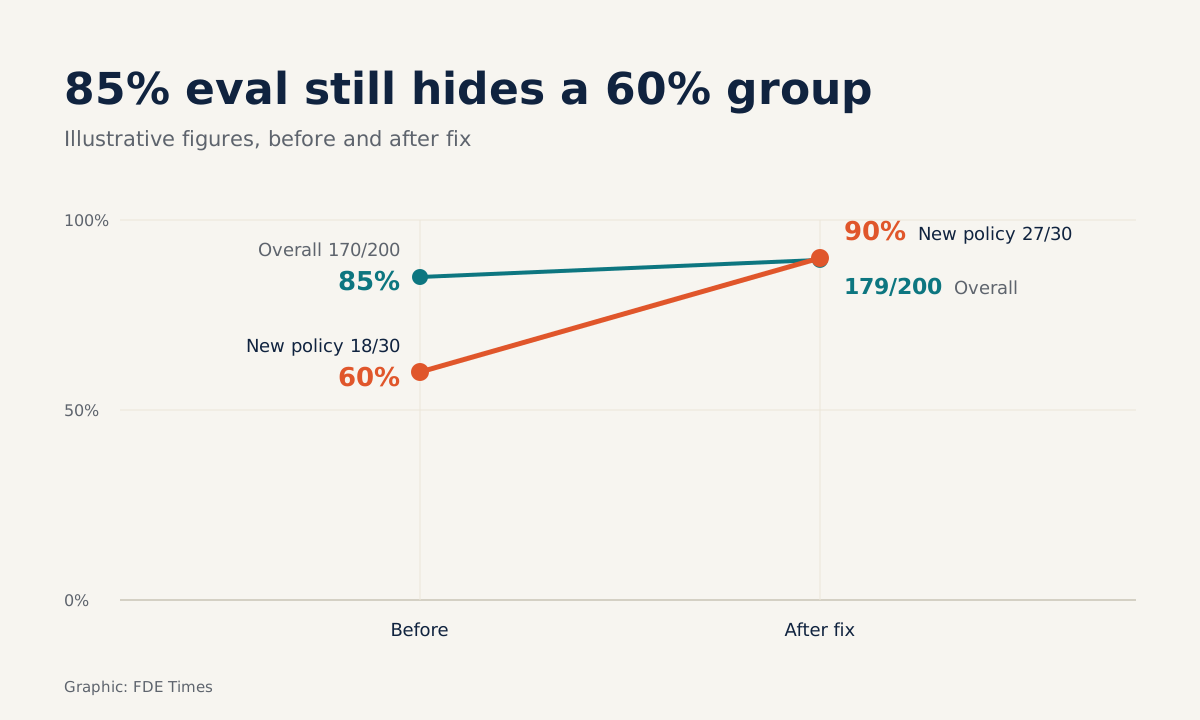
Consider the following story. You build an agent that answers internal questions and assemble an eval set of 200 questions. The agent gets 170 right, or 85%. That looks fine, but when you isolate the 30 questions about a new policy, the agent gets only 18 right, or 60%.
The cause is that the new policy data had not been added to the sources the agent retrieves from. You fix the pipeline and rerun the eval: the new-policy group rises to 27 out of 30, or 90%, and the overall score to 179 out of 200. These numbers are illustrative; when you tell your story, use your real ones.
A story like this shows exactly what the posting asks for. You do not trust an average, you know how to split an eval by group, and you traced the cause to the data rather than rushing to blame the prompt. Prepare two stories with this structure: problem, measurement, cause, fix, before-and-after result.
The design exercise: talk about data before prompts
In its announcement of the FDE partner network, Salesforce wrote that getting AI into production is a disciplined engineering job.
The announcement also describes the FDE as the person who works out how an agent connects to enterprise data and what guardrails it has, before anything gets built. That is also the best order in which to answer a design question.
Imagine the brief: a retailer wants an agent to handle refund requests. Many candidates open with the prompt. A better approach is to ask questions first: where does the order data live, which fields may the agent read, and may it write to the system?
For refunds above a threshold set by the customer, the agent must hand off to a human approver. The agent must never change a price on its own.
Only once data and guardrails are clear do you move on to tool calls. For example, the agent has one tool that looks up order status and another that creates a refund request, and the second may only be called after the conditions have been checked.
Next comes the eval: a question set split by request type, with a separate group of cases the agent must refuse.
Many people forget the final part. As Salesforce describes it, launch day is the starting line, not the finish line. The FDE’s work continues with monitoring and fixing incidents in production. Spend the last minute explaining which metrics you would watch after launch and what you would do if the rate of hand-offs to human approvers suddenly spiked.
Why does the onsite feel like a consulting interview?
Salesforce organises Agentforce FDEs into pods of two FDEs and one Deployment Strategist, so that moving from prototype to production happens quickly. The posting also mentions roughly 25% travel, working directly alongside customers. The “feels like consulting” comment on Blind therefore makes sense.
One Salesforce FDE has said the role carries a lot of influence, not only with customers but on the future of Agentforce. That remark suggests how you should tell your project stories.
When describing a project, add one detail: what you brought back from the field to the product team. A story with that detail shows you understand the FDE as a two-way bridge between customers and the product.
Don’t let the coding test knock you out
The advice to “do well on HackerRank” is a single comment on Blind. The thread does not confirm which round includes a coding test, so treat it as a possibility to guard against rather than a syllabus. Even so, it is the easiest place to lose points if you spend all your time preparing for the consulting side.
Pick one of the four languages the posting lists and practise on a fixed schedule. One suggestion: two problems a day, 45 minutes each, without looking up syntax. Prioritise the patterns common in integration work: string and array manipulation, counting and grouping with hash maps, sorting, and traversing nested data such as JSON.
After each problem, write a few tests for edge cases such as empty input or missing fields, then explain your solution aloud in two minutes. The habit trains exactly what an FDE needs: correct code under time pressure and the ability to explain your choices clearly.
Mistakes that sink strong candidates
One easy mistake is describing a project without eval numbers. When the interviewer asks “how do you know it works?”, “the customer was happy with it” is not enough. Another is designing an agent and forgetting the guardrails, which means forgetting who is allowed to stop the agent, and when.
Nor should your story end on launch day, when Salesforce treats that as the moment the work begins. The last mistake concerns your CV. Don’t just write “built agents with LangChain”.
Be more specific, for example: “took an agent integrating two customer systems into production, built a 200-question eval set, was on call for incidents for the first 3 months”. The numbers in this example are illustrative; replace them with your own real figures.
Aced counted about 65 roles with an FDE title at Salesforce, spread across six continents, as of 2 September 2026. The set of stories you prepare now is therefore likely to be reusable, and it should hold up the way a good agent does: with data, with guardrails, and with a plan for after launch day.
Was this article useful?
Thanks for the feedback!
5 sources
- Back to Build: Why Agentforce Inspired 3 FDEs to Return to Salesforce · 2025-11-15
- Salesforce Launches the Forward Deployed Engineering Partner Network to Scale Agentforce Success · 2026-04-15
- Forward Deployed Engineer (All Levels) – Salesforce · 2026-06-27
- salesforce forward deployed engineer interview (Blind) · 2025-09-12
- Salesforce Forward Deployed Engineer jobs (Aced) · 2026-09-02