Why opening with RAG misses the point in Cohere's FDE design round
Candidates describe a one-line prompt with no schema or user numbers; strong answers first ask where the system will run, like a small customer discovery.
In brief
- Candidates report this order of rounds: a recruiter call, AI system design, debugging, then coding, sometimes with AI assistance allowed.
- Cohere reportedly probes retrieval architecture harder than other companies and puts heavy weight on enterprise context: data sovereignty, audit logs, on-premise deployment.
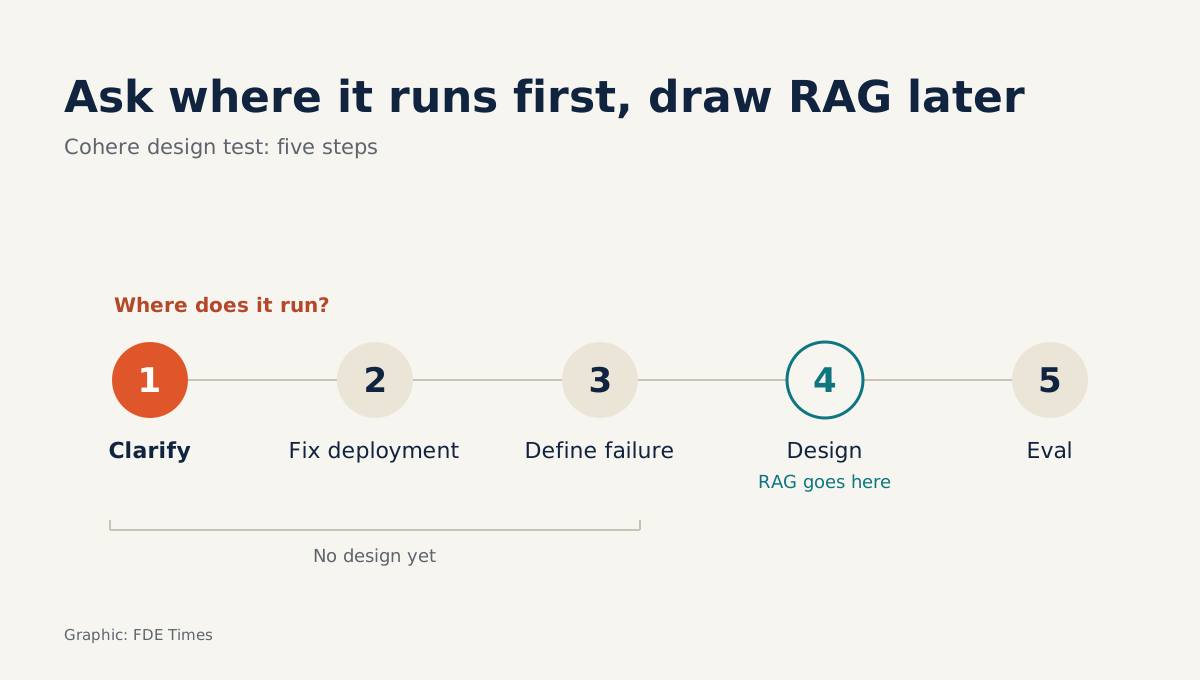
- A good answer follows this order: ask clarifying questions, pin down the deployment environment, define failure, choose the architecture, then design an eval with numbers.
Picture an interviewer who says just one sentence: “Design a guardrail for an LLM’s knowledge cutoff.” This is a design question a candidate reported on Lodely after interviewing at Cohere. It comes with no schema, no user count and no indication of which cloud the system runs on.
The easiest reflex is to start drawing a RAG pipeline straight away. You can draw one, but doing so skips exactly the part the interviewer wants to see.
Cohere’s FDE job posting for its Agentic Platform team says the role leads the design, building and delivery of LLM-powered agents: agents that can reason, plan and act across multiple tools and APIs.
The same posting asks the FDE to own scoping and shaping use cases end to end, not just to write code. That makes the design round a customer discovery session in miniature. If you are aiming for an FDE role at any enterprise LLM company, this is the skill to practise first.
What do the rounds look like?
A guide on techinterview.org describes Cohere’s general interview process as a loop of 4-5 rounds lasting about 4-7 weeks. The guide is not specific to FDE roles.
For forward-deployed roles, candidates on Lodely report a more specific order. These are candidate accounts that Cohere has not confirmed, so treat them as a rough map rather than an official syllabus.
| Round (as candidates report it) | What it really tests | How to prepare |
|---|---|---|
| Recruiter call | Whether you understand FDE as a customer-facing role | A story about a time you scoped a problem for users yourself |
| AI system design | Enterprise LLM architecture and its trade-offs | The five-step method below, with plenty of RAG practice |
| Debugging | Reading errors calmly in a system someone else wrote | Practise debugging a retrieval pipeline that returns wrong results |
| Coding (sometimes AI-assisted) | Production-ready Python, and judgement when an AI assistant is involved | Write clean, tested code and be able to explain every line the AI suggests |
What are interviewers really scoring?
Cohere’s posting lists three things worth reading closely. First comes production Python, together with the ability to build rigorous eval frameworks that go beyond trial and error.
Under nice-to-haves, the posting mentions experience in heavily regulated or sensitive industries such as finance, healthcare and telecoms, along with an understanding of security and compliance for enterprise AI.
The techinterview.org guide is blunter still. It says Cohere interviews probe retrieval architecture harder than its peers do, so its first piece of advice is to learn RAG in real depth. Next comes familiarity with enterprise concerns: data sovereignty, audit logs, on-premise deployment.
The deployment concern is not theoretical. Cohere’s documentation lists four deployment options, including private deployment on cloud, in which the enterprise runs the entire Cohere stack on its own cloud platform.
Speaking to TechCrunch about its North agent platform, a Cohere co-founder said they could deploy on “a GPU sitting in a closet” that a customer already has somewhere.
Worked example: a guardrail for knowledge cutoff
Step 1: ask clarifying questions. Suppose the interviewer answers that the customer is a bank and the internal assistant serves its advisers. The first thing to ask is where the system will run and whether data may leave the bank’s infrastructure. Only then ask which kinds of question depend on time, and what the consequences of a wrong answer are.
Step 2: pin down the deployment constraints. Suppose the bank runs on-premise or on a private cloud. You then cannot call an external web search to fetch fresh information: the only “fresh” source is the internal document store, so the process for updating that store becomes part of the guardrail. Every time the guardrail intervenes must also be written to an audit log so the compliance team can review it.
Step 3: define failure. Knowledge cutoff causes two kinds of error. The first is the model confidently answering about an event that happened after the cutoff date. The second is more dangerous for a bank: the model gives information that was once correct but is now out of date, such as a regulation that has been replaced, even though the store already holds the new version.
Step 4: architecture. Only now do you draw, and you draw within the limits set in step 2. A classifier labels whether a question is time-sensitive. Time-sensitive questions are routed to retrieval over the internal store, with documents tagged by effective date and the latest version preferred.
If the newest document is older than the allowed threshold, or no document is found, the system gives a qualified answer and states the date its data runs to. If a qualified answer is not possible, the system declines.
Step 5: eval. This is what separates strong candidates from average ones. You could sketch something like this on the whiteboard:
EVAL_SET = [
    {"q": "What is the definition of the capital adequacy ratio?", "time_sensitive": False},
    {"q": "How does the latest lending limit regulation apply?", "time_sensitive": True, "has_fresh_doc": True},
    {"q": "What does the policy announced last week say?", "time_sensitive": True, "has_fresh_doc": False},
]

# results: each EVAL_SET item after running through the system, with added
# answered_confidently, refused, cited_latest_doc (whether the system used the latest version)
def score(results):
    post_cutoff = sum(r["time_sensitive"] and not r.get("has_fresh_doc")
                      and r["answered_confidently"] for r in results)
    stale_doc = sum(r["time_sensitive"] and r.get("has_fresh_doc")
                    and r["answered_confidently"] and not r["cited_latest_doc"] for r in results)
    over_refusal = sum(not r["time_sensitive"] and r["refused"] for r in results)
    return {"post_cutoff": post_cutoff, "stale_doc": stale_doc, "over_refusal": over_refusal}
The first two metrics correspond to the two kinds of error in step 3, and they pull against the third. Tighten the guardrail and confident but outdated answers fall, but unnecessary refusals rise.
The posting asks for evals that go well beyond trial and error. In this question, the way to show that is to name the trade-off and propose that the bank choose its own thresholds according to the consequences of each type of error.
How to practise
Start by reading the posting closely and underlining every verb: design, scope, deliver, evaluate. Each verb should map to a real story from your own experience. Then pick three enterprise LLM design questions and solve each one using the five steps, speaking aloud as if you were in the interview room.
In parallel, build a small RAG system with an eval attached. It does not need to be pretty, but it does need a test set and before-and-after numbers. On your CV, do not write “experience with RAG”.
Write instead which system you built an eval for and which kind of error it reduced. If you have worked with customers in finance, healthcare or telecoms, put that first, because it is exactly the nice-to-have the posting names.
Mistakes that cost candidates points
The most common mistake is offering a solution before asking clarifying questions. The second is handling knowledge cutoff with a single prompt line along the lines of “don’t make things up”. A prompt like that cannot be measured or verified. The third is forgetting deployment: an architecture that depends on calling an external API collapses the moment the customer says they run on their own infrastructure.
In the AI-assisted coding round, the trap lies elsewhere: pasting suggested code wholesale without being able to explain it. Treat the AI assistant like a junior colleague. You may ask it for a draft, but you are responsible for every line.
The “knowledge cutoff guardrail” question sounds like a technical puzzle. What it really asks is whether you are someone a bank would trust with the GPU in its closet.
Was this article useful?
Thanks for the feedback!
5 sources
- Forward Deployed Engineer, Agentic Platform (Europe) – Cohere AI, Built In London
- Cohere Interview Process 2026: Enterprise AI Lab · 2026-05-04
- Cohere Interview Questions: 6 from Real Interviews · 2026-10-31
- Deployment Options - Overview
- Cohere's new AI agent platform, North, promises to keep enterprise data secure · 2025-08-06