Why every FDE has to explain the same system twice
A director needs one paragraph to make a decision; the client's lead engineer needs enough detail to run the system alone after you leave.
In brief
- Choose the audience before the explanation: a director asks about decisions, a lead engineer asks about operations.
- The context diagram works even for non-technical readers, technology names belong only on the container diagram, and both must come from the same model.
- The technical version is what the client's engineers will open after you have left the project, so treat it as a deliverable.
The person who will be paged at 3am when the system breaks is rarely the person who approved it. A Forward Deployed Engineer usually has to explain the same system at least twice. The first time is in a meeting room with the operations director, who signs off the budget and answers to the leadership team. The second is with the client’s lead engineer, who will be on call for incidents in the middle of the night long after you have left the project.
Those two meetings call for two different ways of talking. FullStack writes that FDEs must explain technical trade-offs to people who will never read the code. Palantir goes further and splits the work into two roles: according to Oxagile, the Echo role handles the mission, stakeholders and client adoption, while the Delta role handles technical execution.
Working alone, you have to play both roles, with two explanations drawn from a single model so that they never contradict each other.
Each audience arrives with a different question
Lucidchart advises thinking about who the audience is before choosing an approach. On an FDE project, that question has a fairly specific answer.
The director wants to know what the system changes about their work and what they need to decide. The lead engineer wants to know what runs where, what can break, and who fixes it when it does.
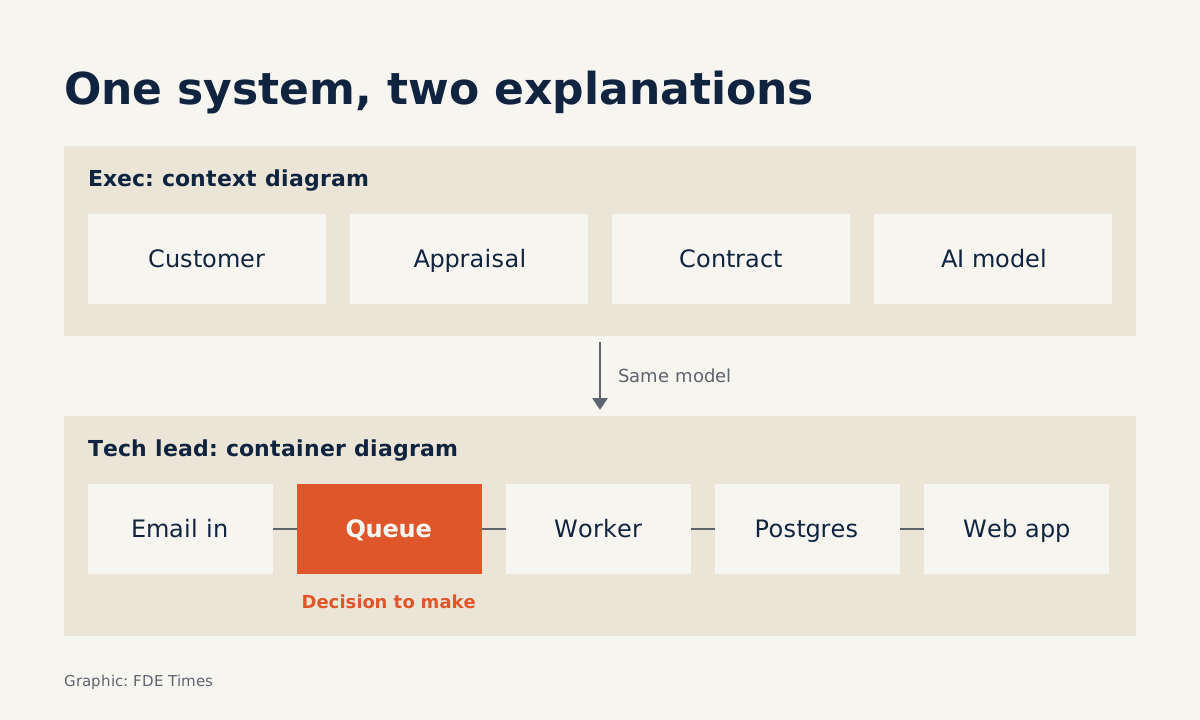
The C4 model provides two matching layers. According to the C4 documentation, the system context diagram is the kind you can show to non-technical people. Because its audience does not need to know the technology, the safe approach is to draw only people and software systems.
The container diagram sits one level below and is meant for developers and operations staff. It shows the high-level architecture, the main technology choices and how the containers communicate with one another. Because both diagrams describe the same system, what you promise the director will match the configuration you hand over to the engineer.
Pictures have an advantage of their own. Lucidchart argues that visual content is easier to learn and is remembered longer than concepts that are only read or heard, so a four-box diagram often does more than three pages of description.
One claims system, told twice
Take a hypothetical case. You deploy an agent for an insurance company that reads claims emails, extracts the fields, and puts them on a screen for claims adjusters to approve. One decision has to be made: process each claim as soon as the email arrives, or put claims in a queue and work through them in turn.
The director’s version opens with a context diagram of four boxes: the customer filing the claim, the claims adjuster, the company’s existing policy management system, and the AI model provider. No arrow on it carries the name of a database.
Next comes a single trade-off paragraph, written so the director can answer straight after reading it:
“There are two options.
Option one: each claim is read as soon as the email arrives, and adjusters see the result almost instantly. The catch is that if the external AI service is slow or goes down, some claims have to be resubmitted.
Option two: claims join a queue and are read one by one, with results ready after a few minutes. In return, no claim is lost even when the AI service has problems.
The team recommends option two. We need you to confirm just one thing: is a wait of a few minutes acceptable for the current claims review process?”
The lead engineer’s version is the container diagram of the same system. There is an email intake service, a queue, a worker that calls the model’s API, a Postgres database that stores the extracted results, and a web app for the adjusters.
Here the conversation turns to how many retries to allow, where failed messages are stored, where alerts are set, and who is on call when the queue backs up.
The table below puts the same decision in both registers:
| Aspect | For the operations director | For the lead engineer |
|---|---|---|
| Decision | Is a wait of a few minutes acceptable | Switch from synchronous processing to a queue with workers |
| Risk | Claims may have to be resubmitted | Timeouts calling the model API, lost messages |
| Mitigation | No claim is lost | Bounded retries, a place to store failed messages |
| Their job after the meeting | Answer yes or no | Receive the runbook and on-call rota |
Keeping two versions from becoming two stories
Start with a single model: a list of the actors, systems and containers, kept in one file the whole team edits. Draw the context diagram first. If you cannot draw the system without mentioning technology, you probably do not yet understand whom it serves.
Then write the trade-off paragraph. The Hustling Engineer advises opening with why the concept matters to the listener and always tying technical work to a concrete outcome. The paragraph should therefore end with a question the listener can answer, such as “is a wait of a few minutes acceptable”.
The Hustling Engineer also recommends comparisons with everyday objects and experiences to make complex ideas easier to grasp, and defining any jargon you cannot avoid.
Try replacing “latency” with “a wait of a few minutes” and “retry” with “resend automatically”. A queue can be compared to the ticket machine at a bank: whoever arrives first is served first, and nobody is skipped when a counter closes for a while.
Only then draw the container diagram, copying the component names from the same model and adding the technology. Finally, ask the director to sum up the decision in their own words. If they repeat back the question you posed, the explanation has worked.
The usual mistakes come from both sides
The most common mistake with non-technical audiences is simplifying so far that it becomes condescending. a16z describes FDEs as working inside the client’s organization to understand the business context, and that context lives in the heads of the very people you are presenting to.
The operations director understands the claims review process better than you do, so use the language of that process.
The opposite mistake is too much detail. If the director’s slides carry the name of an open-source library, you are probably presenting to yourself.
The most dangerous mistake is on the engineering side: handing the lead engineer the deck you showed the director and calling it a handover. The person on call at 3am needs the container diagram, the runbook and the decisions that were made; slides will not help them find which message is stuck.
The last mistake is letting the two versions drift apart, for instance telling the director “a few minutes” while the timeout configuration allows a wait of an hour.
Turning the skill into evidence on your résumé
FullStack sets two requirements side by side for a strong FDE: the technical depth of a senior engineer, and the judgment to work with non-technical people on problems nobody has clearly defined. A line on a CV struggles to show this, but documents can.
In your portfolio, place the context diagram, the container diagram and the trade-off paragraph from the same project side by side, each labeled with its intended audience. An interviewer will see both requirements at once.
When reading job postings, look for lines asking you to work with both technical and non-technical stakeholders. They suggest the interview may ask you to explain a system twice. Practice beforehand on a system you have built, with a timer: two minutes for the director, ten for the lead engineer.
On the day you leave the project, the director will remember the decision they made, and the lead engineer will open the documents you left behind the first time the queue backs up. Each explanation should be written for that moment.
Was this article useful?
Thanks for the feedback!
7 sources
- The seven skills that define a forward-deployed engineer · 2026-11-10
- The Palantirization of everything · 2026-01-16
- How to Explain Technical Concepts to Non-Technical Stakeholders · 2024-11-24
- How to communicate technical information to a non-technical audience · 2023-08-02
- System context diagram | C4 model
- Container diagram | C4 model
- Palantir Forward Deployed Engineer Model: What Companies Should Copy · 2026-07-13