How FDEs get the most from a domain expert's 30 minutes a week
The FDE filters out the hard traces in advance, so the expert can grade them and write down the quality criteria within the same session.
In brief
- In 30 minutes an expert can read roughly 20-50 outputs, but a round of error analysis needs at least 100 traces, so the FDE has to filter first.
- Criteria only surface through grading, so leave the prewritten rubric at home: have the expert grade, then settle each criterion as a sentence.
- The expert's pass/fail labels are the benchmark for calibrating the LLM judge; running the judge and reading its results between sessions is the FDE's job.
In their FAQ on AI evals, Hamel Husain and Shreya Shankar give a very specific number: whenever the system changes significantly, spend 30 minutes reading 20-50 LLM outputs by hand. If the client’s domain expert can give you only half an hour a week, that number fits your slot exactly.
The catch is that the same FAQ recommends reading at least 100 traces for a full round of error analysis. You cannot get through 100 traces in 30 minutes, and the expert will not give you more time.
So the skill to master is designing that 30-minute session. The FDE handles the filtering, the expert handles the judgment, and every session must end with at least one criterion written down as a sentence.
Done well, the expert’s labels become the yardstick for calibrating an LLM judge that runs across thousands of cases. Done badly, you get a polite meeting and nothing you can use.
The expert rules, the FDE filters
Husain and Shankar advise handing authority over quality to a single expert who understands the users, rather than to a committee. They call this person a “benevolent dictator” and argue it is the most effective arrangement. The reason is practical: a committee of three will debate one case endlessly, while one person with authority can settle it on the spot.
They also identify the step that genuinely needs an expert’s eye: open coding, or noting where each trace goes wrong. Everything else, from running the judge to filtering traces, can go to the FDE and the machine.
Anthropic’s documentation on building evals goes further: many automatically graded questions, even with a slightly weaker signal, beat a few carefully hand-graded ones.
Both pieces of advice lead to the same rule. Never ask the expert to grade everything. They should see only the cases that the machine and the FDE cannot decide on their own.
A prewritten rubric will not survive the first session
Many FDEs arrive with a carefully drafted ten-line rubric and ask the expert to approve it. Research on EvalGen, presented at UIST 2024, shows why this fails. The authors describe a loop: users need criteria to grade outputs, yet grading outputs is what helps them define the criteria.
The paper also found that some criteria emerge only when graders see particular outputs. In other words, experts cannot anticipate in advance everything they care about.
You have to show them real, sufficiently varied outputs and record what they say as they grade. That is why each session should combine grading and settling criteria within the same 30 minutes.
A 30-minute session, minute by minute
Take a hypothetical example. You have deployed an agent that drafts email replies to customers for an insurance company, and the expert is the head of the claims team. Over the week, the system produced 140 traces.
You run the LLM judge over all of them, read them yourself and grade each one pass or fail, then pick 24 cases: 10 where you and the judge disagree, 8 ambiguous ones you are unsure about yourself, and 6 showing a failure mode you have not seen before.
Anthropic’s documentation advises including ambiguous cases that even humans struggle to agree on. Those are the 8, and they are the ones most worth the expert’s time. The session could run like this:
| Minutes | Activity | Output |
|---|---|---|
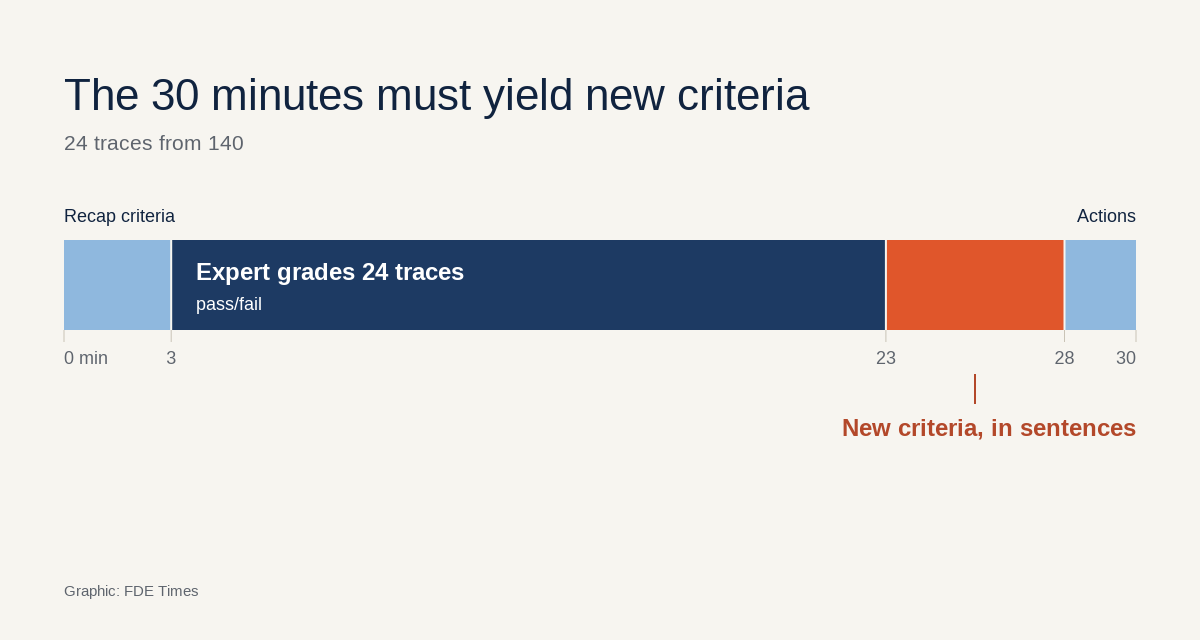
| 0-3 | FDE recaps the criteria settled last week | Expert confirms or amends |
| 3-23 | Expert grades 24 traces, each pass/fail with a one-line reason | 24 labels |
| 23-28 | Review the cases where the expert and the FDE disagreed | One or two new criteria, written as sentences |
| 28-30 | Agree what the FDE does before the next session | List of changes |
Twenty minutes for 24 traces leaves 50 seconds per trace. That pace is hard to hit without binary labels. Husain and Shankar argue that pass/fail grading forces clearer thinking and more consistent labeling. A 1-5 scale would have the expert pausing over a 3 versus a 4 on every case.
Now see how a new criterion emerges. In trace 14, the agent writes: “Your claim is eligible, and the payment will be made next week.” You and the judge both mark it pass, because the email is polite and factually correct. The expert fails it immediately: staff must not promise an outcome before the assessment is complete.
No rubric of yours contained that criterion.
Minutes 23-28 are where it becomes a sentence: “The email must not state an outcome or a payment date before an assessment decision has been made.” Anthropic offers a test for such sentences: a good task is one where two experts grading independently would reach the same pass/fail verdict.
You are the second independent grader. If, after reading that sentence, you still disagree with the expert on a similar case, the sentence is still vague and needs rewriting.
Between sessions, the work is the FDE’s
The expert’s labels are not the end product. Anthropic advises that LLM judges be calibrated closely against human experts, and 24 labels a week are exactly the benchmark set for doing so. Add the new criterion to the judge’s prompt, rerun it on the 24 cases and count how many the judge agrees with the expert on.
Then read the results. Anthropic states plainly that you will not know whether a grader is working well unless you read the transcripts and scores from many runs.
Wherever the judge still disagrees, put those cases into the next session’s batch of 10 disagreements. Every time you change the prompt or the model, rerun this loop, in line with the advice to reread 20-50 outputs after each significant change.
Mistakes that waste the 30 minutes
The most common mistake is inviting three people to be safe: a team lead, someone from legal, someone from customer service. Three people bring three opinions, and no case gets settled. Ask for exactly one person with decision-making authority, and let them consult others outside the meeting.
The second mistake is bringing only easy cases, to keep the meeting smooth and the system looking good. The expert nods 24 times, you learn nothing, and the judge remains untested exactly where it is weakest.
The third is bringing a file of 200 raw outputs and leaving the expert to sort through it. That puts the most expensive person on the project to work on the cheapest task.
Putting this skill on your résumé
When you read an FDE job posting, check whether it mentions both working with domain experts and building evals. If it does, that is your opening to show you have combined the two into a process that runs every week.
On your CV, describe the exact process you ran: how many traces per round, how many criteria you settled with the expert, and how closely the judge agreed with the expert after calibration.
In interviews, tell the story of a criterion like the one in trace 14: something you could never have come up with yourself.
An exercise for this week: go back to your last meeting with a client-side expert and count how many criteria were written as sentences clear enough for two independent graders to reach the same verdict. If the answer is zero, your next 30-minute session already has an agenda.
Was this article useful?
Thanks for the feedback!