A pilot can work perfectly and still die on one question from finance
IBM finds only about 25% of AI initiatives reach their expected ROI, and the missing FDE skill, reading a client's profit and loss, can be learned.
In brief
- Time saved is only soft ROI unless it changes a revenue or cost line on the client's P&L.
- AI budgets increasingly sit with business units, not only with the CIO, so ask plainly who holds the money.
- Finance is where the ROI question will come from, so bring them in early and measure a baseline in the first week.
Six weeks into a pilot, everything looks fine. The agent runs smoothly, the accuracy numbers are good and the head of operations is nodding along. Then someone from finance asks a single question: “How much does this help the company earn or save?” The room goes quiet, and the FDE has nothing to offer but a latency chart.
The scenario is common. IBM cites an MIT report from summer 2025 finding that 95% of generative AI pilots are failing. IBM’s own CEO survey found that only about 25% of AI initiatives reach their expected ROI, 16% are scaled across the enterprise, and only about 29% of executives are confident they can measure ROI.
IBM’s conclusion is that the main challenge is organizational rather than technological. For a developer who wants to become an FDE, that is good news. The missing skill is the ability to follow the client’s money, not one more framework, and it can be learned.
Is time saved the same as money?
IBM splits ROI into two kinds. Hard ROI is tangible impact tied directly to profit. Soft ROI covers benefits that do not yet show up in profit but still help the organization, such as less tired employees or faster decisions.
The trap for engineers is that most of what they can measure (minutes saved, automation rate, accuracy) is only soft ROI. It becomes hard ROI only when it changes a specific line on the profit and loss statement (P&L): revenue goes up, costs go down, or an expense that would have been incurred is no longer needed.
Clients make money in three basic ways: selling more, keeping customers longer, and doing the same work at lower cost. Before writing any code, find out which of these your project affects. If the answer is “none of them”, the project is simply waiting its turn to be cut.
A worked example: a 200-person call center
Take a hypothetical consumer finance company with a call center of 200 agents, each handling 60 calls a day. After every call, an agent spends 3 minutes writing notes into the CRM. You deploy a call-summary agent that brings that down to 1 minute.
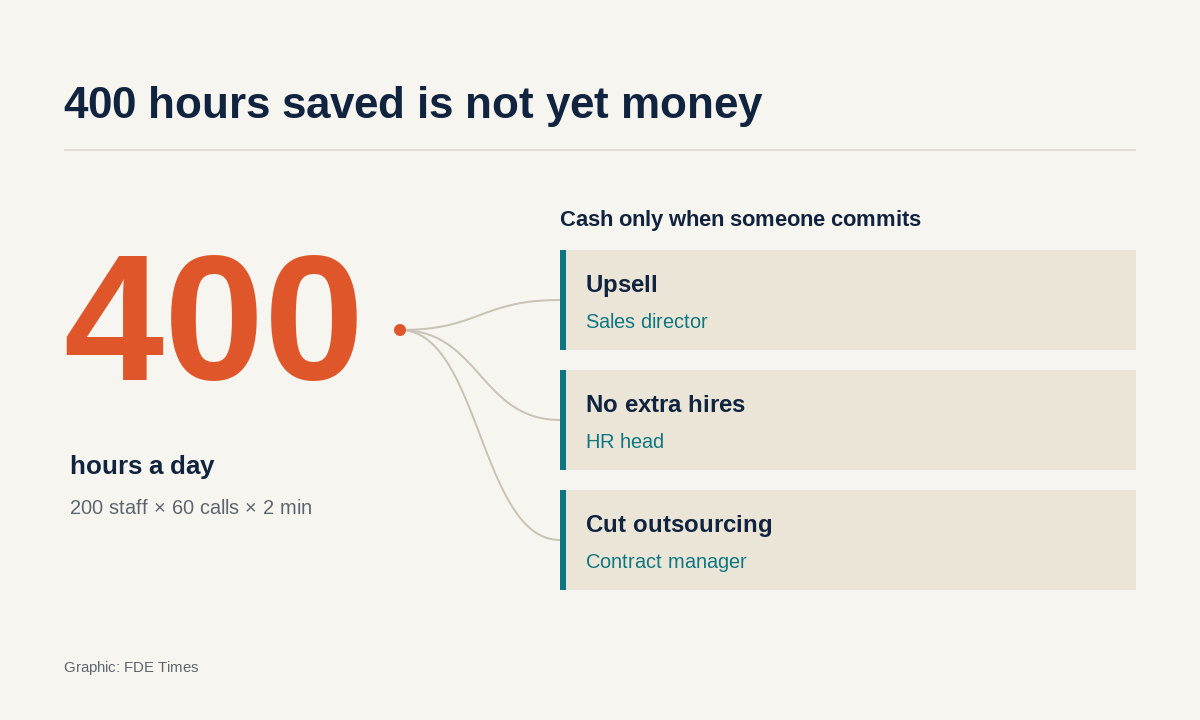
The technical arithmetic looks great: 200 people × 60 calls × 2 minutes = 24,000 minutes, or 400 hours a day. Now ask the finance question: where do those 400 hours go? If staff still work full shifts, still draw full salaries and call volume does not rise, the P&L does not move by a cent. That is soft ROI.
There are three ways to turn it into hard ROI, and each needs a different person to agree. First, the call center takes on more sales calls with the same team, which requires the head of sales to commit to supplying enough leads. Second, the company avoids hiring extra staff for the coming peak season, which requires the head of HR to confirm the hiring plan.
Third, outsourcing costs come down, which requires the manager of the outsourcing contract to agree to scale it back.
The answer to finance then stops being “we save 400 hours”. It becomes: “400 hours a day equals the peak-season headcount HR was planning to hire, and HR has confirmed that figure.” That is a financial statement someone can verify.
Where is the money, and who signs?
Many engineers assume the CIO holds the money, because the CIO is the first person they meet. Futurum Group has found the opposite: AI spending increasingly sits in business-unit budgets, which spreads budget authority beyond the CIO.
Its advice to vendors is to confirm who actually controls the budget before treating the CIO as the main economic buyer.
An opinion piece on DEV Community describes a common split: IT chooses the technology, the business unit adopts it, finance approves the budget. The problem, in the author’s view, is that nobody owns the financial outcome, meaning the gap between projected and actual numbers.
This is one writer’s perspective, not a survey, yet it gives FDEs a usable map.
| Party | What they care about | What the FDE needs to bring |
|---|---|---|
| IT | Security, integration, running costs | Architecture, data handling, maintenance plan |
| Business unit | Whether the department hits its targets | Business metrics before and after, the new workflow |
| Finance | Money spent versus money returned | Baseline, assumptions, how hard ROI is measured |
Finance matters even more once costs start running over plan. Futurum reports that 46.9% of companies say their AI spending is over budget, while only 5.6% are spending less than planned. According to Futurum, finance is also the function most likely to force that conversation into the open.
If you have not met anyone from finance yet, they will come looking for you, usually at the worst possible moment.
Four questions for discovery
You do not need to see the client’s financial statements. You need four questions, asked naturally during customer discovery, ideally with the person who runs the business process.
“If this project succeeds, which number in your monthly report will change?” This finds the P&L line. “What is that number today, and who measures it?” This gives you the baseline. “Which department’s budget pays for the project?” This identifies the economic buyer.
“If you want to roll this out company-wide, who will have to sign off?” This tells you whom to meet next.
Record the answers on a short one-page document: the P&L line, the baseline, the budget holder, the person who signs off on scaling, and the person who will compare projections with actuals. Any blank box is a project risk, as serious as an undocumented API.
Three common mistakes
The first mistake is reporting technical metrics to people who need financial ones. 92% accuracy means nothing to the person approving the budget unless you can say how much the remaining 8% costs to handle manually.
The second is failing to measure a baseline before deployment. Once the agent is live, there is no way to prove that the task “used to take 3 minutes”. Measure in the first week, even if that means timing 30 calls by hand with a stopwatch.
The third is mistaking the friendliest user for the decision-maker. A team lead who praises the work does not necessarily hold the budget. If you have only one relationship on the client side, whether the project lives or dies depends on whether that person stays in the room for the budget meeting.
Putting this skill on your CV
When reading an FDE job description, look for passages about client business outcomes or working with multiple stakeholders. Where they appear, that is the place for an example like the call center above, including in interviews. On your CV, do not write “built a call-summary pipeline”.
Write that you cut after-call handling time from one specific figure to another, which department confirmed it, and what that changed in their plans.
A strong FDE can do more than deploy an agent. They can stand in the middle of the meeting room and answer the finance team’s question before anyone asks it.
Was this article useful?
Thanks for the feedback!