When AI makes the work faster, agree first on what must not get worse
A guardrail metric with a numeric margin and a consequence agreed in advance keeps an FDE from winning on speed while losing on quality.
In brief
- Every metric pulls attention toward what it measures, so if only speed is measured, quality gets left behind.
- A guardrail metric works only when it has a numeric margin and a consequence agreed in advance.
- Data from DORA, METR and an experiment with BCG consultants show that AI can make work faster but less stable, and that users' impressions are no substitute for measurement.
In 2025 Klarna’s chief executive, Sebastian Siemiatkowski, made a notable admission. When the company organized its customer service around AI, cost seems to have become too dominant a criterion, and the end result was lower quality.
Every FDE working on an AI project will meet a smaller version of this story. The sponsor on the client side wants one number: how much faster the agent handles tickets, how many days sooner applications are approved, how many hours the operations team saves.
You optimize that number, the demo looks good, and three months later someone discovers that something else, which nobody was tracking, has slipped.
The skill required here is very specific. From the scoping session onward, you must agree with the client, in writing, what must not get worse, how much worse counts as failure, and what happens then.
Every metric pulls the handlebars its way
Andy Grove set out the problem in High Output Management, long before LLMs existed. According to Yevgeniy Brikman’s review of the book, Grove advised pairing indicators so that both the effect and the counter-effect are measured at once. Cedric Chin, writing for Holistics, cites the image Grove used: measurement is like riding a bicycle, and wherever you look is usually where you go.
Many teams running product experiments have turned this idea into process. Spotify’s Confidence documentation distinguishes a success metric, the one you want to improve, from a guardrail metric, the one you do not want your change to harm.
Spotify adds the idea of a non-inferiority margin: how much a metric may worsen before the change is deemed a failure.
According to Spotify, the real value of this margin is that it forces the team to state how much they are willing to pay on one metric in exchange for an improvement on another. “Quality must not fall” sounds fine but cannot be verified. “The reopen rate must not rise by more than 1 percentage point” can.
Systems operators go a step further and fix the consequence too. The sample error budget policy in the Google SRE Workbook states that if a service has exceeded its error budget for the preceding four weeks, all changes and releases are halted, except P0 incidents and security fixes, until the service is back within its SLO.
So when the threshold is crossed, nobody has to hold a meeting to argue about what to do.
Why AI projects need a guardrail more urgently
AI increases the volume of work produced, and that extra volume is where quality tends to break. The DORA 2025 report found that AI adoption now correlates positively with software delivery throughput but still correlates negatively with stability.
DORA explains that without robust automated testing, mature version control practices and fast feedback loops, a rising volume of changes leads to instability.
AI’s effect is also uneven across types of work. HBS Working Knowledge describes an experiment with BCG consultants: on some kinds of task, those using AI worked faster and better.
On more complex work, however, they were 19 percentage points less likely to reach the correct answer. Measure only average speed and you will not see that the hard cases are going wrong more often.
Users’ impressions are unreliable too. In METR’s randomized trial with experienced open-source developers, using early-2025 tools, those allowed to use AI took 19% longer to finish issues.
They still believed AI had made them 20% faster. METR later noted that the result was dated and published new data in February 2026. The gap between perception and reality remains a reminder for every pilot: praise from users is no substitute for measurement.
A worked example: a customer-support agent pilot
Take a hypothetical case. You deploy an agent that drafts replies for an insurer’s customer-service team. The sponsor measures handling time per ticket. You propose as the guardrail the share of tickets that customers reopen within 7 days, because a fast but wrong answer brings the customer back.
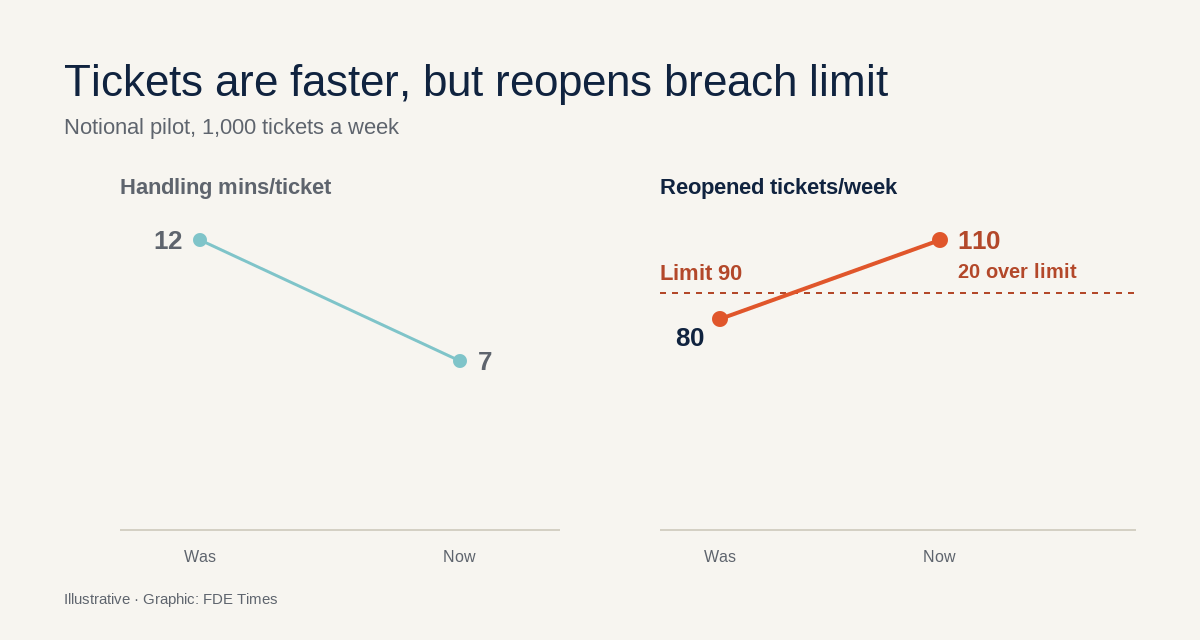
The baseline over the four weeks before the pilot: 1,000 tickets a week, 12 minutes per ticket on average, a reopen rate of 8%, or 80 tickets. Both sides agree an allowed margin of at most 1 percentage point, meaning no more than 90 reopened tickets a week.
The consequence is agreed as well: two consecutive weeks over the margin and the agent reverts to suggesting replies to staff only, with no sending on its own.
After four weeks, handling time has fallen to 7 minutes, saving 5,000 minutes, or about 83 hours a week. The reopen rate has risen to 11%, or 110 tickets, 20 tickets over the margin. Report only the 83 hours and the pilot looks like a big win. With a guardrail, you know you must break down the reopened tickets by request type before scaling up.
This is where the BCG consultant experiment becomes useful. The reopens may well be concentrated in complex cases such as claims disputes. You can keep the agent on simple cases, send the hard ones back to people, then measure again. The guardrail is what tells you where to split the scope.
Write a one-page agreement before the first line of code
No elaborate tooling is needed. A one-page document with seven rows, signed off by the sponsor at kickoff, is enough:
| Item | Question to answer | Example from the pilot above |
|---|---|---|
| Success metric | What does the client want to improve? | Handling time per ticket |
| Guardrail metric | What could get worse because of that improvement? | Reopen rate within 7 days |
| Baseline | What is it now, and over what period was it measured? | 8%, four weeks before the pilot |
| Allowed margin | How much worse may it get, at most? | +1 percentage point |
| Measurement window | Weekly or monthly, and on which set? | Weekly, all tickets |
| Consequence | What stops if the margin is breached? | Revert to suggestion-only mode |
| Decision-maker | Who can approve continuing? | Head of customer service |
To choose the guardrail, ask the client: “If the agent works fast but sloppily, who will notice first, and what will they be looking at?” The answer usually points to a metric the client already has data for.
For software delivery projects, the DX Core 4 framework uses Change Failure Rate as its main quality metric, so that a focus on speed does not come at the expense of stability.
Measure the baseline before switching on AI. Wait until after the pilot and you have no reference point, and every argument about quality comes down to impressions.
Mistakes that make a guardrail useless
The most common is choosing the guardrail after the results are in, when everyone tends to pick the metric that makes the project look good. Almost as common is having a metric but no numeric margin, so every dip has to be argued over from scratch.
Another trap is measuring at the level of individuals. DX warns that the speed metrics in Core 4 must never be used at the individual level or tied to performance reviews. If the client’s staff know their own handling time is being scored, they will steer toward that number, just as Grove’s bicycle image predicts.
The last is looking only at averages. A healthy average reopen rate can hide a group of hard cases that has deteriorated markedly. Break the guardrail down by type of work from the start.
Put the metric pair in your CV and interviews
In a CV, do not write only “reduced handling time”. A speed figure on its own tells half the story, because it says nothing about the cost.
Write the pair, for example “reduced handling time while keeping the reopen rate within the margin agreed with the client”. Have a story ready about a time you had to narrow the scope because a margin was breached, with the baseline, the margin and the decision taken.
When reading job postings, look for passages about measuring outcomes or agreeing success criteria with clients. Those are the best openings for this story in an interview.
Exercise: is the pilot back within the margin?
Return to the insurance pilot above. Suppose that after claims disputes are handed back to people, the first week has 1,000 tickets with 92 reopened and the second week has 1,000 tickets with 88 reopened. The margin is still 90 tickets a week, and the consequence is still a return to suggestion-only mode after two consecutive weeks over the margin.
Before reading on, answer for yourself: must the agent stop sending on its own, and what do you report to the sponsor? Answer: the first week is 2 tickets over the margin and the second is within it, so there have not been two consecutive weeks over, and the agent may keep running.
The report should state both metrics, with a note that the reopen rate is close to the threshold and needs watching for one more cycle.
Redo this calculation with real figures from your current project. If you cannot fill in the baseline or the margin, that is what to settle with the client this week.
Klarna’s lesson is not about choosing AI or people. The company let a single number take the handlebars. On your next project, you can fix the second number at kickoff.
Was this article useful?
Thanks for the feedback!
9 sources
- 'High Output Management' by Andrew S. Grove · 2016-09-01
- Beware What You Measure: The Principle of Pairing Indicators · 2019-05-29
- Better Product Decisions with Guardrail Metrics · 2026-05-12
- Appendix B - Example Error Budget Policy · 2018-02-19
- Announcing the 2025 DORA Report · 2025-09-24
- Introducing the DX Core 4 · 2024-12-10
- Klarna rethinks AI cost-cutting plan with call for real people · 2025-05-08
- Humans vs. Machines: Untangling the Tasks AI Can (and Can't) Handle · 2023-11-22
- Measuring the Impact of Early-2025 AI on Experienced Open-Source Developer Productivity · 2025-07-10