Write your exit plan in week one, before the client depends on you
The handover schedule, the named owner and the conditions for stopping belong in the scoping document, not in a hurried final week.
In brief
- Insight Partners describes the FDE as someone who does not stay at the client permanently, and OpenAI measures success as the point when the client no longer needs an FDE for that class of problem.
- The definition of done, the stop condition and a named owner must be agreed at kickoff, because ownership can only be transferred one piece at a time.
- A handover is finished only when a stranger on the client team can take it over and someone else can run the runbook without asking you.
Insight Partners, in its analysis of the FDE role, says plainly that a forward deployed engineer is not a permanent fixture at the client, and devotes a whole section to the idea of “designing every engagement to end”. OpenAI sets its measure of success the same way: at some point, the client should no longer need an FDE for that class of problem.
It sounds obvious, yet many projects drift the other way. The person who wrote the pipeline becomes the only one who understands it. By month six, error alerts still go straight to the FDE, and the client team has never deployed on its own.
The cause is usually simple: nobody wrote down at the start when the work would be done and who would take over the system. The fix is to write exit criteria in the first week. That decision determines whether the system survives after you leave, and whether you are free to carry what you learned to the next client, which is exactly the goal OpenAI sets for each engagement.
Three things to settle before the first line of code
PostHog’s FDE handbook reduces the kickoff to three tasks: confirm the outcome and the definition of “done”, get access, and agree on a single named owner on the client side.
Adrian Hilton, writing on the Google Cloud blog about handing systems over from development teams to SRE, adds one more requirement: the two sides should also agree measurable, time-bound criteria for judging whether the handover succeeded.
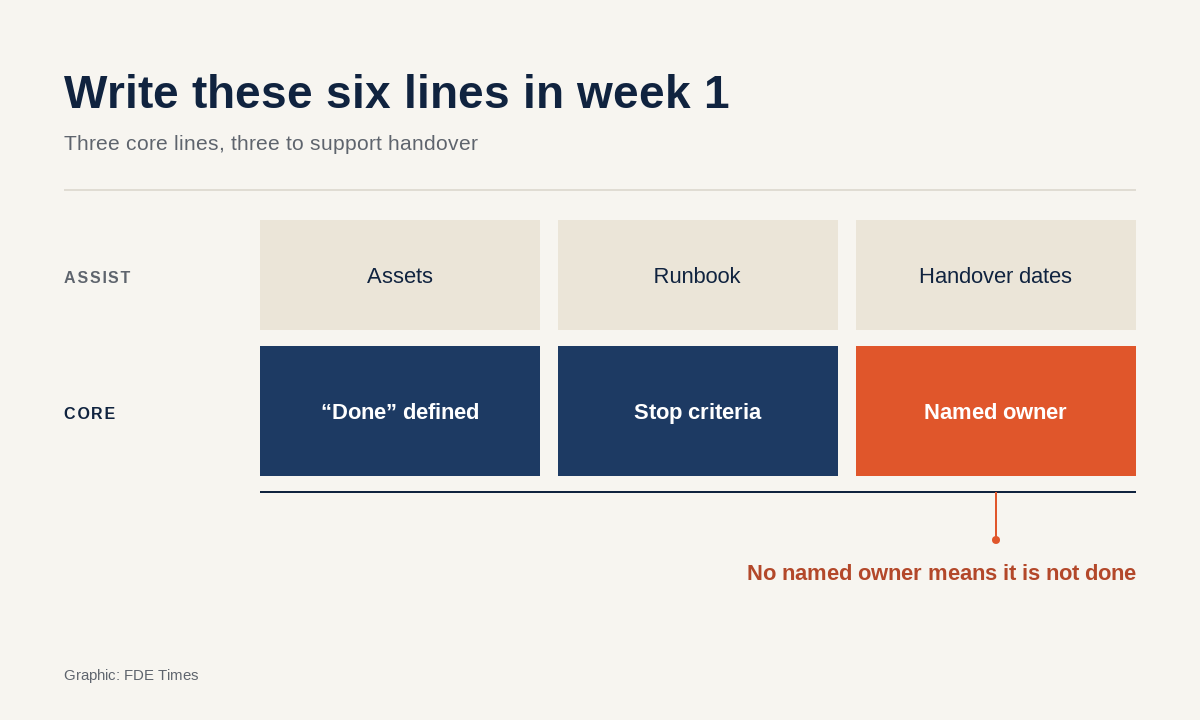
That gives an exit plan three core items. The first is a measurable, time-bound condition for “done”, so that neither side ends up arguing over impressions. The second is a name, because “the operations team will take it” is a promise nobody has signed.
The third is a stop condition. Google’s SRE Workbook says engagements need not last indefinitely, and that when one is not working, the team should not hesitate to plan its exit. Writing that condition down at the start is far easier than finding a way to raise it in month five.
PostHog also sets a standard for the deliverable itself. A deliverable counts as done only when a stranger on the client team can pick it up with no prior context. Its handover conditions also require that a named person on the client side approves the deliverable, and that all remaining work is logged as explicit tasks.
Why week one and not the last week?
Google’s SRE book describes SRE taking on a service as a gradual transfer of responsibility and ownership for individual pieces of production: some of the operations, the change-management process, access rights. It also requires the handing-over team to stay available for support and advice for a while, as the receiving team gets used to production.
Those two details are the reason the exit plan has to exist from week one. If each piece needs its own transfer, followed by a period in which you stand behind the new owners, then counting back from the exit date, the first step has to start almost as soon as the project does.
Write the handover documents in the final week and you will have time to hand over the documents, not the ability to run the system.
The 18F Product Guide, written for handing products over to government partners, gives a concrete marker: start planning the transition and building skills within the first 2–4 weeks.
That is a window of a few weeks, not week one exactly. But because ownership moves one piece at a time and needs an overlap period, writing the plan in the first week leaves you the most room to fall back.
An exit plan written in week one
Take a hypothetical case: you are deploying an agent that triages complaint emails for an insurance company, and a baseline eval round in the first week gives you a starting point. Every threshold and week marker in the table is illustrative; you will agree the real numbers with your own client.
| Item | What to write in week 1 |
|---|---|
| Definition of “done” | The main eval reaches the threshold the client agrees (for example 85%) on a test set labeled by the client team itself, and holds it for two consecutive weeks |
| Stop condition | If the eval is still below 70% after six weeks, stop and write a report on why it is not feasible |
| Owner | A platform engineer on the client side, with name and job title, scheduled to work with you every week |
| Assets | The repo, API keys, dashboards and eval configuration live in the client’s accounts from day one |
| Runbooks | Each runbook lists an owner and has been dry-run by someone else |
| Handover schedule | Week 3, the client watches you work; week 5, the client works and you watch; week 7, the client is primary on call and you only support |
The first three rows are the three core items described above. The last three make sure the handover actually happens rather than existing only on paper.
The baseline eval score turns the vague question “is the agent good enough yet?” into a measurable gap, and that gap gives you both the exit criterion and the stop condition. When the client team runs the eval itself on data it labeled, confirming that the work is done no longer depends on your word.
The “Assets” row is the one most often neglected. For 18F, one sign of a successful transition is that all documentation, source code, tools and infrastructure sit with the partner and no longer rely on 18F’s accounts. If everything lives in the client’s accounts from the start, there is nothing left to move on exit day.
How to do it, step by step
At kickoff, do not just ask what the client wants built. Ask which number will tell them the system has succeeded, and who will be on call when it breaks at two in the morning. The second question often silences the room, and that silence is the information you need.
In the first week, run a baseline eval, write the one-page plan as in the table above and send it to the decision-maker on the client side for written confirmation. From the second week, invite the owner to every deploy, even if they only watch.
Each milestone in the handover schedule should come with evidence the client team must produce before moving to the next step. Google’s SRE book describes a “reverse shadow” stage that some teams use when training new engineers: the newcomer is primary on call and handles every incident, while the experienced engineer stands behind them in support.
SoundCloud’s handover guidance likewise advises moving the on-call rotation only at the end, once the new team understands the system well enough and feels confident with it.
For runbooks, AWS recommends validating them by having someone else on the team run them. Have the client’s engineer do it while you sit quietly. Every time they turn to ask you something is a line in the runbook that needs fixing.
Common mistakes
The first mistake is writing the definition of “done” in adjectives: “runs reliably”, “client is satisfied”. Nobody can measure an adjective, so the project never formally ends. The second is naming a department as the owner instead of a person, so that when handover comes, everyone assumes someone else will take it.
The third is avoiding a stop condition for fear the client will think you lack confidence. Google SRE treats planning an exit from an engagement that is not working as something a team should do, not something to fear. An FDE willing to say in advance when to stop is easier to trust than one who promises everything can be done.
The fourth is moving on-call too early, before the client team can handle incidents on its own. The last is the hardest to spot: running the runbook yourself and calling that validation. You are the one person who cannot take the stranger test.
Turning the skill into a career advantage
When reading FDE job postings, watch for words such as handover, enablement or customer ownership. They may signal a company that values a clean handover as well as speed of building, and they are worth asking about. In an interview, you can turn the question around: how does an engagement here usually end, and who decides that it has ended?
On a CV, “built system X” has become commonplace. “Handed system X over to the client team, who ran and deployed it themselves after I left” is much stronger, provided you have real numbers to back it up.
This week’s exercise: take your most recent project, rewrite its one-page exit plan as if you were in week one, then mark the cells you left blank for too long.
Any cell you leave blank in week one, the client will fill by calling you.
Was this article useful?
Thanks for the feedback!
11 sources
- What FDE means at OpenAI · 2026-10-22
- FDE engagement lifecycle - Handbook (PostHog)
- Working with customers - Handbook (PostHog)
- Plan for the transition (18F Product Guide)
- Site Reliability Engineering, Chapter 32 - The Evolving SRE Engagement Model
- The Site Reliability Workbook, Chapter 18 - SRE Engagement Model
- OPS07-BP03 Use runbooks to perform procedures
- Demystifying the forward deployed engineer · 2026-07-14
- Making the most of an SRE service takeover—CRE life lessons · 2017-07-08
- Accelerating SREs to On-Call and Beyond (Site Reliability Engineering, Chapter 28)
- How to Successfully Hand Over Systems · 2021-04-20