Silence from the client is not a sign the project is going well
Five small signals warn of a failing deployment weeks in advance, and a short script lets an FDE raise them before the client does.
In brief
- Client projects rarely fail in a single day: clients usually show they are unhappy long before they say so.
- Count five signals every week: a responsive contact who goes quiet, scope that creeps, green reports with open blockers, no number for success, and everything running through one person.
- When an FDE stays quiet to fix problems alone, the client tends to read it as avoidance, so bad news should come early and with options.
Three days without a reply and two standing meetings cancelled back to back. Take a hypothetical deployment in its fifth week: the client’s head of operations, who used to answer Slack within hours, has gone quiet. The demo still runs, tickets are still being closed, and nobody has said the project has a problem.
That is what makes a drifting project so hard to catch. Rocketlane observes that most projects do not collapse loudly; they drift away quietly, and clients signal their dissatisfaction long before they say it outright.
An empty ticket queue is no comfort either. Enterpret advises treating an account that never files a ticket as at risk, rather than assuming it is healthy.
For an FDE, that lag is the biggest opportunity available. Once the client speaks up, all that is left is firefighting. Read the signals earlier and there is still time to correct course, and the five signals below show where to look first.
Why does nobody raise the alarm?
Drift has no trigger event. It is the sum of many small changes, each with a reasonable-sounding excuse: the client is busy at quarter end, adding one more data field takes only half a day, that blocker will be sorted next week.
So the skill to build is not intuition but habit. Name each signal, count it every week and act when it repeats. All five signals below can be observed from the meeting calendar, the tickets and email, with no need to guess anyone’s mood.
Signal one: the person who always replied goes quiet
Your champion used to reply within hours; now messages sit for days. Rocketlane describes exactly this scene as a warning sign: a stakeholder silent through the last three calls while the tone of email threads has shifted. Emails and weekly meeting invitations that go unanswered after kickoff belong in the same category.
The silence is usually not hostile. Rocketlane suggests that client project teams often go quiet simply because they are swamped with other work. Busy does not mean satisfied, though, and PostHog’s FDE handbook treats a client who stops responding or stops engaging as a sign that the engagement is stuck.
Measure it with numbers. PostHog sets a standard cadence of one weekly sync, one weekly async update and replies within one business day, which gives a baseline to compare against.
When the champion replies markedly more slowly than that baseline, or a standing meeting is cancelled with no one proposing another time, the signal has hit its threshold.
Signal two: scope creeps a little at a time
You finish a demo and the client says, “While you’re at it, could you add this report?” A week later it is another data source. Nobody files a formal change request, so on paper the scope is unchanged.
fde.academy lists this exact risk: after kickoff, the client expands the original problem without anyone formally acknowledging it. To protect yourself, each time you agree to a request, state how far it pushes the timeline. In the log, count the new requests that arrive without a recorded trade-off.
Signal three: green reports, open blockers
Three meetings in a row, you hear the same line, “still waiting for IT to grant access”, while the status report sent upward stays green. Built In calls this kind of report a “watermelon”: green outside, red inside. In their view it is worse than a red report, because hiding the problem means nobody can come to help.
The Master of Project blog argues that green reports usually grow out of organizational pressure, with deliberate dishonesty rarely the cause, and concludes that a report is only testimony, while the system is the evidence.
So measure blockers where the system records them: the tracker and the meeting notes. A blocker still open at the second meeting needs a named owner on the client side and a specific date.
Signal four: nobody can state a number for success
You ask “what does done look like?” and the client answers “take the load off the team” or “faster”. That sounds fine at kickoff, but it cannot be measured.
An article on scoping at aicodex advises pushing until there is a measurable definition of success that the budget holder has agreed to. If there is still none by the end of the first week, the engagement has drifted from week one, even if the code works.
Signal five: everything runs through one person
To get access, you ask the same person. To call a meeting, the same person. When the client’s leadership asks whether the project is worth the money, the one who speaks up for it is, again, that same person.
fde.academy treats this as a major FDE risk: a single-threaded relationship, with all access and all advocacy concentrated in one individual. Having a clear owner on the client side is good.
The risk arises when that owner is also the only one who can grant access, call meetings and defend the project, because a two-week holiday is enough to bring everything to a halt.
A fifteen-minute drift log
Go back to the deployment from the top of this piece. Say you are rolling out an agent that handles support requests for the client’s operations team. On Friday afternoon of week six, you open the log and fill it in like this.
| Signal | How to measure | Week 6 entry | Action threshold |
|---|---|---|---|
| Champion goes quiet | Response time, cancelled meetings | From a few hours to three days, two meetings cancelled | Slower than one business day, or one cancellation with no new time |
| Scope creep | New requests without a trade-off | Three requests, none with a recorded timeline impact | One request without a stated consequence |
| Green report, open blocker | Consecutive meetings with the blocker still open in the tracker | Read access to ticket data: third meeting, report still green | Second occurrence |
| Success number | A number, confirmed by the budget holder | Only “take the load off the team” | Still missing at the end of week one |
| Single point of contact | Number of people who can grant access or call meetings | One | Only one person |
Read on its own, every row has an excuse for being ignored. Only the whole table shows that every row is over its threshold, and that two rows are connected: the data-access blocker may have dragged on precisely because the champion stopped pushing.
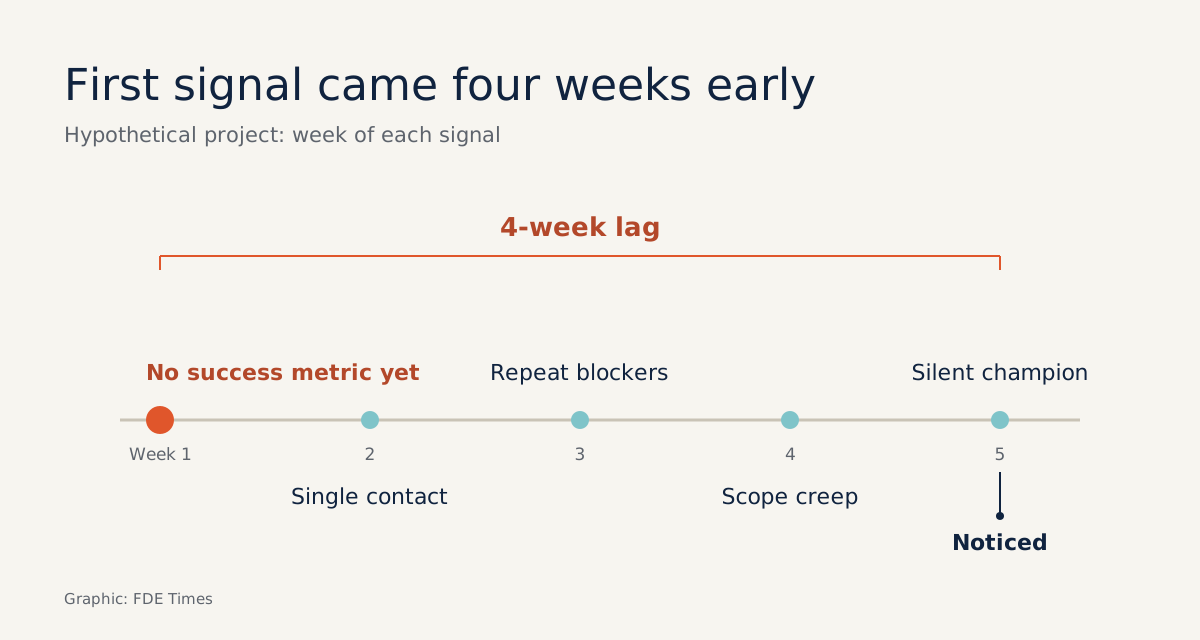
The more worrying picture emerges when you add the week each row crossed its threshold. The success number was missing from week one, the single point of contact from week two, the blocker began repeating in week three, scope crept in week four, and the champion went quiet in week five.
The first signal, in other words, was there four weeks before anyone noticed the silence.
A rule worth setting for yourself: when two signals cross their thresholds in the same week, speak up immediately, without waiting for the monthly review. Under that rule, this project would have triggered a warning in week two.
Say it before the client does
Many FDEs see the signals but choose to fix things quietly on their own. fde.academy warns that silence, even well-meant silence while you try to fix things, is often read as avoidance. Your silence is a signal the client is reading too.
A short script, sent to the champion with the budget holder copied:
“Two things this week are putting next month’s milestone at risk: read access to the ticket data has been pending for three meetings, and three new requests have not been factored into the timeline. Our proposal is to name someone on your side to own access by Wednesday and move two of the requests to a later phase. Which request would you like to keep?”
That message does three things. It names the signals with evidence, ties each one to a consequence, and hands the client a decision to make. Copying the budget holder is also a first step away from depending on a single contact.
Common mistakes
The most common mistake is tracking only technical signals such as latency, integration errors or agent accuracy, when all five signals above sit with people and process. Almost as common is agreeing to a new request without stating its cost, which teaches the client that scope is free.
One more: treating quiet as agreement and waiting for the retro to look back. The question “from which week could this problem have been seen?” is worth far more when you ask it yourself every Friday afternoon, while the project can still be saved.
The threshold-week column in the log also makes good interview material: describing the week you spotted a signal and what you sent is more convincing than any claim to be “good with clients”.
Sooner or later the client will speak up. Your job is to know in advance what they are going to say.
Was this article useful?
Thanks for the feedback!
9 sources
- Introducing Nitro Signals: Catch every delivery drift before it costs you · 2026-04-09
- Why Customers Ghost You and How to Avoid It · 2021-03-13
- What Are the Biggest Risks Forward Deployed Engineers Face? · 2026-07-31
- 10 Mistakes New Forward Deployed Engineers Make · 2026-07-24
- Scoping an FDE engagement: the first week decides the next three months · 2026-08-21
- FDE engagement lifecycle - Handbook (PostHog)
- The 6 Signals of Renewal Risk in Accounts That Never File a Ticket · 2026-09-08
- The Poisonous Watermelon: a Project Management Fable · 2022-03-23
- Watermelon Reports: When a Green Status Hides a Red Project — and How to Audit Your Doubt · 2026-10-21