On a 10,000-row table, deep learning still struggles to beat trees
Images and text tip the balance the other way, and four questions about data type, labels, explainability and GPUs settle most client decisions.
In brief
- On mid-sized tabular data (around 10,000 samples), tree-based models are still state of the art, according to the benchmark by Grinsztajn and colleagues.
- Images and text are not naturally numerical; deep learning learns features from raw data on its own, which is where it shines.
- Four questions to ask the client before choosing: data type, data volume, need for explanation and GPUs.
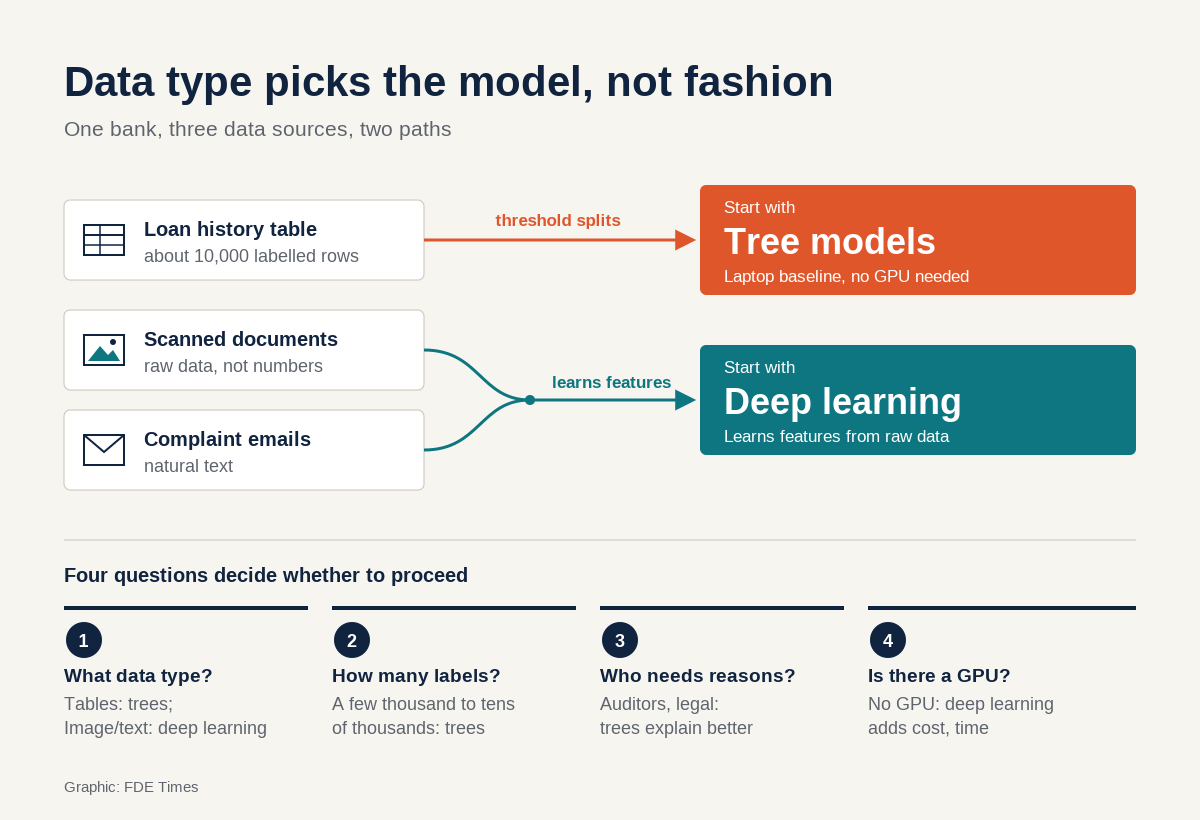
Three datasets land on the desk in the first week at a bank: a table of loan history, a folder of scanned documents and an archive of customer complaint emails. Someone in the room asks the familiar question: “Shall we just use deep learning for all three?”
The right answer is neither yes nor no. It depends on the form of the data, and an FDE needs to be able to explain why in two minutes. This is one of the first technical decisions an FDE makes, and it shapes infrastructure costs, time to results and whether the client ends up trusting the model at all.
This guide sets out a simple way of thinking built on four questions: what form the data takes, how many labels there are, who needs an explanation, and whether there is a GPU. In most cases those four questions already give the answer.
Mid-sized tables are still home turf for tree models
The loan table is a textbook supervised learning problem. Microsoft Learn describes supervised learning as training data that contains both feature values and known labels, and uses exactly this example: predicting whether a bank customer will default based on income, credit history, age and other factors.
That is binary classification on tabular data.
For this kind of data the evidence is fairly clear. The benchmark by Grinsztajn and colleagues on tabular data concluded that tree-based models remain state of the art on mid-sized datasets of around 10,000 samples. If the client’s table is about that size, that is the first signal in favor of trees.
The reason goes beyond folklore. The authors show that neural networks are biased toward overly smooth solutions, which makes irregular functions hard for them to learn. Tabular data is full of exactly those step changes: once income crosses a threshold the risk shifts sharply, and two or more late payments mean something entirely different from one.
Decision trees split on thresholds naturally.
A worked example: a baseline for the loan table
Say the table has about 10,000 rows, with columns such as income, age, num_late_payments and loan_type, and a defaulted label. The first job is not designing a network architecture. It is building a gradient boosting baseline in a few dozen lines of code.
import pandas as pd
from sklearn.model_selection import train_test_split
from sklearn.ensemble import HistGradientBoostingClassifier
from sklearn.metrics import roc_auc_score

df = pd.read_csv("loans.csv")
X = df.drop(columns=["defaulted"])
y = df["defaulted"]
X["loan_type"] = X["loan_type"].astype("category")

X_tr, X_te, y_tr, y_te = train_test_split(
    X, y, test_size=0.2, stratify=y, random_state=42)

model = HistGradientBoostingClassifier(categorical_features="from_dtype")
model.fit(X_tr, y_tr)
print("AUC:", roc_auc_score(y_te, model.predict_proba(X_te)[:, 1]))
This baseline runs on a laptop, needs no GPU and produces a number to negotiate with. If anyone then wants to try a neural network, it has to beat that number on the same test set. That turns an argument about what is fashionable into a measurement.
Neural networks for tables are not off limits. fast.ai’s Practical Deep Learning course has a whole section on tabular data with categorical, continuous and mixed variables. But treat a network as the second candidate, worth trying only once the tree baseline exists and the data is large enough.
With images and text, the balance tips the other way
The document folder and the email archive are a different matter. IBM explains that text, images, social network graphs and user behavior are not naturally numerical data, so they need far more feature processing.
With classical ML, someone has to work out how to turn a photo of an invoice into numeric columns, a job that is laborious and error-prone.
Deep learning works on raw data and automates most of that feature engineering. Microsoft Learn also notes that deep neural networks can be used for regression, classification and specialized models for natural language processing and computer vision. For scanned documents and complaint emails, deep learning should be the starting point.
Four questions to ask the client before deciding
The form of the data points the way, but the client’s circumstances decide whether that way is open. IBM sets out the core trade-off: deep learning scales more easily but is harder to interpret than traditional ML, and it requires very large amounts of data. Microsoft Learn adds that neural networks should be trained on machines with GPUs, which are optimized for matrix operations.
| Question for the client | If the answer leans toward… | What it means for the choice |
|---|---|---|
| What form is the data in? | Tables, or images and text | Tables: start with tree models; images and text: start with deep learning |
| How many labeled samples are there? | A few thousand to a few tens of thousands | Favor tree models, especially for tables |
| Who needs to understand why the model decided? | Credit, audit, legal | Tree models are easier to explain; write this requirement down |
| Is there GPU infrastructure? | No, or it needs budget approval | Deep learning brings extra cost and setup time |
For the bank in this example, the loan table answers all four questions in favor of tree models. The images and emails justify investing in deep learning, but two questions need asking in the first week: do they have enough labeled images, and where are the GPUs?
Five steps to apply at a client
Step one: classify each data source as tabular, image, text or mixed. Step two: count the genuinely labeled samples, not the raw rows, because labels are what supervised learning needs.
Step three: ask who will use the results and who they must explain them to. Step four: check the infrastructure, including GPUs, where the data is allowed to live and what training time is acceptable.
Step five: build the cheapest baseline that suits the data type first, and only then try heavier options on the same test set. Write up the results as a short page the client can read.
Common mistakes
A harder mistake to spot is forgetting to ask about explainability. An accurate model that the credit team cannot explain to borrowers or auditors will never leave the demo stage.
For anyone preparing to apply for FDE roles, this is exactly the kind of decision to put on a CV: not just “used XGBoost” but “chose a tree model over a neural network because of mid-sized data and an explainability requirement, measured on the same test set”.
At the next meeting, when someone asks “shall we use deep learning for all three?”, there is a shorter answer ready: trees for the table, neural networks for images and text, and a baseline to prove it.
Was this article useful?
Thanks for the feedback!
5 sources
- Why do tree-based models still outperform deep learning on tabular data? (Grinsztajn et al.) · 2022-07-18
- What is Machine Learning? | IBM · 2025-08-18
- Types of machine learning model - Training | Microsoft Learn · 2026-03-27
- Deep learning - Training | Microsoft Learn · 2026-03-27
- Practical Deep Learning for Coders - Practical Deep Learning