The sequel to Team of Teams holds its best lesson for FDEs
Chris Fussell's One Mission shows what a liaison does: report a partner's real reaction back home and put out small fires before they spread.
In brief
- Team of Teams (Portfolio, 2015) by Stanley McChrystal and three co-authors argues that small teams should be free to experiment and then share what they learn across the whole organisation.
- One Mission, Chris Fussell's follow-up, shows that a liaison translates a partner's reactions, and that the role should go only to experienced people.
- For FDEs, the value of both books lies in one loop: embed in the client team, report real reactions, put out small fires, then share regularly with product.
Six months. According to Shortform’s book summary, the Task Force commanded by Stanley McChrystal once ran an “embedding” programme: one member was sent to work inside another team for six months.
If you are an FDE, that description will sound familiar. You too are embedded in a client’s team, and the hardest work usually comes afterwards: connecting the client team with the product team back home, so that each side understands the other before a misunderstanding has time to become a crisis.
That is why this military book belongs on an FDE’s shelf. It will not teach you to write code. It teaches you to stand at the point where two organisations meet.
What the book says, and who wrote it
The full title is Team of Teams: New Rules of Engagement for a Complex World. Stanley McChrystal wrote it with Tantum Collins, David Silverman and Chris Fussell, and Portfolio (Penguin Random House) published it on 12 May 2015. The publisher presents it as a guide to making teams more adaptable, agile and cohesive while everything around them is changing.
The central argument is compact. Give small teams the authority to experiment, then let them share what they learn across the whole organisation, and the organisation as a whole will respond faster and decide better. Since 2011, McChrystal Group, McChrystal’s consultancy, has kept refining the method and taking it into many organisations outside the military.
In 2017 Chris Fussell followed up with One Mission. The part most worth an FDE’s time is in this second book: the pages on liaison officers. The first book explains why teams need to be connected; the second shows what the person doing the connecting does every day.
First idea: embed people to see what the other team is good at
According to Shortform, the aim of the embedding programme was to build understanding and trust, because the person sent across saw the other team’s strengths first-hand. The word worth noticing is “strengths”. The embedded member was not there to find the other team’s faults; they were there to stop seeing it as “the other side”.
For FDEs, this works in both directions. The first: you yourself must see where the client team excels, for instance in understanding its business data or its operational processes more deeply than you do. The second, often forgotten: the product team at home also needs to be embedded, even for a single session, so it stops seeing the client as a list of tickets.
One small step worth taking now at your client: invite a product engineer to sit with the client’s operations team for half a day. The purpose is the same as McChrystal’s embedding programme, only smaller in scale: to let that person see for themselves where the client team excels, rather than hearing it second-hand from you.
Second idea: the liaison is a translator, so don’t give the job to a newcomer
Fussell describes a liaison officer as the vital line to MNC-I, a key partner, and the person who kept trust between the two sides. The work sounds mundane. They go back and tell leadership, in effect: boss, when we did X, they were really upset.
Picture an FDE version. The product team has just changed how an API paginates, and the client’s nightly reconciliation pipeline has started failing. A message written the way a liaison officer would write it might read:
“Tuesday’s update moved the orders endpoint from offset to cursor pagination. The client finance team’s nightly reconciliation pipeline only reads the first page, so this morning’s report is missing data.
Their team lead is very frustrated and has asked whether they should pause the rollout. Proposal: keep the old pagination running in parallel until they have fixed it, and give this team advance notice of every upcoming API change.”
Four sentences, all four parts: what changed, who is affected, how they reacted, what to do first. Fussell calls the result small fires put out before the whole forest burns.
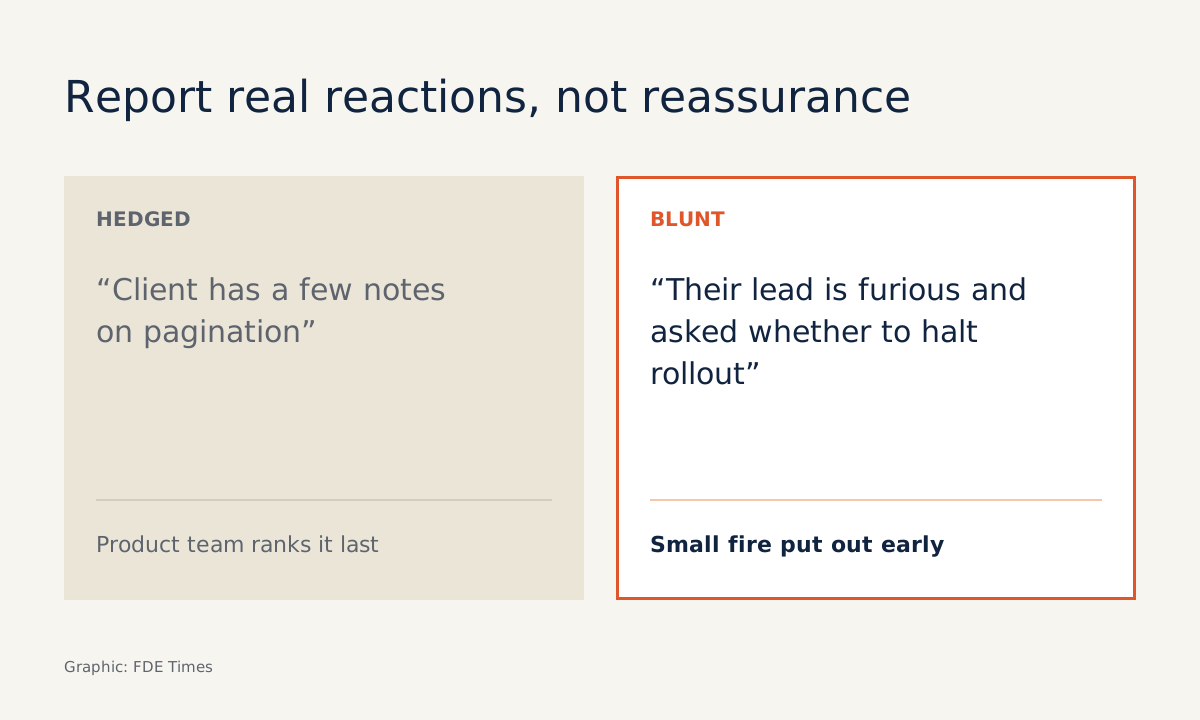
The most common mistake is softening the client’s reaction. Writing “the client has some feedback on pagination” sounds more polite, but the product team will put it at the bottom of the backlog while the other side is weighing whether to halt the rollout. The line “they were really upset” that Fussell recounts is valuable precisely because it was not reassuring.
Fussell also stresses that only experienced members make effective liaisons with the most important partners. If you lead an FDE team, do not hand your biggest client to a new hire.
Third idea: shared consciousness does not appear on its own
McChrystal Group calls the precondition for the whole model “shared consciousness”. According to the firm, it forms and lasts only through information shared regularly and transparently. “Regularly” is the word most easily lost if you only report home when something goes wrong.
One Mission has a line that makes the division of roles clear: the teams in the field fight the battle where they are, while leaders and liaisons handle the relationships needed to support them. In an engagement, the client team and your engineers handle the deployment. Your part is to keep the product team, the sales team and the leadership on both sides looking at the same picture.
In practice: every Friday, send a fixed update, same template, same time, even in weeks when nothing happened. A quiet week still has value, because it tells the product team that no news means everything is fine.
What order to read them in, and what to put on your CV
Read Team of Teams first, concentrating on the sections about shared consciousness and the autonomy of small teams. Then read One Mission to see how those ideas play out in the hands of a liaison. The first book suits FDEs leading an engagement or building a team. The second suits anyone about to be sent to sit with a client.
If you are trying to move into FDE work, put on your CV one occasion when you turned client feedback into a change in the product, along with what changed. When reading job ads, look for lines asking you to bring client feedback back to the product team: that is the liaison role under another name.
Writing code is only half of an FDE’s job. The other half is connecting two organisations, work that Fussell would entrust only to the most experienced people.
Was this article useful?
Thanks for the feedback!
5 sources
- Team of Teams: New Rules of Engagement for a Complex World (Penguin Random House) · 2015-05-12
- How to Foster Team Trust in a Complex Organization (Shortform) · 2021-03-30
- An excerpt from 'One Mission: How Leaders Built a Team of Teams' (Foreign Policy) · 2017-06-15
- Enhance Team Intelligence with Shared Consciousness | McChrystal Group
- About Us | McChrystal Group