The question Impact Mapping makes FDEs ask before building any feature
Written in 2012, Gojko Adzic's short book still gives forward deployed engineers a way to stop scope creep in the very first discovery session.
In brief
- Gojko Adzic's 2012 book is a practical guide to impact mapping, a collaborative approach to strategic planning.
- Its biggest value for FDEs: linking every feature to the customer's goal, which curbs scope creep and over-engineering.
- Read it before your first engagement and use it straight away in discovery; it is not a book to read as theory.
A customer sends over 12 features with a note: “all needed this quarter”. The scenario is hypothetical, but every FDE has met some version of it. The engineer’s reflex is to estimate each item and schedule it.
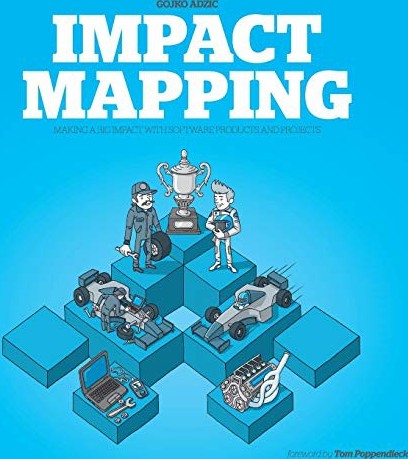
Impact Mapping: Making a big impact with software products and projects by Gojko Adzic proposes the opposite: before estimating anything, ask which business goal each feature serves.
The book came out on 1 October 2012, ISBN 978-0955683640. Adzic describes it as a practical guide to a simple method for collaborative strategic planning. Fourteen years is a long time for a software book, but the problem it targets has not gone away: plans and delivery roadmaps drifting away from business goals, which happens very easily on a customer site.
For an FDE, that is the most valuable question of the whole engagement. The method’s official site states its purpose plainly: to help you build products and deliver projects that make an impact, not just ship software.
Who is the book for, and why should junior FDEs read it?
Adzic says the primary audience is senior people involved in building software products. He also writes for business people assigned to software projects, promising to help them communicate their ideas better to the delivery team.
An FDE with two to eight years of experience sits squarely between those two groups. When you sit down with the person who owns the customer’s business goal, you may be the one who has to turn that goal into engineering work, with nobody to translate for you. You do not need to be senior to use the book; you need it precisely because the job asks you to do a senior person’s work.
Read it in this order: before you start a new engagement, then take the method straight into your first discovery session. This is not a book to finish and shelve. It is only worth something when you draw a real map with a real customer.
First idea: the impact is the product
According to impactmapping.org, an impact map shows how a delivery plan connects to the outside world, including customers and users, and that connection does not stand still.
This changes your first question. “What does the system need to do?” is not yet the right one. The right question is who has to behave differently, and how that helps the customer’s goal.
A small map for 12 features
Imagine the customer is an insurer, and the 12 features revolve around its claims-processing system.
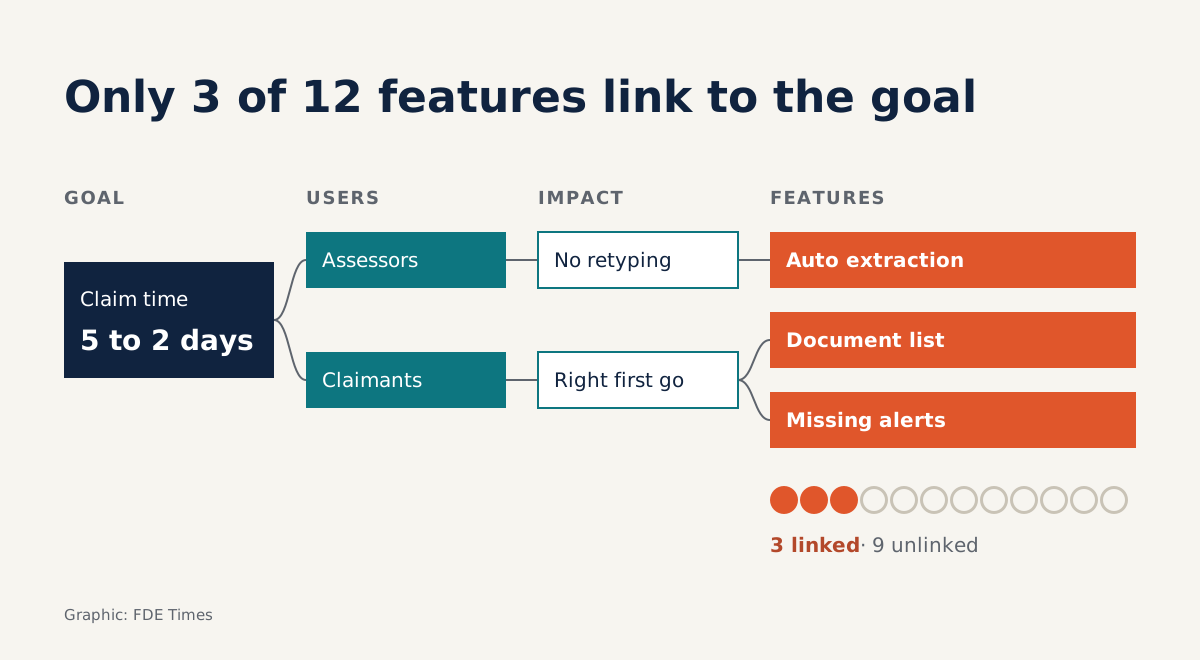
The top layer is the goal the customer’s leadership tracks: say, cutting the time to process a claim from five days to two. The second layer answers who has to act differently to get there: in-house claims assessors, and policyholders when they file a claim.
The third layer records the behaviour change. Assessors stop retyping data from documents by hand; claimants submit every required document the first time instead of having their claims sent back.
Only in the bottom layer do features appear. Automatic data extraction from documents hangs off the assessors’ change; a checklist of required documents in the claim form and an alert for incomplete claims hang off the claimants’ change.
Three features earn a place on the map. The other nine, such as a custom dashboard or PDF report export, may still make sense, but they cannot yet hang off any branch, so they wait. You now have a clear reason to say “not yet”, and that reason has nothing to do with your team being short-staffed.
When you practise, start at the top layer. If the customer cannot yet state the goal as a number, discovery is not finished and no feature should be estimated.
Second idea: the map is a tool for cutting waste
The official site names one concrete benefit: reducing waste by preventing scope creep and over-engineered solutions. For an FDE, these are the two most expensive traps.
Scope creep comes from the customer, with another request added at every meeting. Over-engineering comes from you, when you build a general-purpose pipeline for a need that only has to run well in one department.
The map handles both with the same test. Every new request must attach to an existing branch on the map; if it cannot, it has to open a new branch and state clearly which goal it serves.
Every architectural decision must answer the same question. The method is presented as a way to keep organisations from getting lost while building products and delivering projects, and for an FDE, “lost” usually means three months building exactly to spec while solving the wrong problem.
Third idea: draw it with the customer, not for them
Adzic calls this a collaborative technique, and that is the word worth noticing most in the whole definition. A map you draw alone in your hotel and then present is just one more plan.
A map drawn on a whiteboard with the budget holder and the end users is different: it is the moment they see for themselves that the feature they asked for connects to nothing.
The book’s page quotes a practitioner saying that after only a short time, the method had helped their team make better prioritisation decisions.
Prioritisation is exactly where FDEs tend to get stuck between the customer and the product team back home. With a map the customer helped draw, the argument shifts from “who shouts loudest” to “which branch is closer to the goal”.
How to bring this skill into your CV and interviews
The advantage of this skill is that it leaves concrete traces in every project you have worked on. When reading FDE job ads, look for phrases such as understanding the customer’s business goals, prioritising scope or working directly with stakeholders; if an ad uses them, this is a skill worth putting first.
On your CV, do not open with what you built. Write in the map’s order: what the customer’s goal was, who changed their behaviour, and only then the system you delivered. In an interview, when asked about a project, describe the features you persuaded the customer not to build, and what you based that on.
A good FDE does not measure themselves by the number of features shipped, but by the number of features the customer no longer needs because the real problem has been solved.
Was this article useful?
Thanks for the feedback!