The submarine book that teaches FDEs to stop being the bottleneck
David Marquet turned followers into leaders aboard USS Santa Fe, the skill an FDE needs if a deployment is to survive handover day.
In brief
- Marquet took USS Santa Fe from the worst submarine to the top of the fleet, and the boat kept producing captains after he left.
- A client team only decides for itself when the environment allows it and people feel safe to speak up, even if they might be wrong.
- Widen the team's authority in step with their competence and grasp of the goal; do not hand over everything in the first week.
In early 1999, according to an article from the Naval Submarine League, the submarine USS Santa Fe had re-enlisted only three sailors in the previous 12 months. By 2001, nine of the boat’s ten eligible petty officers had been selected for chief.
The man between those two numbers was L. David Marquet, and Turn the Ship Around! is his book about those years. It says nothing about software, yet it diagnoses an ailment that every FDE meets sooner or later.
At a client site it is easy to become the captain everyone has to ask. Rerunning a pipeline, changing a prompt or rolling back a release all wait for your nod. Shortform, summarising Marquet, describes the consequence precisely: when a strong leader leaves, performance often collapses, because the team has grown used to depending on them. For an FDE, that moment has a name: handover day.
The worst boat in the fleet changed who made decisions
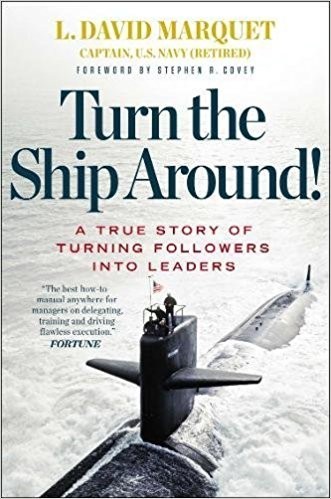
The book’s full title is Turn the Ship Around! A True Story of Turning Followers into Leaders, with a foreword by Stephen R. Covey. According to the publisher, Santa Fe went from the worst submarine to the top of the fleet after Marquet reversed its bad trends.
The more telling evidence, though, is on Marquet’s own site: an unusually high number of Santa Fe officers were later selected to command submarines, and according to Stratechi this continued after he had left the boat.
Wikipedia gives a figure of ten captains, though it has not been checked against Navy data. For an FDE, the equivalent measure is a client team that can run the system once you are no longer there.
First idea: fix the environment, not the people
In a talk at Google in 2017, Marquet described his role on Santa Fe as creating an environment where people came to work and gave their best. The focus was the environment, not replacing the crew.
Imagine you have deployed an agent that handles tickets for the operations team of a logistics company. The on-call engineer is the one who sees the logs, knows the peak hours and can spot which type of ticket the agent is getting wrong.
If they want to switch the agent off for one ticket type and still have to message you at midnight to ask, the fault is not their ability. It is the environment: the person with the information lacks the authority, and the person with the authority lacks the information.
The first job at a client site is to list the decisions that are waiting on you. Then ask, item by item, who has the data to make that decision and which process is blocking them.
Second idea: people only decide when they feel safe
At Google, Marquet also said he tried to make his people feel safe speaking their minds, even when an idea might be wrong or different. At a client, this is the precondition for everything else: engineers will not decide for themselves if a single mistake gets raised in front of their boss.
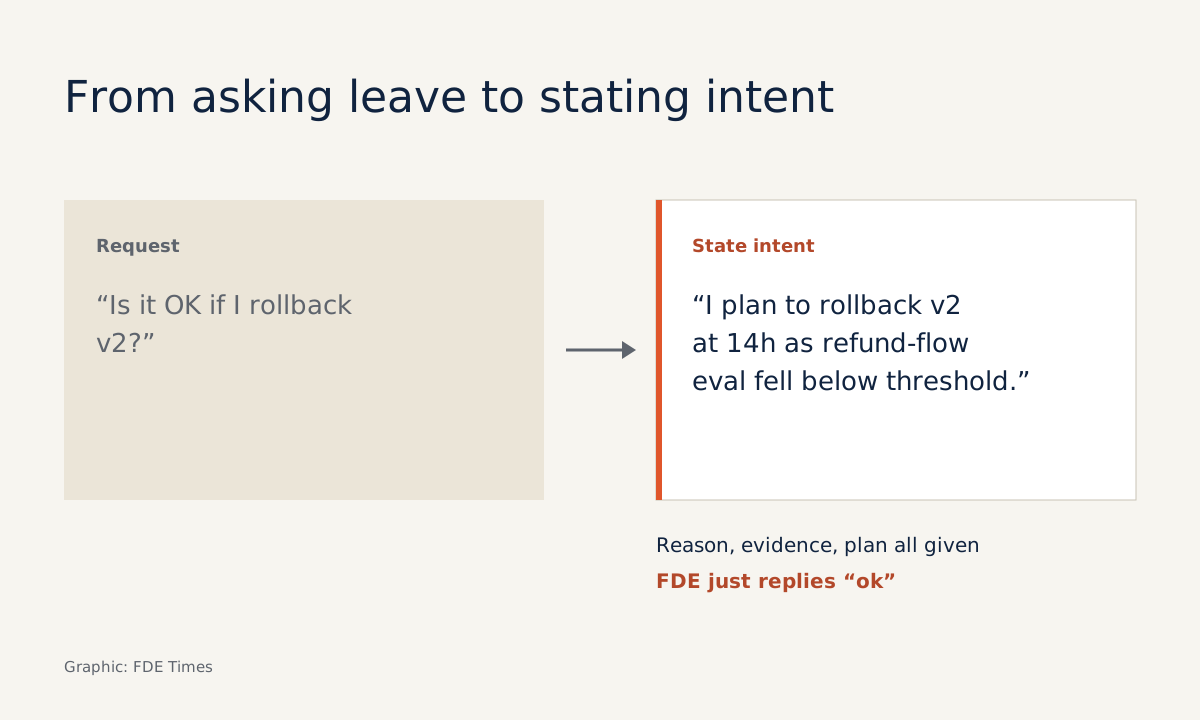
One concrete tool is to turn requests for permission into statements of intent. Stratechi’s summary of the book takes the phrase “I Intend To”, announcing what you are about to do, as its title.
“Can I roll back v2?” becomes “I intend to roll back v2 at 2pm because the eval suite for the refund flow has dropped below threshold; I’ve checked that v1 still runs fine.” The second version already contains the reason, the evidence and the plan, so all that is left for you is to ask one more question or reply “ok”.
Third idea: widen authority with competence and clarity
Crisp, a licensed partner of Intent-Based Leadership International, states a short principle: adjust the level of control to competence and clarity. Handing authority to a team that cannot yet read an eval, or does not know what goal the system serves, is a bet on luck.
So do not give the client team full authority in the first week. At first, have them send “I intend to” for small changes such as configuration or alert thresholds. Once they can read eval results and articulate the system’s business goal, extend their authority to prompts, then to rollbacks.
Clarity is easy to underrate, because it does not show up in the code. If the team does not know which metric the client actually cares about, they will optimise the wrong thing, however skilled they are.
The best evidence is what happens after you leave
The book suits FDEs about to lead an engagement on their own, and tech leads who want to move into FDE work. Read it as an exercise: whenever a decision moves from captain to officer, note in the margin the matching decision in your deployment and the name of the person who should own it. By the end you will have a draft handover list for the following week.
That list is also material for a CV. Recruiters struggle to believe a line such as “strong leadership skills”, but find it easier to believe a measurable result after you hand over a project.
A sample CV line might read: “Handed authority over configuration, prompts and rollbacks to the client’s operations team; the system ran for N weeks after handover with no FDE intervention.” Replace N with your own real number. If you do not have one yet, start counting from your current engagement.
In an interview, an answer of about 30 seconds can follow three beats. Situation: “Every rollback waited for FDE approval, even at midnight.” Action: “Wrote a one-page goal document, taught the team to read evals, then replaced permission requests with ‘I intend to’ messages.” Result: “Before handover, the team decided rollbacks themselves; the FDE only replied ok.”
Santa Fe is remembered for the captains it produced after Marquet. A deployment should be judged the same way: by how it runs once you have gone.
Was this article useful?
Thanks for the feedback!
8 sources
- Turn the Ship Around! by L. David Marquet | PenguinRandomHouse.com
- Turn the Ship Around! – David Marquet (official site)
- Turn the Ship Around Summary: I Intend To (Stratechi)
- David Marquet - Wikipedia
- THE CHIEFS TAKE CHARGE (Naval Submarine League) · 2004-04
- Turn the Ship Around | L. David Marquet | Talks at Google · 2017-08-22
- Why Traditional Leadership Is a Failure (but Remains the Default) · 2025-12-21
- Intent Based Leadership | Crisp