Why FDEs should start Michigan's leadership series with course three
Influencing People takes 12 hours, can be taken on its own, and targets the daily FDE task of moving teams that do not report to you.

In brief
- The University of Michigan's Leading People and Teams on Coursera has five courses at beginner level, with no prior experience required.
- Maxim Sytch's Influencing People (12 hours) is third in the series and teaches how to build relationships that give you influence without a title, which is what FDEs do every day.
- FDEs should take it first, and it can be taken on its own in about a week; save Managing Talent for when you lead an FDE team.
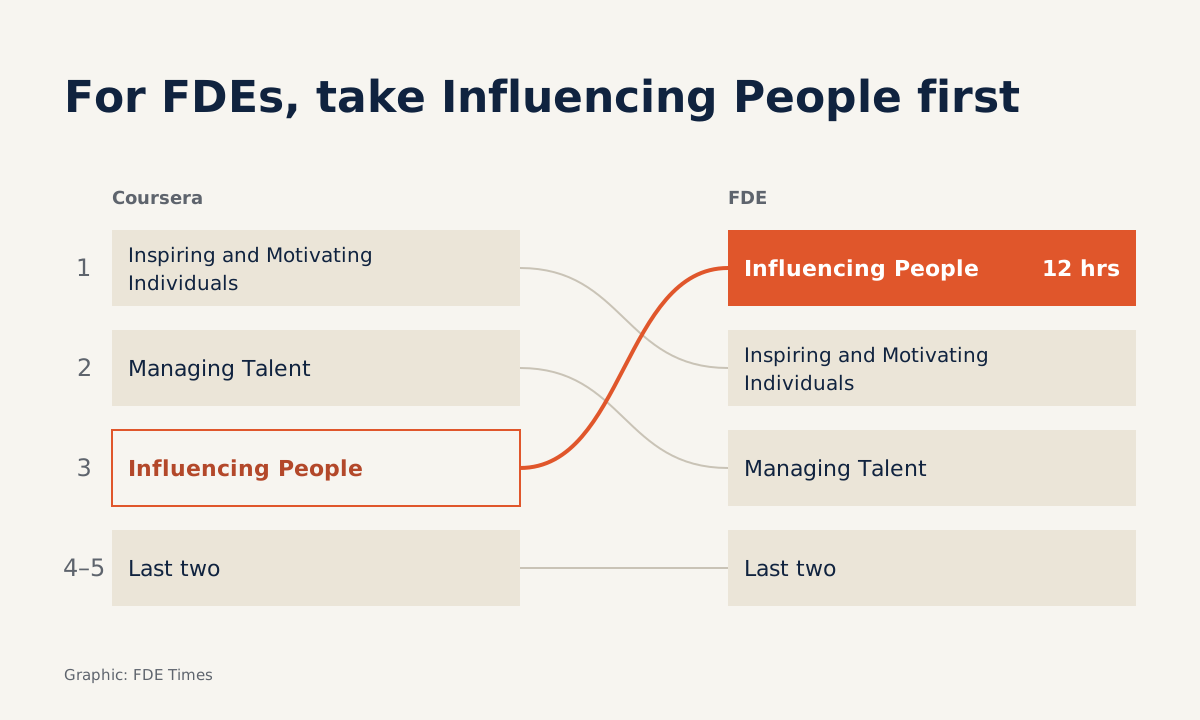
The University of Michigan’s Leading People and Teams series has five courses, and Influencing People comes only third. For a Forward Deployed Engineer, it is the one to open first.
The reason is the nature of the work. A LeadDev piece on the reality of the FDE job describes the role as working across stakeholders on the client side and internal teams alike, and observes that knowing exactly whom to ask is as valuable as knowing the answer.
You do not manage the client’s data team. You do not manage the product team back home either. Yet a deployment only runs when both sides do their part, so leading without a title is an FDE’s daily work, not a future concern.
What does the series actually contain?
The series was built by the University of Michigan on Coursera and is taught by Scott DeRue and Maxim Sytch. It is beginner level and requires no prior experience.
There are five courses. The official order puts Inspiring and Motivating Individuals and Managing Talent first, followed by Influencing People (12 hours). Moving Influencing People to the front is therefore a deliberate choice for FDEs, not the path Coursera suggests.
Fortunately, Influencing People can be taken on its own: it is a standalone course on Coursera, taught by Maxim Sytch. The course page lists four modules, about one week at 10 hours a week, so there is no need to commit to the whole series to start.
Why take Influencing People first?
Georgia Southern’s career centre guide to the FDE role says FDEs meet stakeholders from analysts to VPs and CTOs to understand which problems really matter. The same guide is blunt: if an FDE’s work does not influence what gets built next, the role is being misused.
Both tasks, persuading people at the client and pushing the roadmap at home, happen where nobody has to do what you say. One of the course’s stated objectives is to build and maintain high-quality relationships that give you influence without a title, which the course calls informal power.
Three ideas worth keeping from the course
The first: informal power is built before you need it. When you study the section on relationships, apply it straight away to your current engagement: who controls access, who signs off on security, who can fix the bug, and which of them you have spoken to without needing a favour.
The second: diagnose first, persuade second. Another LeadDev piece, on leading without a title, says the first step is to understand each party’s position, because logic alone moves no one, and small, specific requests tend to get an immediate answer.
Imagine you need the client’s data team to grant read access to one table so your agent can query it, and the request has sat untouched for two weeks. Instead of repeating “could you please grant access”, find out why they are hesitant, for example because they are worried about an audit.
Then send exactly one read-only permission on one table, with an expiry date and a revocation script already written. Now the other side only has to say yes.
The third: tell influence apart from manipulation, a learning objective the course states explicitly. For an FDE, that line is tied to trust.
The LeadDev piece on the FDE job notes that the goal is not always to build exactly what was asked for; when proposing an alternative, spell out the trade-offs rather than holding back information to win agreement.
From a stalled request to a CV line
Recruiters look for exactly this skill; they just describe it more concretely than “cross-functional”.
Harper’s FDE job posting asks candidates to bring problems to Product and Engineering with evidence and a clear point of view, and to build trust and act as a bridge between technical staff and business leaders.
When you read a job description, underline sentences like these.
Then turn the access example above into evidence. A CV line might read: “Unblocked a data-access request stalled for two weeks with the client’s data team by narrowing it to time-limited read-only access with a revocation script, without any authority over that team.”
In an interview, the 30-second answer follows the same three beats: the problem, how you narrowed the request, and the relationship that came out of it. For example:
“A data-access request had been sitting for two weeks. Asking around revealed the client’s team was worried about an audit, so the request went back as a single read-only permission on one table, with an expiry date and a revocation script. They approved it, and from then on there was someone to ask whenever data was needed.”
Evidence like this carries more weight than a certificate.
What order to take them in, and what to avoid
A sensible order for FDEs: Influencing People first, over about a week, then Inspiring and Motivating Individuals. Managing Talent can wait until you start leading an FDE team; while nobody reports to you, there is little room to practise it. The two courses that follow Influencing People in the series’ official order come last.
The common mistake is to finish the course before applying any of it. Pair each module with a real task in a live engagement, because this skill only takes shape when there is a real person to persuade.
The management title may or may not come. Whether tomorrow morning’s meeting with the client’s data team gets a result depends on what you learn in those 12 hours.
Was this article useful?
Thanks for the feedback!