AWS's AI Practitioner exam says it won't test what FDEs do
Generative AI and foundation-model domains carry about 26 of the 50 scored questions, so study Bedrock hard and learn pipeline building elsewhere.
In brief
- AIF-C01 measures understanding, not build skills: model programming and building AI/ML pipelines are outside the exam's scope
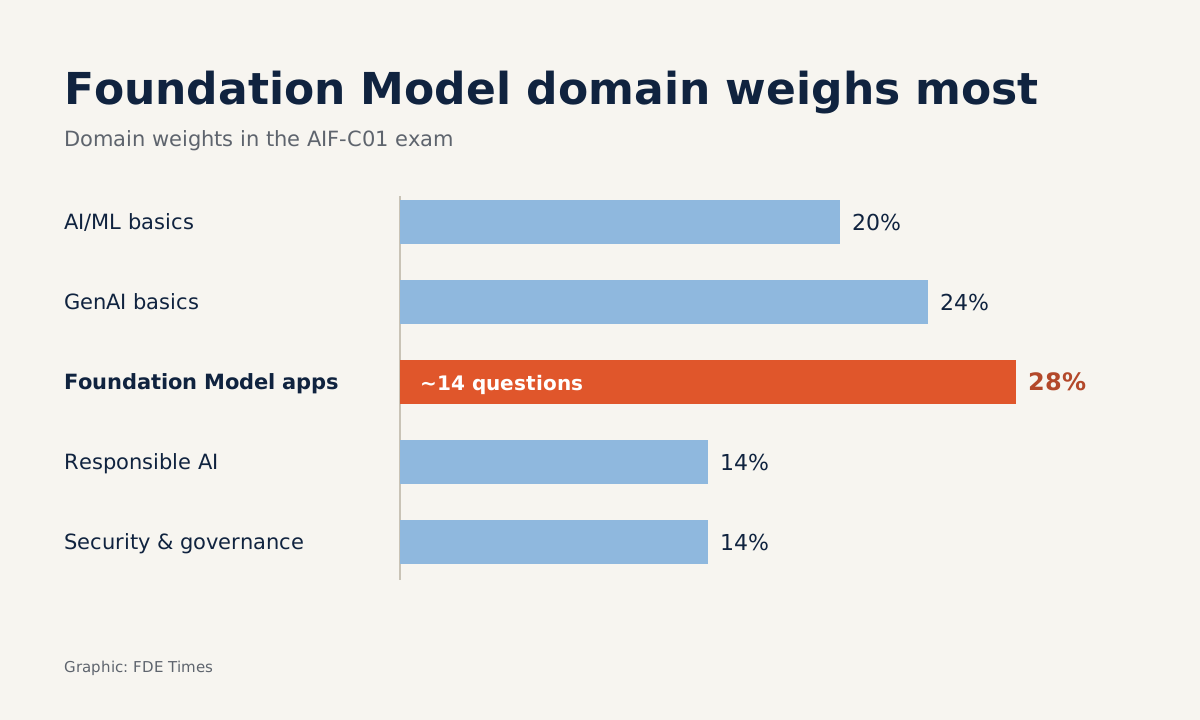
- The Applications of Foundation Models domain carries 28%, roughly 14 of the 50 scored questions; it is the part FDEs should study most closely
- Do the free Skill Builder material first, take the Official Pretest before the exam, then build your own RAG project with evals
The exam guide for AWS Certified AI Practitioner contains one sentence worth reading slowly: the target candidate is someone who uses AI/ML solutions on AWS, not necessarily someone who builds them. For an FDE, that sentence determines how to approach the whole course.
AIF-C01 is a foundational certification issued by AWS. The exam tests understanding of AI concepts and of AWS AI tools, with a lean towards business applications. The exam guide also lists outright what is out of scope: model programming, building and deploying AI/ML pipelines or infrastructure, and hyperparameter tuning.
Yet that is precisely what an FDE does on a customer site. So is it worth studying? Yes, if you are about to join a deployment on AWS and need to speak the same language as the customer’s architects about Bedrock, RAG or model evaluation. No, if you expect the certificate to prove you have put an agent into production.
Where do the marks actually sit?
The exam has 65 questions in 90 minutes, but 15 are unscored, leaving 50 that decide the result. Multiply each domain’s weighting by those 50 questions and you get these estimates:
| Domain | Weighting | Estimated scored questions |
|---|---|---|
| Fundamentals of AI and ML | 20% | about 10 |
| Fundamentals of GenAI | 24% | about 12 |
| Applications of Foundation Models | 28% | about 14 |
| Responsible AI | 14% | about 7 |
| Security, compliance and governance | 14% | about 7 |
Scores run on a 100–1,000 scale with a pass mark of 700. Scoring is compensatory, so you do not need to pass each domain individually. The GenAI and Foundation Model domains alone account for about 26 of the 50 questions. The exam fee is $100 and the certification is valid for three years.
Fortunately for FDEs, the domain worth the most marks is also the one closest to real work: domain 3. Three ideas from it are worth keeping after the exam.
RAG is asked about as a business story
The exam expects you to define Retrieval Augmented Generation and describe its business applications, with Amazon Bedrock Knowledge Bases as the example. Framing the question this way teaches exactly the skill many FDEs lack: explaining RAG in terms of the customer’s problem rather than a vector diagram.
Picture an insurance company that wants a chatbot to answer from its internal policy terms, which change every quarter.
A self-written question in the exam’s style would ask: the company wants answers that always match the latest terms at low cost, so should it pre-train its own model, fine-tune every quarter, paste the full set of terms into the prompt, or use RAG with Bedrock Knowledge Bases?
The method is elimination. Pre-training is far too expensive for a deployment project. Fine-tuning every quarter means retraining every time the terms change. Pasting the whole document set into the prompt means every question pays tokens for all the terms.
That leaves RAG: the documents live outside the model, so when they are updated the answers change with them, with no retraining at all. It is also what you would say to the business people on the customer’s side. When studying domain 3, practise ruling out the wrong options with reasons, because that is how you will defend an architecture in a real meeting.
Each way of customising a model pays in a different place
The exam asks about the cost trade-offs between pre-training, fine-tuning, in-context learning, RAG and model distillation. On a customer site, this question usually arrives as “why don’t we just fine-tune it?”.
One sensible answer is to rank the options by cost: in-context learning costs only prompt-writing effort and tokens; RAG adds the work of building and maintaining a data source; fine-tuning needs labelled data and a retrain every time something changes; and pre-training is almost never an option for a deployment project.
The exam only asks at the conceptual level, but if you can write this comparison table yourself, you already have material for your first architecture consultation.
Model evaluation: the exam teaches the names, customers need the numbers
Domain 3 covers Bedrock Model Evaluation, benchmark datasets, human-in-the-loop evaluation, and the metrics ROUGE, BLEU, BERTScore and LLM-as-a-judge. All of it stops at the conceptual level; it does not teach you to build an eval set yourself.
This is the course’s biggest gap. Knowing the definition of ROUGE is enough to pass. But to prove to a customer that a chatbot answers correctly, you need a set of questions drawn from their own documents, with reference answers, rerun after every prompt change.
What order wastes the least effort?
If you are starting from zero, AWS Educate has a learning path leading to AIF-C01, covering Foundations of ML and Generative AI, including Amazon Bedrock. Then move on to the Exam Prep Plan on AWS Skill Builder, the preparation path AWS designates.
The free tier includes a two-hour Exam Prep course and the official 20-question practice set, enough to learn the question format before you pay anything. The Enhanced version requires a paid subscription and adds more practice questions and labs.
The Official Pretest comes with a Skill Builder subscription, so you will most likely need a paid plan to take it. If you have decided to pay, take the pretest to gauge your readiness before booking the exam; if not, the free 20-question set is the minimum test.
When revising, use the list of in-scope services as your framework: Amazon Bedrock, Bedrock AgentCore, Amazon Nova, SageMaker AI, SageMaker JumpStart, plus Kiro and Strands Agents among the developer tools. AWS notes that this list is not exhaustive and may change, so do not spend effort memorising it.
What must you fill in yourself after the exam?
Exactly what the exam guide excludes. Set up a Bedrock Knowledge Base on a public document set, write your own eval set, and record scores before and after each change. That project shows you can do the work the exam does not test.
On your CV, do not let the certificate stand alone. List it next to that project, with a measured number. If the FDE job descriptions you are targeting include phrases such as “Bedrock”, “RAG” or “evaluation”, AIF-C01 shows you know the vocabulary; but be ready to prove the build side too, because AWS has stated plainly that it is outside the exam’s scope.
Was this article useful?
Thanks for the feedback!
6 sources
- AWS Certified AI Practitioner (AIF-C01) – Exam Guide (AWS Docs)
- Content Domain 3: Applications of Foundation Models (AWS Docs)
- In-Scope AWS Services (AIF-C01 Exam Guide, AWS Docs)
- AWS Certified AI Practitioner
- Prepare for your AWS Certification Exam
- Get on the path to the AWS Certified AI Practitioner with AWS Educate · 2024-09-26