The skills that got you promoted as an FDE won't teach you to lead
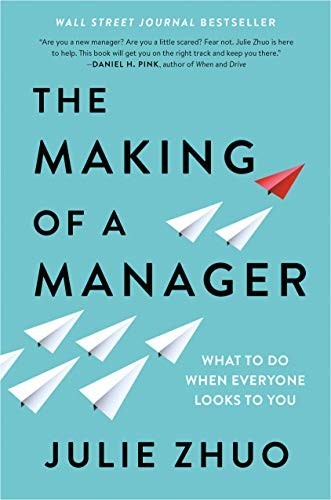
Julie Zhuo's The Making of a Manager is the book to open before the title changes, because FDE managers still have to stay close to customers.
In brief
- The book's message: management is a skill you can learn, not an innate talent
- First-line FDE managers are usually picked from Senior FDEs or FDE Leads, even though field deployment and leading people are different skills
- Three ideas worth keeping: feeling lost at first is normal, managers are measured by outcomes, and a 1:1 should be useful to the other person
A 2026 guide to building FDE teams from Recruiting From Scratch advises that the first FDE manager should almost always be a former Senior FDE or FDE Lead who genuinely wants to develop other people.
The same guide warns that field deployment and managing people are different skills. The best FDE on the team is not necessarily the best person to lead it.
That is the trap in this promotion. You were chosen because you could untangle the hardest deployment and talk to the most difficult customer, but none of that teaches you how to help other people do the same.
If you are an FDE with two to eight years of experience, you will face this question sooner or later. Julie Zhuo’s The Making of a Manager: What to Do When Everyone Looks to You is the book to open first.
Why is managing FDEs harder than ordinary management?
Recruiting From Scratch stresses that FDE managers must stay close to customer relationships, because managing from the office does not work for field deployment. In other words, you cannot step away from customers entirely to focus on people.
You have to do both at once. So the management skills need to be in place before the title changes; you cannot work them out as you go while a customer is waiting.
What is the book, and what does it promise?
The hardcover was published by Portfolio, an imprint of Penguin Random House, on 19 March 2019. The publisher sums up its central message in one sentence: great managers are made, not born. It calls the book a guide to becoming the kind of manager you once wished you had.
Zhuo’s own website describes the book as a complete, practical handbook for new managers in 12 chapters, including Your First Three Months, The Art of Feedback, Managing Yourself, Hiring Well and Nurturing Culture. Also on Zhuo’s site, Michael Bungay Stanier praises the book for helping readers master three areas: purpose, people and process.
For FDEs, these three map onto daily work. Purpose is what the team is trying to achieve at each customer. People is who goes where and who needs coaching. Process is how the team shares lessons across engagements instead of each person relearning them from scratch.
Three ideas worth keeping
The first comes straight from the publisher’s description: new managers often feel they have no idea what they are doing, and that does not mean they are wrong for the role.
For an FDE used to being the person who understands the system best in the room, this reminder takes some of the pressure off: management is a learnable skill, much like learning an unfamiliar codebase.
The second: an independent summary on Life Club makes clear that a good manager’s job is about outcomes, not activity.
This is a hard shift for FDEs, who are used to measuring themselves by tickets closed or pipelines built. When you lead a team, the question becomes: did the customer get what they needed, regardless of whose code it was?
The third comes from an interview with Zhuo in First Round Review, published on 18 March 2019, a day before the book came out. In her view, the ideal 1:1 is one the team member finds useful for themselves, not for the manager.
She suggests opening with: “What’s top of mind for you right now?” to find out what matters to the other person. And she sets a rule: managers should not hand out advice or jump in to “rescue” them.
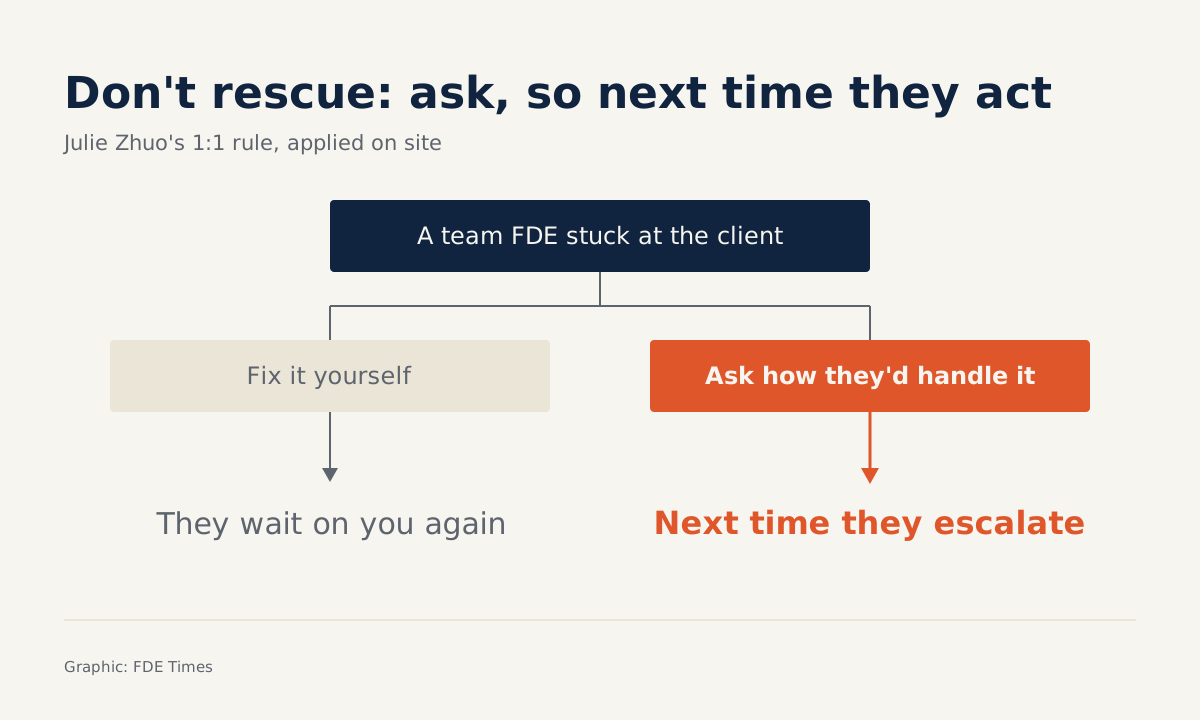
Picture a familiar situation: an FDE on your team keeps missing deadlines at a banking customer. A strong FDE’s reflex is to open a laptop and fix it for them. Zhuo’s opening question might reveal the real problem: say, they are stuck waiting for data access and reluctant to escalate on the customer’s side.
At that point, instead of calling the customer yourself, you ask how they plan to handle it and where they need your support. Next time, they can escalate on their own; if you rescue them, next time they will wait for you again.
Which chapters to read first, and who should read it?
If you have just been asked to lead people, start with Your First Three Months, then The Art of Feedback and Managing Yourself. Leave Hiring Well and Nurturing Culture for later, when the team starts hiring. For 1:1s, the First Round Review piece is a short read, easy to revisit before each meeting in your first week.
A 2022 reviewer on DEV Community called it a must-read for new managers and noted that it covers feedback and leading a small team in depth.
If you are still an individual FDE but aiming for a Lead role, reading early pays off even more. When you look at job descriptions, watch for words such as “mentor”, “lead a pod” or “develop people”. On your CV, do not just list deployments; note how many people you have coached, and which engagements they went on to run on their own.
The book is a handbook for new managers in general, not one written for teams working in the field.
So a useful exercise is to take one example from each chapter and rewrite it as a field scene: how would the feedback conversation in The Art of Feedback go, for instance, when the person receiving it has just botched a demo in front of the customer?
If you can rewrite 12 scenes like that, you will have your own set of team-leading scenarios ready before anyone hands you the title.
Was this article useful?
Thanks for the feedback!
6 sources
- The Making of a Manager (Penguin Random House) · 2019-03-19
- The Making of a Manager (juliezhuo.com)
- The essential questions that have powered this top Silicon Valley manager's career (First Round Review) · 2019-03-18
- How to build a forward deployment engineering team at scale (Recruiting From Scratch) · 2026-06-25
- The Making of a Manager Summary and Review (Life Club)
- The Making of a Manager review (DEV Community) · 2022-08-30