Orosz's engineering guidebook skips FDEs but covers much of the job
Read it as a reference, not cover to cover: its six parts are graded by level, and would-be FDEs should start with the chapter on changing jobs.

In brief
- The book has six parts, each tied to a level: Parts 1 and 6 for all levels, Part 2 for junior to mid-level, Part 3 for senior, Part 4 for tech lead, Part 5 for staff and principal.
- Part 4 is written for tech leads: project management, shipping to production, stakeholders, team structure and team dynamics. This is very close to what an FDE does when leading a deployment.
- The author treats it as a reference book, one to reopen each time you move up a level.
Gergely Orosz spent four years writing The Software Engineer’s Guidebook. Partway through, he left his publisher, Manning, to self-publish. He has said that at the time he felt the book was going to be simplified, and that following some of the editorial feedback would have made it weaker.
He is also candid about the cost of that decision: without a publisher, nobody enforced deadlines, and the writing took longer than planned. The book came out in 2023, aimed at software engineers who want to progress through the senior, tech lead, staff and principal levels at both tech companies and startups.
If you are an engineer with a few years of experience and are aiming for an FDE role, know this up front: this is not a book about FDEs.
Even so, FDE roles often require you to own a project, get it into production and work with several parties whose interests differ. Some parts of the book deal with exactly those tasks, only from the perspective of an engineer inside a product company.
A reference book is not meant to be read cover to cover
On the book’s landing page, Orosz describes it as a reference book, to be revisited as your career advances. Its structure reflects that: six parts, each labelled with the level it targets.
Part 1, Developer Career Fundamentals, is for all levels. It covers career paths, owning your career, performance reviews, promotions, thriving in different kinds of environments and changing jobs. For anyone considering a move into FDE work, the chapters on changing jobs and working environments are the place to start.
Part 2, The Competent Software Developer, is written for people from entry level to mid-level: getting things done, coding, the software development process and the tools of a productive engineer. Part 3 is for senior engineers, with chapters on collaboration, testing and software architecture.
Part 4 is for tech leads, and Part 5 for staff and principal engineers, with chapters on understanding the business, reliability and architecture. Part 6 is the conclusion, also marked as being for all levels.
Mindi Weik, a reader who reviewed the book on Substack in 2024, found the most immediately applicable material to be the content on career fundamentals and core competence, the first two parts. She chose those very sections to present to her team, and found the book useful when weighing a leadership track against a technical one.
Part 4 reads like the job description of an FDE leading a team
Part 4 is titled “The Pragmatic Tech Lead”. According to the table of contents on the official site, it includes chapters on project management, shipping to production, working with stakeholders, team structure and team dynamics.
The book does not discuss customer deployments. But set beside the work of an FDE leading a team, each chapter maps onto something you will have to do.
Imagine you are an FDE leading a team of three deploying a document-processing agent for a bank. Project management means holding the pilot schedule when the customer’s data arrives late. Shipping to production means getting through the bank IT team’s security review.
Stakeholders means the head of operations wants to move fast while the head of risk wants to move slowly. Team structure means deciding which of your three people will sit with the customer’s engineers. No ticket captures any of this, yet it decides whether the project succeeds or fails.
So do not read Part 4 like a textbook. Bring a specific project with you and turn each chapter into a question about it: why is the schedule slipping, who has the power to block the move to production, and who on the team is best suited to sit next to the customer.
A work log: a small habit with long-term payoff
In her review, Weik stresses recording your work and the feedback you get from colleagues, calling it a good way to quantify your impact. She uses a Trello board, and suggests alternatives such as a brag document or Notion.
For people working on customer sites, the habit is even more worth keeping. This kind of work is easy to forget: after six months you remember that you “did an integration”, but not what problem you solved, for whom, or with what result.
Consider what a good log entry looks like: “Week 3, logistics customer: order data arriving late because the sync job only ran overnight; proposed switching to hourly syncs and won over the head of IT; dispatch board now updated in time for the morning shift.” The entry has all three parts: context, what you did, and the result.
When it comes time to write your CV, that entry becomes a bullet point backed by evidence. When reading the job description for an FDE role, look for requirements about working with customers or owning projects, then pick the log entries that match each one.
In interviews, it is also a ready-made story for the question “tell me about a time you handled a difficult stakeholder”.
In what order should you read it?
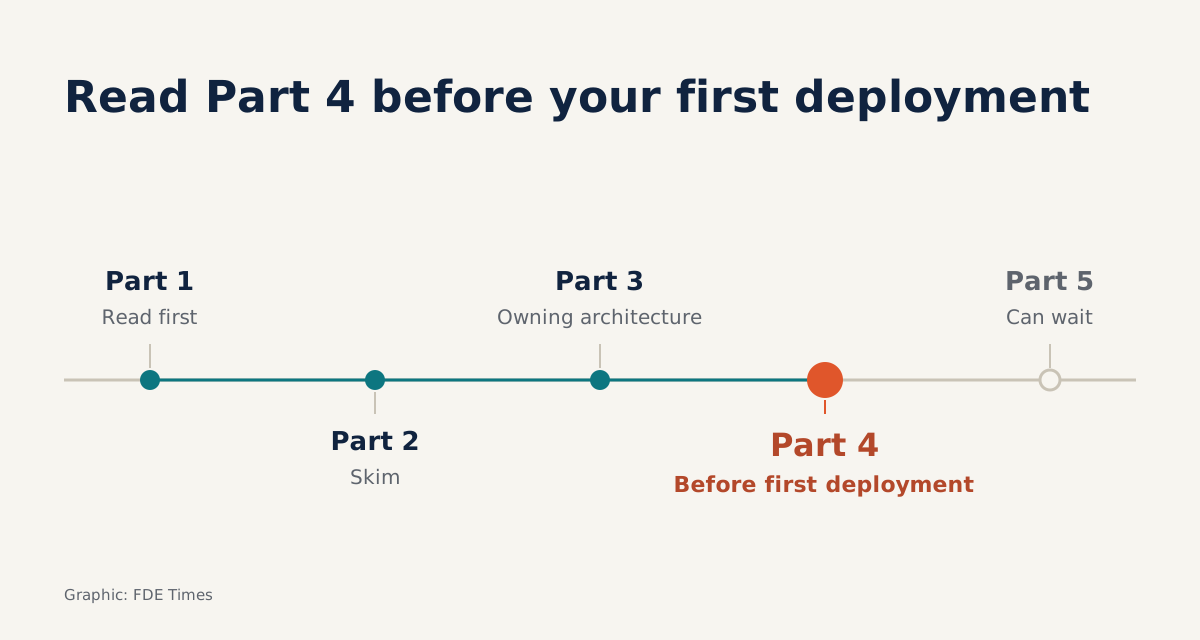
If you are mid-level or newly senior, start with Part 1 to review your career path and how to change jobs, then skim Part 2 to check for gaps in how you work day to day. Part 3 is worth reading closely if you are about to be given work that requires making architectural decisions yourself.
Save Part 4 for when you are about to lead your first deployment, or when applying for an FDE role that calls for technical leadership. Part 5 can wait. For each part, pick one thing you can act on this month rather than underlining whole pages.
Orosz wrote the book for readers to come back to. For anyone moving into FDE work, the most useful return visit is usually when your responsibilities have just stepped up a level, and what you read only becomes a skill once you have tried it with a real customer.
Was this article useful?
Thanks for the feedback!