A free Ignition course teaches FDEs the language of the factory floor
The credential is free as well, but the course pays off through the order you take it in and the modules you are willing to skip.
In brief
- Inductive University is run by the company that makes Ignition, and both the courses and the credential are free.
- The Ignition 8.3 catalog has separate modules on tags, OPC UA and devices, databases, alarming and security, exactly what an FDE meets on the plant floor.
- Finish the credential track first, skip Vision if the client does not use it, then pick electives that match the client's system.
Inductive Automation, the company behind the Ignition software, offers every course on Inductive University for free, and the credential costs nothing either. The school launched in September 2014 at the Ignition Community Conference with 25 SCADA courses and 5 MES courses, and it has charged no fees since day one.
For an FDE, this is the cheapest way to get to know a difficult group of clients: factories. Once a deployment reaches the production floor, you are no longer working with a familiar REST API. You will meet devices connected over OPC UA, along with the tags, alarming and databases of a SCADA system.
A guide to an FDE’s first 90 days on fde.academy argues that the real learning happens while shadowing other people at work, more than through any formal curriculum. That guide does not deal with factories specifically.
Still, once you have the basic vocabulary, you can use your time shadowing operations engineers to ask about the client’s own system, without them stopping to explain every term.
A curriculum written by the company that makes Ignition
The Ignition 8.3 catalog has two parts. Credential Courses run from the fundamentals to advanced features and lead to the IU credential. Elective Studies are optional.
In the catalog, tags, OPC UA and devices, databases, alarming and security are separate modules. The course closest to the job of connecting machines to Ignition is “OPC UA and Devices in Ignition”, though the catalog page lists only its title, with no description. At launch, lessons were videos of 1 to 5 minutes, grouped by topic.
One point is easy to get wrong. The credential is awarded when you complete every required course on Inductive University, and it is separate from the paid certification exam. The difference matters when you write your CV.
What skills does the course build for an FDE?
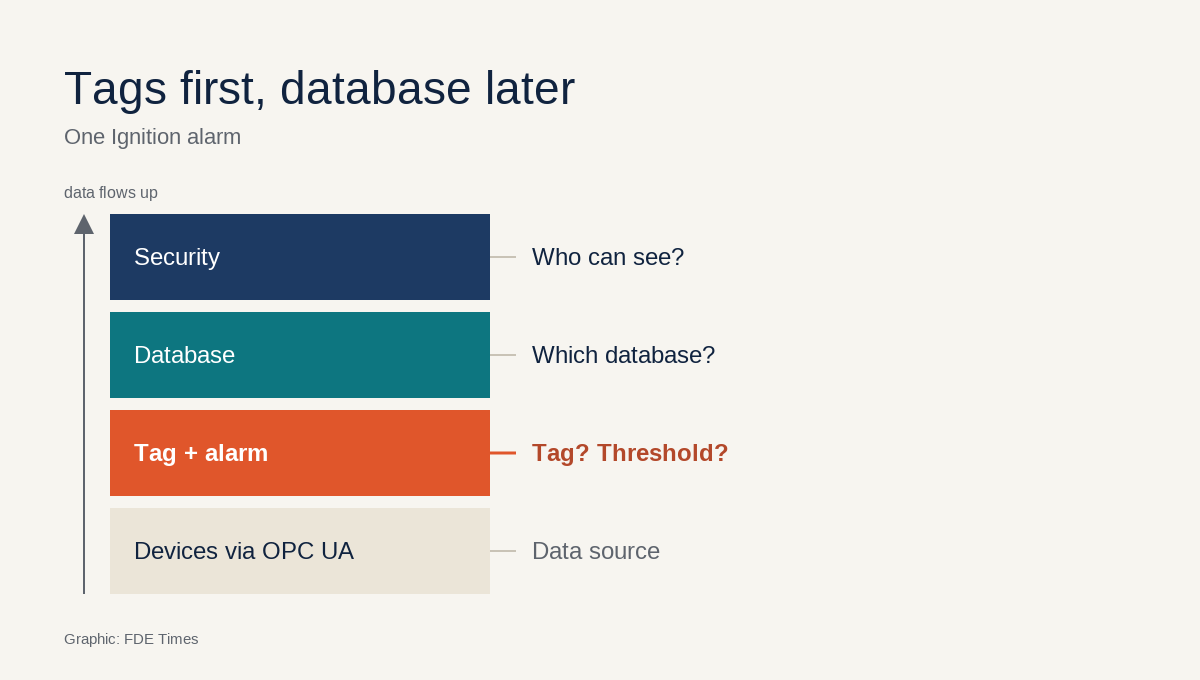
The main skill is tracing data from a machine on the line to the database. Take a hypothetical example: the client wants an agent that summarizes the night shift’s alarms for the morning shift supervisor.
The Ignition 8.3 documentation says alarms are configured directly on tags, in the Tag Editor, and that one tag can carry several alarms. An alarm event occurs when the value of the source tag is compared against the configured thresholds. So your first question is not about the database. You need to know which tag carries which alarm, and with what threshold.
Only then do you ask which database stores the data for the agent to query, and finally security: what the agent’s account is allowed to read. Each question maps to a module in the catalog.
Once you grasp this chain, you can talk to the client’s automation team. You know what to ask, and you avoid proposing things the running architecture cannot support.
What order to study in, and what to skip
In a 2025 thread on Inductive Automation’s forum, someone asked what order to take the courses in. One member advised skipping the Vision material if you will not use it. The same person argued that the most valuable part of Inductive University is Elective Studies. This is one user’s opinion, not the company’s official path.
Elective Studies were added in 2021. The company states plainly that they are extra material, for those who want to go deeper in their careers or learn for interest, and that they are not required. The two views do not conflict: the optional part can be the deepest precisely because it does not have to teach everything to everyone.
A sensible order for an FDE is therefore to finish the Credential Courses for the foundations and the credential. Then choose electives that match the part of the client’s system you are about to work on. If the client does not use Vision, spend that time on tags, alarming and databases.
Common mistakes when studying alone
The first mistake is jumping straight into the database module because it feels familiar. Without understanding tags, you will not know where the data in the tables comes from, or at which layer alarms are generated.
The opposite mistake is studying everything, including modules the client does not use. Skipping Vision when the client does not run it is simply spending time where it counts. FDEs on site do the same: understand the running parts thoroughly, and learn the rest when it is needed.
The third mistake is treating watching every video as finishing. The credential is awarded only when you complete every required course, so make that the real milestone rather than counting videos watched.
Exercise: redraw the path of an alarm
After the courses on OPC UA, tags and alarming, return to the example of the agent summarizing night-shift alarms. On a single sheet of paper, draw the data moving from the device through OPC UA, becoming a tag that carries an alarm, then reaching the database, and mark where security decides who can read it.
Next to each layer, write one question you would ask the client’s automation team: which tag carries the alarm, what the threshold is, which database holds the data, which account can read it. If you cannot yet frame a question for a layer, go back to the module for that layer.
Listing the credential correctly on a CV
Do not take this course as evidence that every FDE job posting demands Ignition. But look at adjacent roles. Hitachi once posted an “Ignition Engineer (Deployment & Validation)” role, now closed. It called for on-site deployment, commissioning, validation and go-live support for SCADA/MES solutions running on Ignition, along with the ability to troubleshoot OPC UA.
The title does not say FDE, but the work is very close: going to the client and putting a system into real operation. If the posting you are targeting mentions Ignition, SCADA, MES or OPC UA, this credential deserves a place at the top of your skills section.
On your CV, write it accurately as “Ignition credential (Inductive University, 8.3)”, and do not call it a certification, which is a different, paid exam. Add a line showing that you understand how data moves from devices through tags to the database, with the diagram from the exercise above if you have it.
Hitachi’s posting wanted a deployment engineer who could handle OPC UA on site, not just someone who could build models. If you are aiming for similar projects, a free course from the vendor itself is a sensible place to start learning that part.
Was this article useful?
Thanks for the feedback!
8 sources
- About Inductive University - FAQ, Glossary
- Inductive Automation Announces New Inductive University · 2014-09-25
- Inductive University Course List - Learn Ignition Free
- Inductive University Expands With New Elective Studies · 2021-08-17
- Best order to take the trainings for someone new to the software · 2025-10-13
- Alarming (Ignition 8.3 docs)
- Ignition Engineer (Deployment & Validation) - Hitachi · 2026-06-17
- Forward Deployed Engineer First 90 Days: What Actually Happens on the Job · 2026-08-06