A dbt starter course only pays off once your pipeline runs itself
Sources and scheduled jobs are the two lessons an FDE most needs to practice in depth, because that is where a project touches the client's data.
In brief
- dbt Labs' 2026 introductory dbt session lists sources and running workflows on a schedule among its learning goals
- The 2021 description of dbt Fundamentals mentioned only models, tests, ref and documentation; DataCamp's track does not mention scheduling
- FDEs should practice sources and scheduled jobs in depth, because they mark the boundary with client data and the gap between demo and production
The “Getting started with dbt” session that dbt Labs added to dbt Summit in September 2026 sets a very practical goal: run and deploy dbt workflows on a schedule, then understand the results of each run. On the same list, sources sit alongside projects, models, the DAG, tests and documentation as core concepts.
For a Forward Deployed Engineer, those two items matter more than anything else on the list. A source is where your project receives data from the client’s systems. A schedule is what keeps the project alive after the handover meeting.
An introductory course is enough to tell you that both exist. To make them work at a client, you have to practice them yourself on dirty data and on a job that genuinely runs for days in a row. The rest of this article shows how.
What did the original course teach?
In December 2021, dbt Labs introduced dbt Fundamentals as a guided tutorial of about five hours, starting with setting up dbt Cloud and ending with the first deployment of a project.
The course was open to anyone who wanted to get closer to the data development workflow and required only basic SQL. It came with instructions for opening a free two-week trial account and a quiz at the end.
The content at the time covered writing models and tests, the ref function, which dbt Labs called “life-changing”, and how to generate and view documentation. That description does not mention sources or scheduling, though silence does not prove the course skipped them.
At an independent provider, DataCamp’s dbt Fundamentals track is aimed at analysts, assumes no prior knowledge and teaches building ELT workflows with sources, seeds and snapshots, but its landing page does not mention scheduling.
Read the three descriptions side by side and the most likely gap is scheduling rather than sources. Before you sign up, search the syllabus for those two words.
Why ref deserves the most time
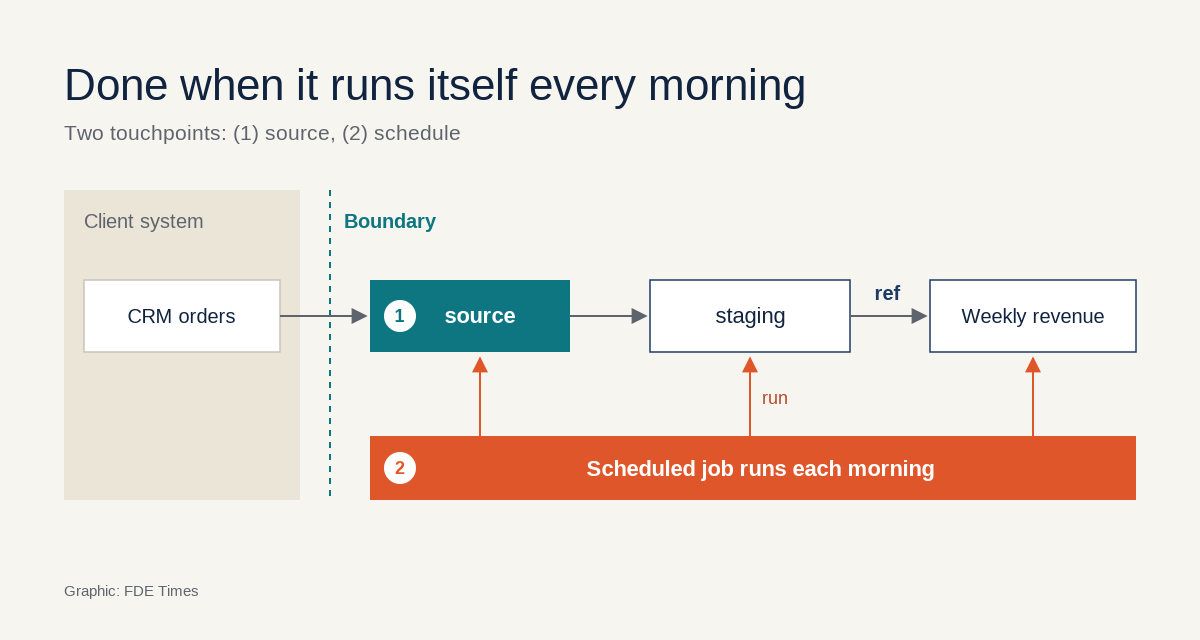
The following example is hypothetical and runs through the whole article. A retail client has an orders table from its CRM already sitting in the warehouse. You write a staging model to clean it, then a weekly revenue model that calls the staging model with ref.
The biggest payoff shows up at handover. A chain of SQL with hard-coded table names is usually understood only by the person who wrote it. A project whose models are linked with ref, with tests and documentation, is one the client’s data team can read, understand and take over once you have left.
Sources are where the project meets client data
The dbt documentation defines a source as a way to name and describe data that Extract and Load tools have loaded into the warehouse. For an FDE, that is the boundary between the client’s systems and your work.
In the retail example, declaring the orders table as a source means you record what you are receiving before you write a single line of logic. When the client asks where a revenue figure comes from, the answer is already in the project.
If your course has a lesson on sources, do not stop at the sample dataset. Practice on a dirty file of your own, with duplicate rows and empty cells, to see where sources and tests catch errors.
A deployment is finished only when it has a schedule
The first deployment is only half the journey. The dbt documentation advises that instead of running commands by hand on the command line, you use the scheduling features built into the dbt platform to automate when and how runs happen.
Deploy jobs can run on a schedule, through the API, or after another job completes. The 2026 introductory session also emphasizes understanding run results, a skill you will use every morning at a client.
For an FDE, the gap between “works when I press the button” and “runs by itself every morning” is the gap between a demo and production. Once you finish the deployment lesson, create a real scheduled job straight away and practice reading the log of each run.
Traps for the hurried learner
The most common trap is letting models read straight from raw tables without declaring sources. The project still runs, but you lose the one place that records where the client’s data comes from.
Another trap is understanding ref in the lesson, then falling back on hard-coded table names when a deadline looms. And if you treat the deployment lesson as an extra, running it by hand once and moving on, the project will stop the moment you leave the client.
Exercise: a small pipeline, from raw to self-running
A sensible order is to take the introductory course, read the dbt documentation on sources and deployment carefully, then build a small project of your own. Go back to the retail example: load an orders file into your trial account’s warehouse and declare it as a source.
Write a staging model, then a weekly revenue model that calls it with ref. Add tests so that order IDs are unique and not null, generate documentation, then create a job that runs every day. The exercise counts as done only when the job has run for several days in a row without you touching it.
Turning a few hours of study into a line on your CV
The quiz helps you check yourself, but what a hiring manager can actually open is the repo from that exercise. The CV line should be specific, along the lines of “built a dbt pipeline from raw data to reporting tables, with tests and a daily schedule”, with a link to the repo.
When you read FDE job postings, watch for words such as dbt, analytics engineering or data pipeline. If they appear, you already have a story to tell: where the data comes in, how it is connected, and why it runs on its own every morning.
Was this article useful?
Thanks for the feedback!