Harvard's free CS50x makes you learn C first, and that is the point
Grading weights correctness three times as heavily as style, a rule that fits the scripts an FDE leaves behind at a customer site.
In brief
- CS50x is free and has no prerequisites. According to edX, about two-thirds of learners have never taken a CS course.
- The course teaches C first, then Python, SQL, HTML/CSS/JavaScript and Flask. Work is graded as 3 × correctness + 1 × style.
- For aspiring FDEs, the most valuable thing to keep is the final project, not the certificate.
In CS50x, correctness counts three times as much as style. The course syllabus says each assignment is usually scored as 3 × correctness + 1 × style. Code that runs correctly is necessary, but hard-to-read code still loses points.
For anyone planning a move into Forward Deployed Engineering, this grading scheme is worth carrying with you. Picture a script you write on a customer site: first it must run correctly on real data, and then someone else still has to be able to read it after you have moved on.
If you entered the industry without formal computer science training, CS50x is a cheap, systematic way to fill that gap: the learning is free and the curriculum follows a clear order. It is a common starting point. edX, which distributes the course, says about two-thirds of CS50 learners have never taken a CS course.
Why C before Python?
CS50’s Introduction to Computer Science is offered by Harvard University as OpenCourseWare, taught by David J. Malan; the current edition is CS50x 2026. The course takes both people who can already program and people who cannot. The FAQ states that you do not need to prove you have passed any prior course, and there are easier versions of the problem sets for less experienced learners.
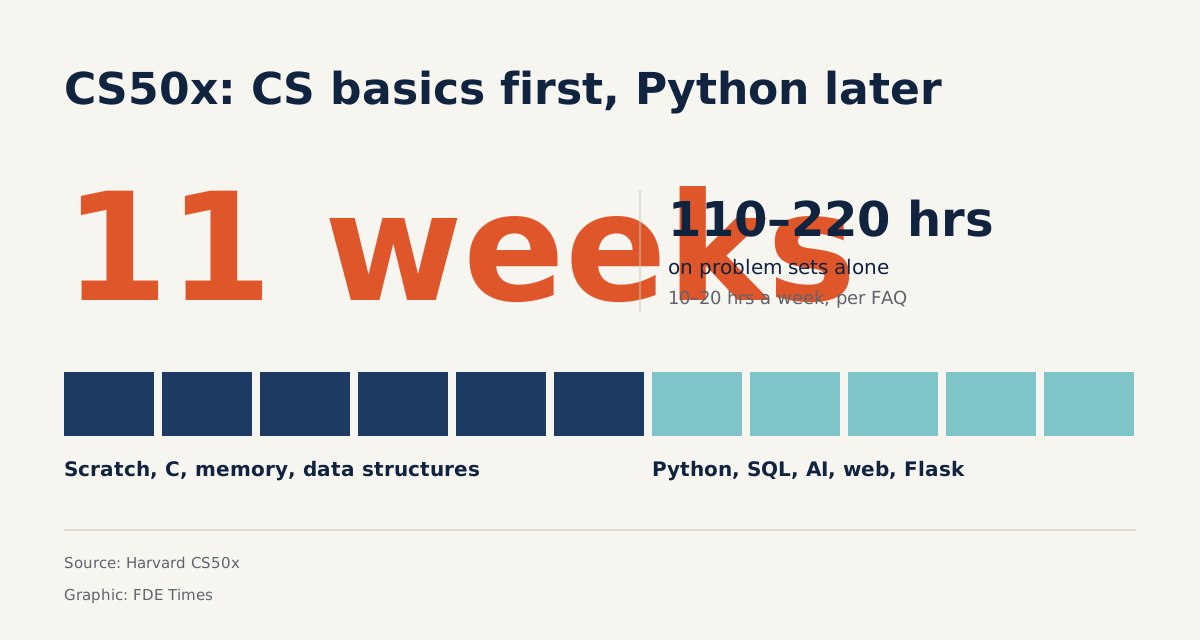
The curriculum has eleven weeks of material, from week 0 to week 10. The order is Scratch, C, arrays, algorithms, memory, data structures, and only then Python, SQL, AI, web and Flask. Every week follows the same rhythm: watch the lecture, optionally watch the section and shorts, then submit the problem set.
Many career changers want to skip the C part and go straight to Python. Don’t. The weeks on memory and data structures show you first-hand what Python is still doing for you underneath.
Imagine a data-processing job that runs fine on 10,000 rows and then falls over at 10 million. Someone who has been through those weeks has somewhere to start looking for the cause instead of guessing. Python only hides these problems; it does not make them go away.
That is also Malan’s intention. On the freeCodeCamp podcast, he explained deliberately limiting assistive tools, including smart code editors and LLMs, so that students grasp the fundamentals faster. According to freeCodeCamp, millions of people have taken CS50 over the past decade, both in person and online.
How long does it take, and what counts as a pass?
The FAQ advises budgeting 10–20 hours a week for the problem sets alone. Over eleven weeks, that is roughly 110 to 220 hours, not counting lectures and the final project. Someone in a full-time job, studying evenings and weekends, should plan on three to four months rather than eleven weeks.
The free CS50 certificate requires at least 70% on every problem set and on the final project. The Harvard Online page describes the requirement as satisfactorily completing 9 problem sets plus the final project. If you need a verified certificate, you can buy one through edX at cs50.edx.org.
Try the grading formula on a hypothetical example, assuming both criteria are scored out of 5. A fully correct submission with style of only 2/5 earns 3 × 5 + 2 = 17/20, or 85%.
A submission scoring 4/5 on correctness and 2/5 on style earns 14/20, just reaching 70%. If much of the work is wrong, no amount of good style will save it, so get it correct first and tidy the code afterwards.
Three ideas to take to a customer site
The first is that learning slowly takes you further. When you have to debug an unfamiliar pipeline, what helps is understanding arrays, memory and algorithms, not remembering syntax. Do the problem sets without asking an LLM to write the code, at least in the early weeks.
The second is built into the grading formula: correctness comes first, but other people must be able to read your code. Practise writing as if someone else will take over maintenance tomorrow. Clear variable names and tidy functions are habits worth building from the first problem set.
The third is turning knowledge into a product. The syllabus calls the final project the course’s climax, and you may work in a team of up to three. With the Python, SQL and Flask you learn in the course, try building a small web app that reads real data, rather than an exercise that only runs on sample data.
Putting CS50x on your CV so it carries weight
A certificate line only shows that you finished the course. A working project on a real problem shows much more. So choose your final project from something real: an internal report that is still done by hand, or a spreadsheet your colleagues open every day.
On your CV, put the repo link and a one-sentence description of the outcome before the course name. When you read a job description, look for lines that mention SQL or rapid prototyping. Your CS50 project gives you a concrete example to talk about for each of them in the interview.
CS50x will not turn you into an FDE. It gives you the foundations, so that when someone asks why a system is slow, your answer comes from real understanding rather than guesswork.
Was this article useful?
Thanks for the feedback!
7 sources
- CS50x 2026 – CS50's Introduction to Computer Science (Harvard) · 2026
- CS50x 2026 Syllabus · 2026
- CS50x Certificate
- CS50x 2026 FAQs · 2026
- CS50 – Harvard's Introduction to Computer Science (edX)
- CS50: Introduction to Computer Science (Harvard Online)
- Harvard CS50 prof David J. Malan on why you should learn programming slowly [Podcast #197]