Maven's top-grossing AI evals course starts by reading the output
Hamel Husain and Shreya Shankar argue eval criteria only emerge once humans grade output, so FDEs must find them themselves, and the course costs $4,200.
In brief
- The 'AI Evals For Engineers & PMs' course on Maven teaches a loop: build a real agent, find where it breaks, fix it with trustworthy evals
- The core claim: error analysis is the most important activity, and eval criteria emerge when humans grade output rather than being set in advance
- It is not for beginners; read the free Field Guide and FAQ on hamel.dev first, and pay only once you have a product in production
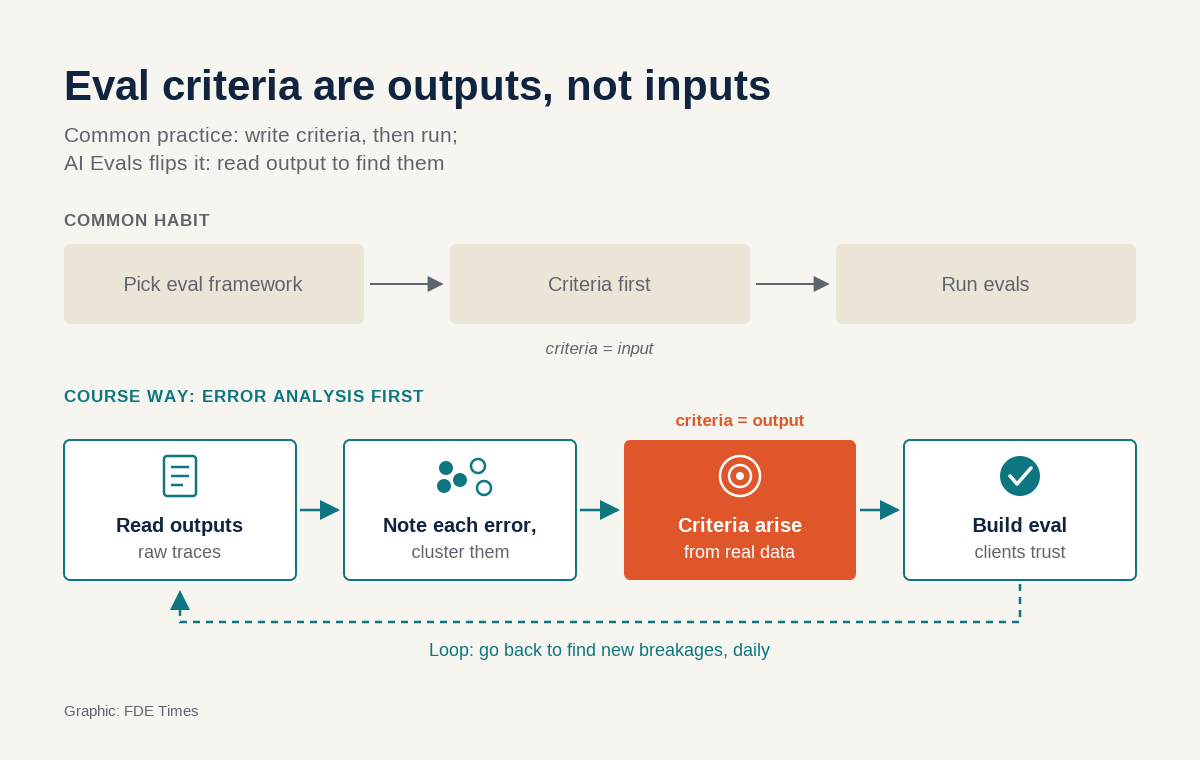
The highest-grossing course on Maven does not sell a tool. After teaching more than 5,000 engineers and PMs, Hamel Husain and Shreya Shankar reduced their position to one short line in the course’s official FAQ: error analysis is the most important activity in evals. Dashboards and LLM-as-judge come later. First comes sitting down and reading the model’s output, one example at a time.
For anyone who wants to work as an FDE, that is the detail that matters most. In his Field Guide, Hamel writes that evaluation criteria cannot be fully defined before humans have graded an LLM’s output. If that holds, an engineer deploying an agent for a client cannot wait for the client to hand over criteria. They have to read the output and discover the criteria themselves.
The skill of finding where an agent fails, then turning that finding into an eval suite the client trusts, is what this course trains.
What the course actually teaches
Its full name is “AI Evals For Engineers & PMs”, and it runs live in cohorts on Maven. Hamel Husain describes himself as an ML engineer with more than 20 years of experience; Shreya Shankar holds a PhD in EECS from UC Berkeley and will join CMU’s faculty in 2027. The course has had more than 5,000 students from more than 500 companies, with a rating of 4.7 across 1,011 reviews.
Its promise fits into a single loop: build a real AI agent, find where it breaks, then improve it with trustworthy evals. Students get more than 200 pages of course reading, 4 homework assignments with solutions and walkthroughs, more than 10 office hours and lifetime Discord access.
Recordings are kept permanently, and students can retake any later cohort at no extra cost.
The listed price is $4,200, a significant sum for many engineers. So the more useful question is whether it is worth it for you, and the answer depends on whether you already have a product running.
Why “look at the data” needs teaching
It sounds obvious. Yet common practice runs the other way: pick an eval framework, write the criteria, then run it. In his Field Guide to rapidly improving AI products, Hamel says plainly that nothing replaces the insight gained from looking at real examples.
Combine that with the argument that criteria only surface once humans grade output, and the usual engineering habit is inverted. Criteria are an output of error analysis, not an input to evals.
Take a hypothetical FDE deploying a ticket-answering agent for a logistics company. Before reading any traces, the engineer guesses the main failure is hallucination. After reading them, it may turn out that the agent answers correctly in the wrong tone, or ignores a field in the client’s internal system. No benchmark contains those failures; they show up only when someone sits down and reads.
Who should take it, and in what order
The course page is explicit: this is a deep dive, not an introduction to LLMs or prompt engineering, and it works best if you are building something. If you have no agent running with real users yet, save your money. The assignments will have nothing to attach to, and office hours will turn into listening to other people’s questions.
The sensible order is to read for free first and pay later. The Field Guide and the AI Evals FAQ on hamel.dev lay out the core ideas, enough to decide. The FAQ in particular, according to the two authors, collects the questions they were asked most often while teaching more than 5,000 engineers and PMs.
If, after reading both, you still want someone to guide you through each assignment and a community to ask, the course starts to earn its price.
For FDEs, the extra value sits in the word “PMs” in the title. Studying alongside the people who make product decisions means practicing how to talk about evals in their language, which is something an FDE does every week in front of clients.
What to take away, and what to put on a CV
The other point worth keeping is that the loop has to close. The course’s promise goes beyond “find where it breaks” to “improve it with evals”, and then back to finding the next failure. Evals become a daily working rhythm rather than a gate at the end of a project.
To show this skill on a CV, skip “experienced with evals”. State how many traces you read, how many failure categories you sorted them into, and which category your eval caught. One line like that says more than any framework name.
The tuition can wait. The habit of reading output should start this week, because that is what clients are paying for.
Was this article useful?
Thanks for the feedback!